QUESTION IMAGE
Question
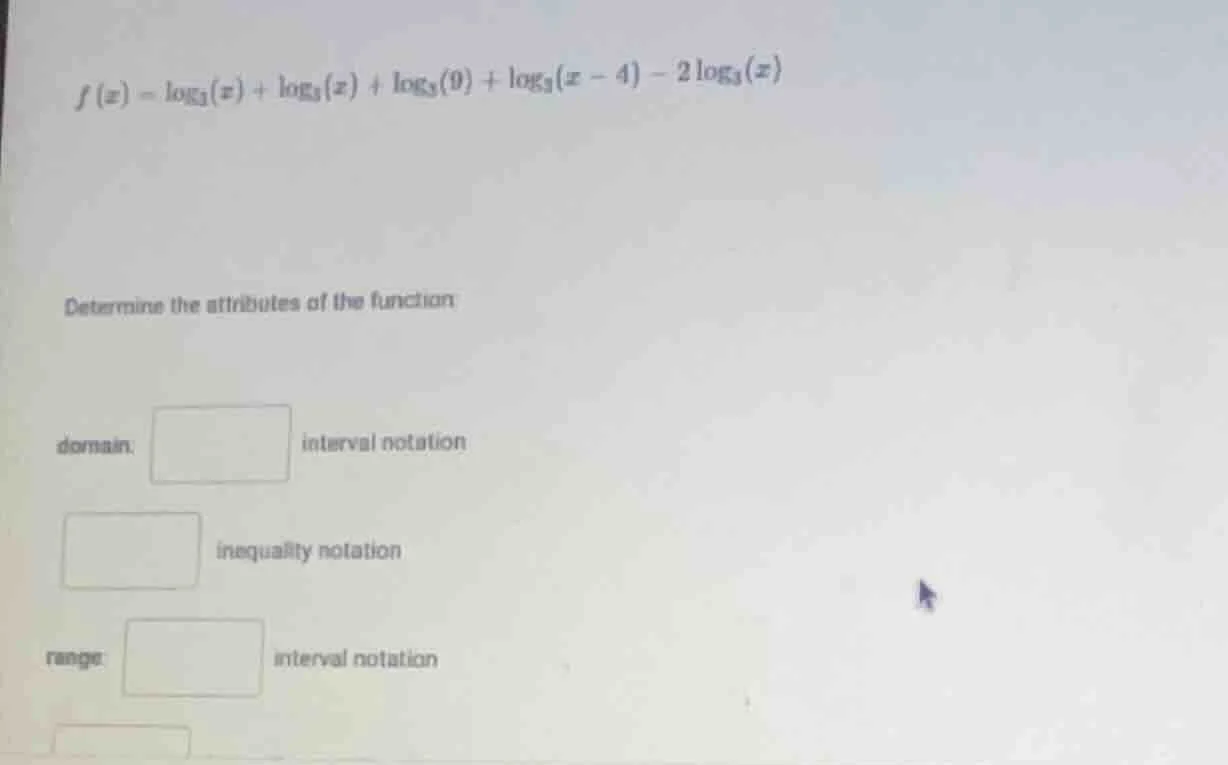
f(x) = \log_{3}(x) + \log_{3}(x) + \log_{3}(9) + \log_{3}(x - 4) - 2\log_{3}(x)\
\
determine the attributes of the function\
\
domain. \boxed{} interval notation\
\boxed{} inequality notation\
range \boxed{} interval notation
Step1: Simplify the function
First, we simplify the function \( f(x)=\log_{3}(x)+\log_{3}(x)+\log_{3}(9)+\log_{3}(x - 4)-2\log_{3}(x) \).
Combine like terms:
The terms \( \log_{3}(x)+\log_{3}(x)-2\log_{3}(x)=0 \). And we know that \( \log_{3}(9)=\log_{3}(3^{2}) = 2\). So the function simplifies to \( f(x)=\log_{3}(x - 4)+2 \).
Step2: Find the domain (interval notation)
For a logarithmic function \( y = \log_{b}(u) \), the argument \( u>0 \). In our simplified function \( f(x)=\log_{3}(x - 4)+2 \), the argument of the logarithm is \( x - 4 \). So we set up the inequality:
\( x-4>0 \)
Solving for \( x \), we add 4 to both sides: \( x > 4 \). In interval notation, this is \( (4,\infty) \).
Step3: Find the domain (inequality notation)
From the above step, the inequality that defines the domain is \( x>4 \).
Step4: Find the range (interval notation)
The parent function \( y=\log_{3}(u) \) has a range of \( (-\infty,\infty) \) (all real numbers). When we have \( y=\log_{3}(x - 4)+2 \), this is a vertical shift of the parent logarithmic function. Vertical shifts do not affect the range of a logarithmic function (since we are just moving the graph up or down, and the function still takes on all real values). So the range of \( f(x) \) is \( (-\infty,\infty) \) or in interval notation \( (-\infty,\infty) \).

Snap & solve any problem in the app
Get step-by-step solutions on Sovi AI
Photo-based solutions with guided steps
Explore more problems and detailed explanations
- Domain (interval notation): \( (4,\infty) \)
- Domain (inequality notation): \( x > 4 \)
- Range (interval notation): \( (-\infty,\infty) \)