QUESTION IMAGE
Question
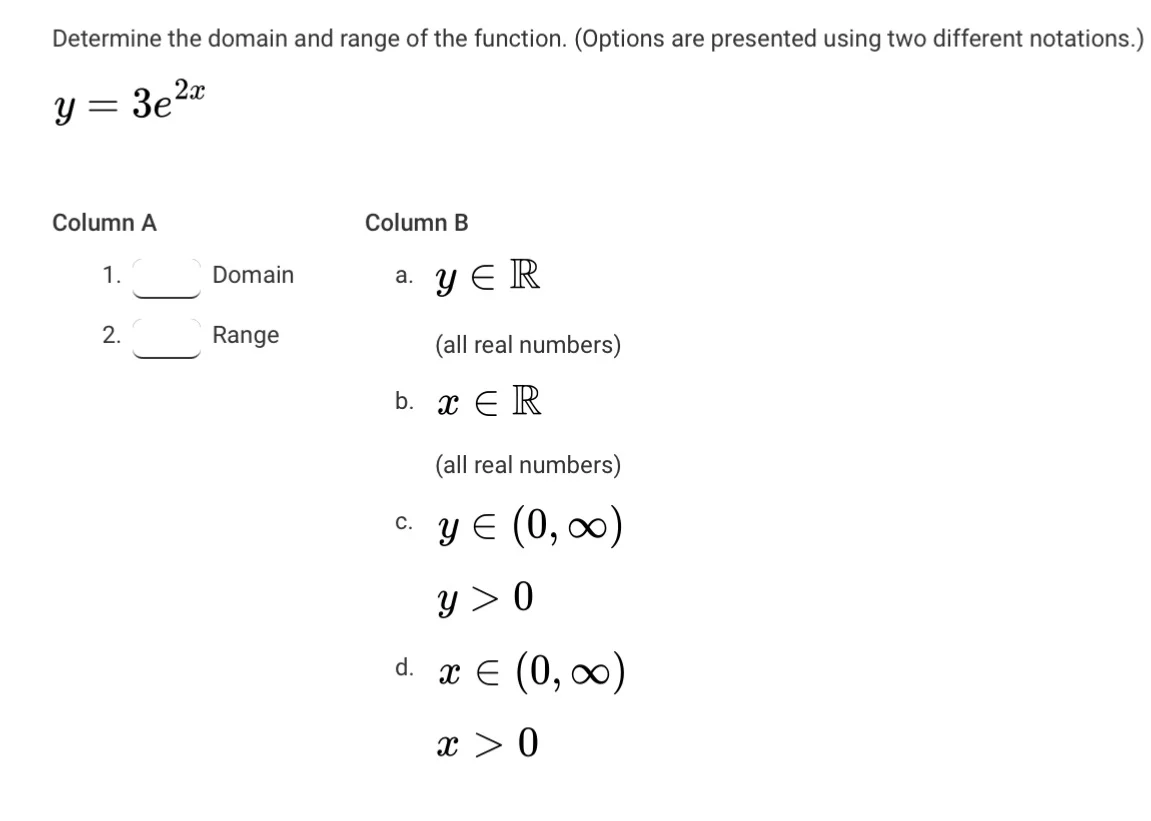
determine the domain and range of the function. (options are presented using two different notations.)
y = 3e^{2x}
column a\tcolumn b
- ○ domain\ta. y \in \mathbb{r}
\t\t\t\t(all real numbers)
- ○ range\tb. x \in \mathbb{r}
\t\t\t\t(all real numbers)
\t\t\tc. y \in (0, \infty)
\t\t\t\ty > 0
\t\t\td. x \in (0, \infty)
\t\t\t\tx > 0
Step1: Analyze the Domain of \( y = 3e^{2x} \)
The function \( y = 3e^{2x} \) is an exponential function. The exponential function \( e^{kx} \) (where \( k \) is a real number) is defined for all real numbers \( x \). There are no restrictions on the input \( x \) (like division by zero or square roots of negative numbers) here. So the domain (set of all possible \( x \)-values) is all real numbers, which corresponds to option b (\( x \in \mathbb{R} \), all real numbers).
Step2: Analyze the Range of \( y = 3e^{2x} \)
We know that the exponential function \( e^{u} \) (where \( u = 2x \) here) has a range of \( (0, \infty) \) because \( e^{u} > 0 \) for all real \( u \), and as \( u \to \infty \), \( e^{u} \to \infty \), and as \( u \to -\infty \), \( e^{u} \to 0 \) (but never actually reaches 0). When we multiply \( e^{2x} \) by 3 (a positive constant), the range is still \( (0, \infty) \) because multiplying a positive number by a positive constant keeps it positive, and the behavior as \( x \) changes remains such that \( y \) can get arbitrarily close to 0 (but not 0) and arbitrarily large. So the range (set of all possible \( y \)-values) is \( y \in (0, \infty) \) (or \( y > 0 \)), which corresponds to option c.

Snap & solve any problem in the app
Get step-by-step solutions on Sovi AI
Photo-based solutions with guided steps
Explore more problems and detailed explanations
- Domain: b. \( x \in \mathbb{R} \) (all real numbers)
- Range: c. \( y \in (0, \infty) \) (\( y > 0 \))