QUESTION IMAGE
Question
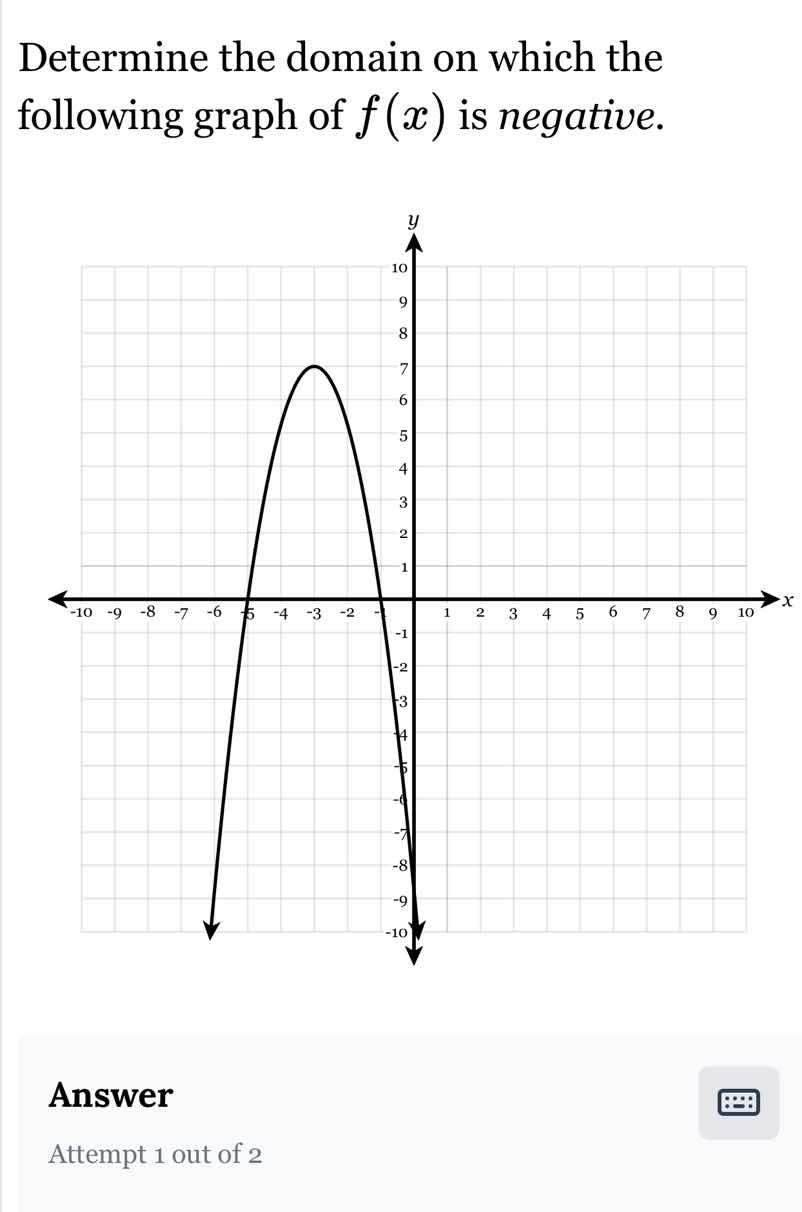
determine the domain on which the following graph of f(x) is negative.
answer
attempt 1 out of 2
Step1: Identify x-intercepts
The graph intersects the x - axis at \( x = - 5 \) and \( x = 0 \) (wait, no, looking at the graph, the left root is at \( x=-5 \) and the right root? Wait, the parabola opens downward? Wait no, the arrows at the ends: the left end goes down, the right end goes down? Wait no, the graph: when x approaches \( -\infty \), y approaches \( -\infty \), and when x approaches \( +\infty \), y approaches \( -\infty \), so it's a downward opening? Wait no, the vertex is at \( x = - 3 \), and the graph crosses the x - axis at \( x=-5 \) and let's see the right intersection: looking at the x - axis, the graph crosses the x - axis at \( x=-5 \) and at \( x = 0 \)? Wait no, the x - axis is crossed at \( x=-5 \) and at \( x = 0 \)? Wait, no, when x = 0, y is - 8, so no. Wait, the graph crosses the x - axis at \( x=-5 \) and at \( x = 0 \)? Wait, no, let's check the x - axis. The left intersection is at \( x=-5 \), and the right intersection: looking at the graph, when x is less than - 5, the graph is below the x - axis (y negative), between - 5 and the other root, the graph is above the x - axis (y positive), and then to the right of the other root, the graph is below the x - axis (y negative). Wait, the vertex is at \( x=-3 \), so the parabola is symmetric about \( x=-3 \). So the roots are at \( x=-5 \) and \( x=-1 \)? Wait, no, the distance from the vertex \( x=-3 \) to \( x=-5 \) is 2 units, so the other root should be at \( x=-3 + 2=-1 \). Ah, I see, I made a mistake earlier. So the graph crosses the x - axis at \( x=-5 \) and \( x=-1 \).
Step2: Determine where y < 0
A function is negative when its graph is below the x - axis (y - value < 0). For a parabola that opens downward (since the ends go down), the graph is below the x - axis when \( x < - 5 \) or \( x > - 1 \). Wait, let's verify: when x < - 5, say x=-6, the graph is below the x - axis (y negative). Between x=-5 and x=-1, the graph is above the x - axis (y positive). When x > - 1, say x = 0, y=-8 (negative), x = 1, y is more negative. So the domain where f(x) is negative is \( x < - 5 \) or \( x > - 1 \), which in interval notation is \( (-\infty, - 5)\cup(-1, \infty) \). Wait, but let's check the graph again. The x - intercepts are at \( x=-5 \) and \( x=-1 \) (since the vertex is at x=-3, mid - point of - 5 and - 1 is \( \frac{-5 + (-1)}{2}=\frac{-6}{2}=-3 \), which matches the vertex x - coordinate). So the parabola opens downward (since the coefficient of \( x^{2} \) is negative, as the ends go down). So the graph is above the x - axis (y>0) between the roots (\( - 5 < x < - 1 \)) and below the x - axis (y < 0) outside the roots, i.e., \( x < - 5 \) or \( x > - 1 \).

Snap & solve any problem in the app
Get step-by-step solutions on Sovi AI
Photo-based solutions with guided steps
Explore more problems and detailed explanations
\( (-\infty, - 5)\cup(-1, \infty) \) (or in inequality form \( x < - 5 \) or \( x > - 1 \))