QUESTION IMAGE
Question
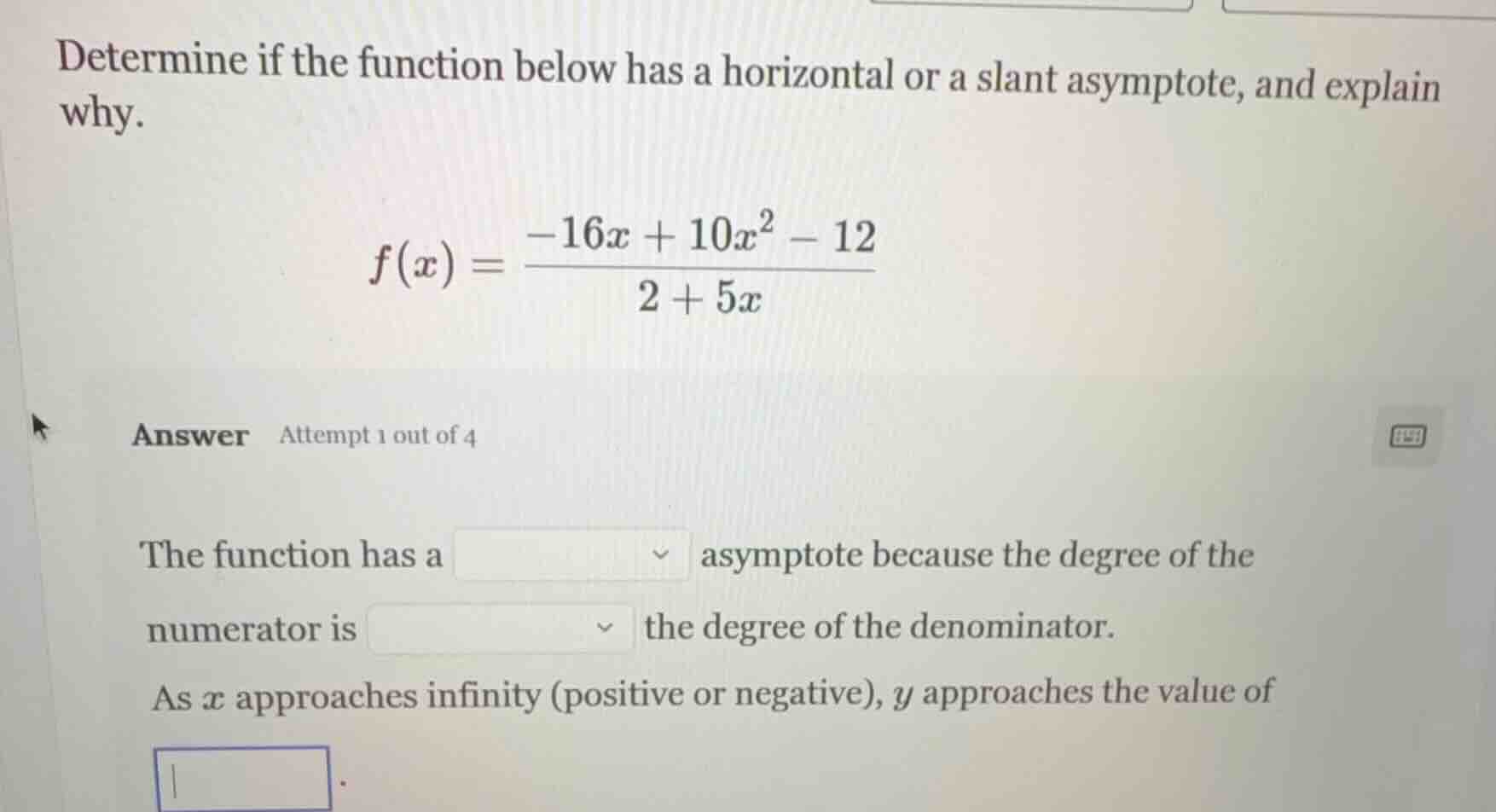
determine if the function below has a horizontal or a slant asymptote, and explain why.
$f(x) = \frac{-16x + 10x^2 - 12}{2 + 5x}$
answer attempt 1 out of 4
the function has a asymptote because the degree of the
numerator is the degree of the denominator.
as $x$ approaches infinity (positive or negative), $y$ approaches the value of
.
Step1: Identify degrees of numerator and denominator
The numerator is $-16x + 10x^2 - 12$, which can be rewritten as $10x^2 - 16x - 12$. The highest power of $x$ here is 2, so the degree of the numerator is 2. The denominator is $2 + 5x$, or $5x + 2$, with the highest power of $x$ being 1, so the degree of the denominator is 1.
Step2: Determine type of asymptote
For rational functions, if the degree of the numerator is exactly one more than the degree of the denominator, the function has a slant (oblique) asymptote. Here, $2 - 1 = 1$, so the numerator's degree is one more than the denominator's. To find the slant asymptote, we perform polynomial long division of the numerator by the denominator.
Divide $10x^2 - 16x - 12$ by $5x + 2$.
First term: $\frac{10x^2}{5x} = 2x$. Multiply $(5x + 2)$ by $2x$: $10x^2 + 4x$. Subtract from the numerator: $(10x^2 - 16x - 12) - (10x^2 + 4x) = -20x - 12$.
Next term: $\frac{-20x}{5x} = -4$. Multiply $(5x + 2)$ by $-4$: $-20x - 8$. Subtract: $(-20x - 12) - (-20x - 8) = -4$.
So, $\frac{10x^2 - 16x - 12}{5x + 2} = 2x - 4 - \frac{4}{5x + 2}$. As $x \to \pm\infty$, the term $\frac{4}{5x + 2} \to 0$, so $y$ approaches $2x - 4$. But the question also asks about the value approached? Wait, no, the slant asymptote is the linear part, but maybe the question's last part is about the slant asymptote's equation, but let's check the blanks. Wait, the first blank: slant (since degree numerator is one more than denominator). Second blank: greater than (by 1). Third blank: the slant asymptote's linear function, but when $x$ approaches infinity, $y$ approaches the slant asymptote, which is $2x - 4$? Wait, no, maybe I misread. Wait, the problem says "As $x$ approaches infinity (positive or negative), $y$ approaches the value of..." Wait, no, for slant asymptote, as $x \to \pm\infty$, $f(x)$ approaches the slant asymptote (a line), but maybe the question has a typo, or maybe I need to check again. Wait, no, when we do the division, we get $f(x) = 2x - 4 - \frac{4}{5x + 2}$. So as $x \to \pm\infty$, the remainder term goes to 0, so $f(x) \to 2x - 4$. But maybe the question is asking for the slope-intercept? Wait, but let's fill the blanks:
First blank: slant (because degree numerator (2) is one more than denominator (1), so slant asymptote). Second blank: greater than (since 2 > 1). Third blank: the slant asymptote's equation, but when $x$ approaches infinity, $y$ approaches the slant asymptote, which is $2x - 4$? Wait, no, maybe the question is simplified. Wait, let's re-express the function:
$f(x) = \frac{10x^2 -16x -12}{5x + 2}$. Divide numerator and denominator by $x$ (for large $x$): $\frac{10x -16 - \frac{12}{x}}{5 + \frac{2}{x}}$. As $x \to \pm\infty$, $\frac{12}{x} \to 0$ and $\frac{2}{x} \to 0$, so $f(x) \to \frac{10x -16}{5} = 2x - \frac{16}{5}$? Wait, no, that's wrong. Wait, no, when the numerator is degree $n$ and denominator degree $m$, if $n = m + 1$, we do long division. So my long division was correct: $10x^2 -16x -12$ divided by $5x + 2$ is $2x - 4$ with remainder -4. So $f(x) = 2x - 4 - \frac{4}{5x + 2}$. So as $x \to \pm\infty$, $f(x) \to 2x - 4$. But the question says "y approaches the value of..." Maybe the question meant the slant asymptote's equation, but let's check the blanks.
First blank: slant (because degree numerator > degree denominator by 1, so slant asymptote, not horizontal (horizontal is when degree numerator ≤ degree denominator)). Second blank: greater than (since 2 > 1). Third blank: the slant asymptote, which is $2x - 4$? Wait, but maybe the question has a mistake, or maybe…

Snap & solve any problem in the app
Get step-by-step solutions on Sovi AI
Photo-based solutions with guided steps
Explore more problems and detailed explanations
The function has a $\boldsymbol{\text{slant}}$ asymptote because the degree of the numerator is $\boldsymbol{\text{greater than}}$ the degree of the denominator. As $x$ approaches infinity (positive or negative), $y$ approaches the value of $\boldsymbol{2x - 4}$.