QUESTION IMAGE
Question
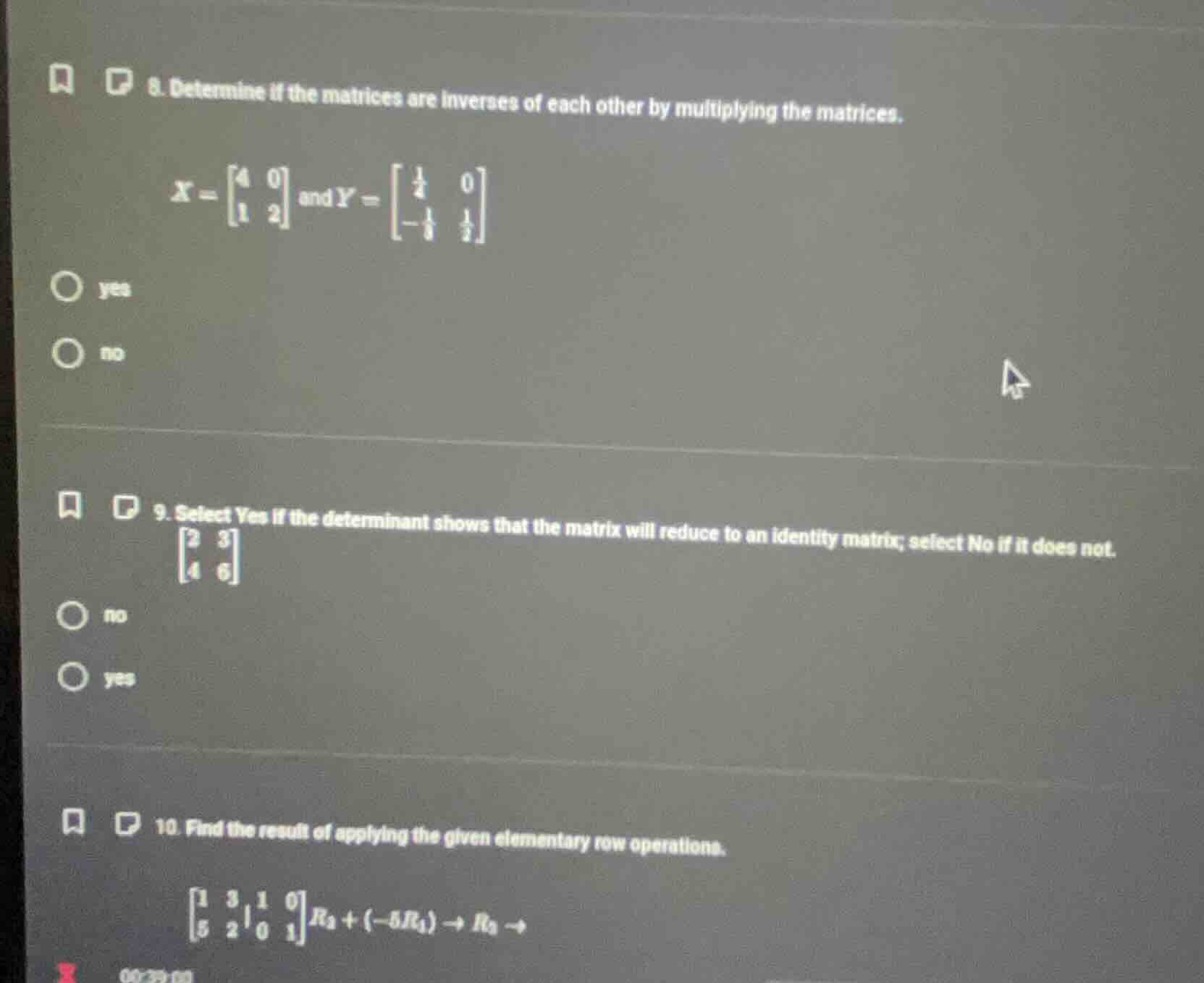
- determine if the matrices are inverses of each other by multiplying the matrices.
$x = \
$ and $y = \
$
\bigcirc yes
\bigcirc no
- select yes if the determinant shows that the matrix will reduce to an identity matrix; select no if it does not.
$\
$
\bigcirc no
\bigcirc yes
- find the result of applying the given elementary row operations.
$\
r_2 + (-5r_1) \to r_2 \to$
Question 8
Step1: Recall matrix multiplication rule
For two matrices \( A =
\) and \( B =
\), the product \( AB \) is \(
\). We need to multiply \( X \) and \( Y \) and check if the result is the identity matrix \( I =
\).
Step2: Multiply \( X \) and \( Y \)
Given \( X =
\) and \( Y =
\)
First element (1,1): \( 4\times\frac{1}{4}+0\times(-\frac{1}{8}) = 1 + 0 = 1 \)
First element (1,2): \( 4\times0 + 0\times\frac{1}{2}=0 + 0 = 0 \)
Second element (2,1): \( 1\times\frac{1}{4}+2\times(-\frac{1}{8})=\frac{1}{4}-\frac{2}{8}=\frac{1}{4}-\frac{1}{4}=0 \)
Second element (2,2): \( 1\times0 + 2\times\frac{1}{2}=0 + 1 = 1 \)
So \( XY=
\), which is the identity matrix.
Step1: Recall determinant formula for \( 2\times2 \) matrix
For matrix \( A=
\), determinant \( \det(A)=ad - bc \). If \( \det(A)
eq0 \), the matrix is invertible (can reduce to identity matrix), else not.
Step2: Calculate determinant of given matrix
Given matrix \(
\), \( a = 2, b = 3, c = 4, d = 6 \)
\( \det(A)=2\times6 - 3\times4 = 12 - 12 = 0 \)
Since determinant is 0, the matrix is not invertible and cannot reduce to identity matrix.
Step1: Recall elementary row operation
The operation is \( R_2 + (-5R_1) \to R_2 \), which means we take row 2, subtract 5 times row 1, and replace row 2 with the result.
Given augmented matrix \(
\) (assuming the matrix is \(
\) as per the format, with first two columns as coefficient matrix and last two as identity part for inverse maybe, but the operation is on row 2)
Step2: Apply the operation to each element of row 2
Row 1: \( [1, 3, 1, 0] \)
Row 2 original: \( [5, 2, 0, 1] \)
New row 2: \( [5 - 5\times1, 2 - 5\times3, 0 - 5\times1, 1 - 5\times0] \)
Calculate each element:
First element: \( 5 - 5 = 0 \)
Second element: \( 2 - 15 = -13 \)
Third element: \( 0 - 5 = -5 \)
Fourth element: \( 1 - 0 = 1 \)
So the new matrix is \(
\)

Snap & solve any problem in the app
Get step-by-step solutions on Sovi AI
Photo-based solutions with guided steps
Explore more problems and detailed explanations
yes