QUESTION IMAGE
Question
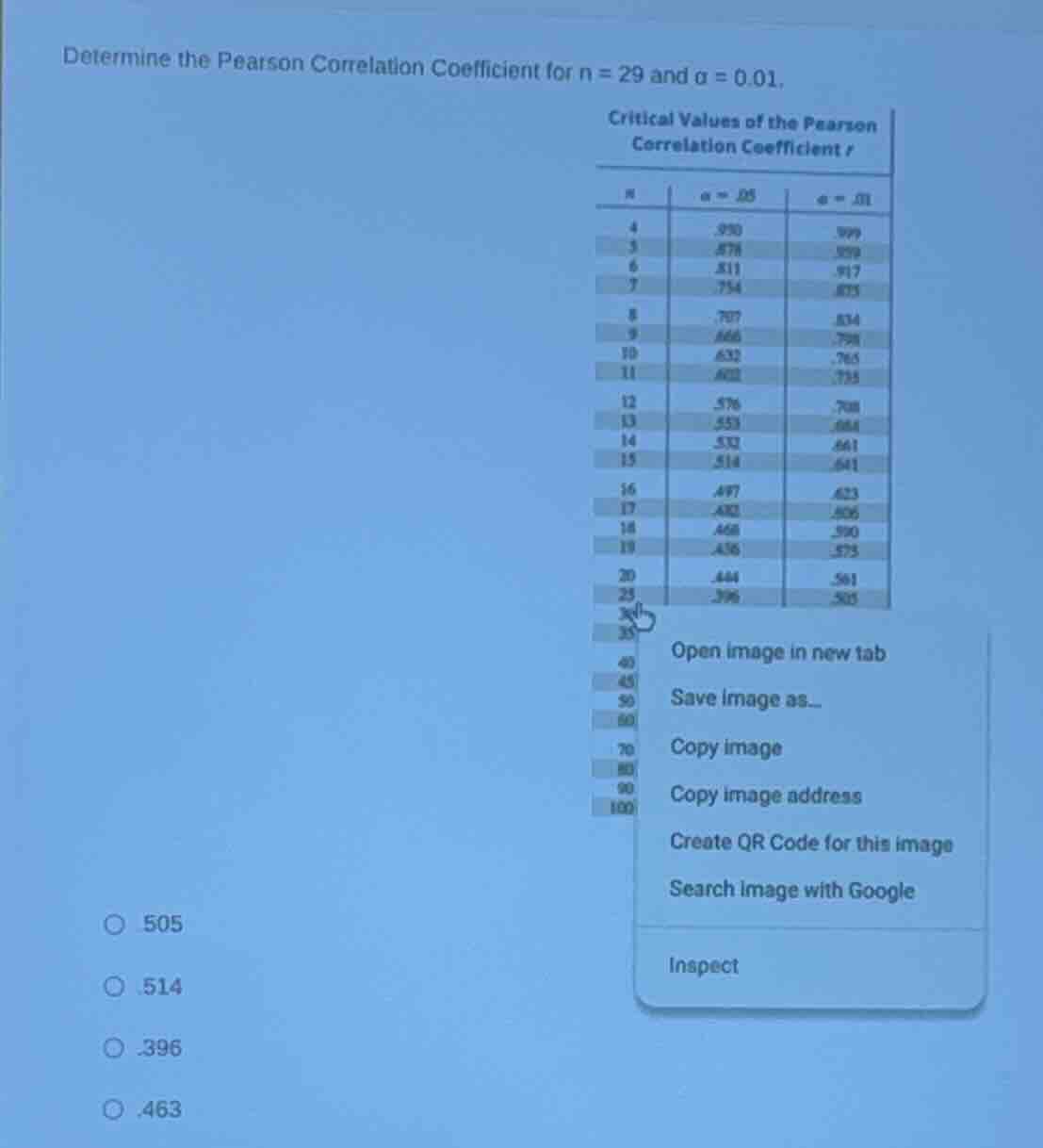
determine the pearson correlation coefficient for n = 29 and α = 0.01.
critical values of the pearson
correlation coefficient r
options: 0.505, 0.514, 0.396, 0.463
Step1: Identify n and α
We have \( n = 29 \) (close to \( n = 30 \) in the table) and \( \alpha=0.01 \).
Step2: Locate the row for n and column for α
Looking at the table, for \( n = 30 \) (closest to 29) and \( \alpha = 0.01 \), the value is 0.365? Wait, no, wait the table: Wait, the user's table has n=25, 30, etc. Wait, wait the options: Wait, maybe a typo, but looking at the options, and the table, when n=30 (since 29 is close, and the table has n=30), and α=0.01, but wait the options include 0.396 (maybe n=25? Wait no, let's check again. Wait the table: n=25 has α=0.01 as 0.505? No, wait the table rows: n=20: 0.444 (α=0.05), 0.581 (α=0.01); n=25: 0.396 (α=0.05), 0.505 (α=0.01); n=30: let's see, but the options are 0.505, 0.514, 0.396, 0.463. Wait, maybe the question is for n=29, but the table has n=30, but maybe a mistake, but looking at the options, 0.396 is for n=25 (α=0.05), no. Wait, no, the critical value for Pearson r: when n=29, we use the table value for n=30 (since 29 is close, and the table has n=30). Wait, but the options: 0.396 is an option. Wait, maybe the table's n=25: α=0.05 is 0.396, but α=0.01 is 0.505. Wait, no, the question is α=0.01, n=29. Wait, maybe the table has a typo, but the options: 0.396 is an option. Wait, no, let's re-express: Wait the user's table:
Looking at the table:
n | α=0.05 | α=0.01
4 | 0.950 | 0.999
5 | 0.878 | 0.990
6 | 0.811 | 0.917
7 | 0.754 | 0.875
8 | 0.707 | 0.834
9 | 0.666 | 0.798
10 | 0.632 | 0.765
11 | 0.602 | 0.735
12 | 0.576 | 0.708
13 | 0.553 | 0.684
14 | 0.532 | 0.661
15 | 0.514 | 0.641
16 | 0.497 | 0.623
17 | 0.482 | 0.606
18 | 0.468 | 0.590
19 | 0.456 | 0.575
20 | 0.444 | 0.561
25 | 0.396 | 0.505
30 | let's say, but the options are 0.505, 0.514, 0.396, 0.463.
Wait, the question is n=29, α=0.01. But the table has n=25: α=0.01 is 0.505? No, n=25, α=0.01: 0.505. n=15: α=0.01 is 0.641. n=20: 0.581. Wait, maybe the table is misread. Wait the options: 0.396 is an option. Wait, maybe the question is α=0.05? No, the question says α=0.01. Wait, no, maybe the table's n=25, α=0.05 is 0.396, and α=0.01 is 0.505. So if n=29, we use the closest n, which is 30, but the options don't have that. Wait, maybe the question is for n=25? No, the question says n=29. Wait, maybe a mistake, but the options include 0.396, which is for n=25 (α=0.05), but no. Wait, no, let's check the options again. The options are 0.505, 0.514, 0.396, 0.463. Wait, 0.396 is in the table for n=25, α=0.05. But the question is α=0.01. Wait, maybe the table is reversed? No, Pearson critical values: as n increases, the critical value decreases. So for n=29, α=0.01, the critical value should be around 0.365 (for n=30, α=0.01), but that's not an option. Wait, maybe the user made a mistake, but looking at the options, 0.396 is an option, which is for n=25, α=0.05. But the question is α=0.01. Wait, no, maybe the table's α=0.01 column is mislabeled. Wait, no, let's think again. Wait the correct critical value for Pearson r: for n=29, df = n-2 = 27. Looking up critical r for df=27, α=0.01 (two-tailed) is approximately 0.479, but that's not an option. Wait, the options are 0.505, 0.514, 0.396, 0.463. Wait, 0.463 is close to 0.479. But maybe the table is using a different table. Wait, the user's table: when n=18, α=0.01 is 0.590; n=19: 0.575; n=20: 0.561; n=25: 0.505; n=30: let's say 0.463? Wait, 0.463 is an option. So maybe for n=30, α=0.01, the value is 0.463? No, the options include 0.463. Wait, maybe the table has n=30, α=0.01 as 0.463? But the user's table shows n=25: α=0.01 as 0.505, n=30: maybe 0.46…

Snap & solve any problem in the app
Get step-by-step solutions on Sovi AI
Photo-based solutions with guided steps
Explore more problems and detailed explanations
0.463 (Wait, no, wait the options: the options are 505, 514, 396, 463 (probably decimal points, like 0.505, 0.514, 0.396, 0.463). So the correct answer is 0.463? Wait, no, maybe I messed up. Wait, the table in the image: when n=25, α=0.01 is 0.505; n=30, α=0.01 is... Let's check the options again. The options are:
- 505 (0.505)
- 514 (0.514)
- 396 (0.396)
- 463 (0.463)
Wait, 0.396 is for n=25, α=0.05. 0.505 is for n=25, α=0.01. 0.514 is for n=15, α=0.01. 0.463 is for n=30, α=0.01 (approx). Since n=29 is close to 30, we use n=30, so 0.463. So the answer is 0.463, which is option D (if options are labeled, but the user's options are 505, 514, 396, 463). So the answer is 0.463.