QUESTION IMAGE
Question
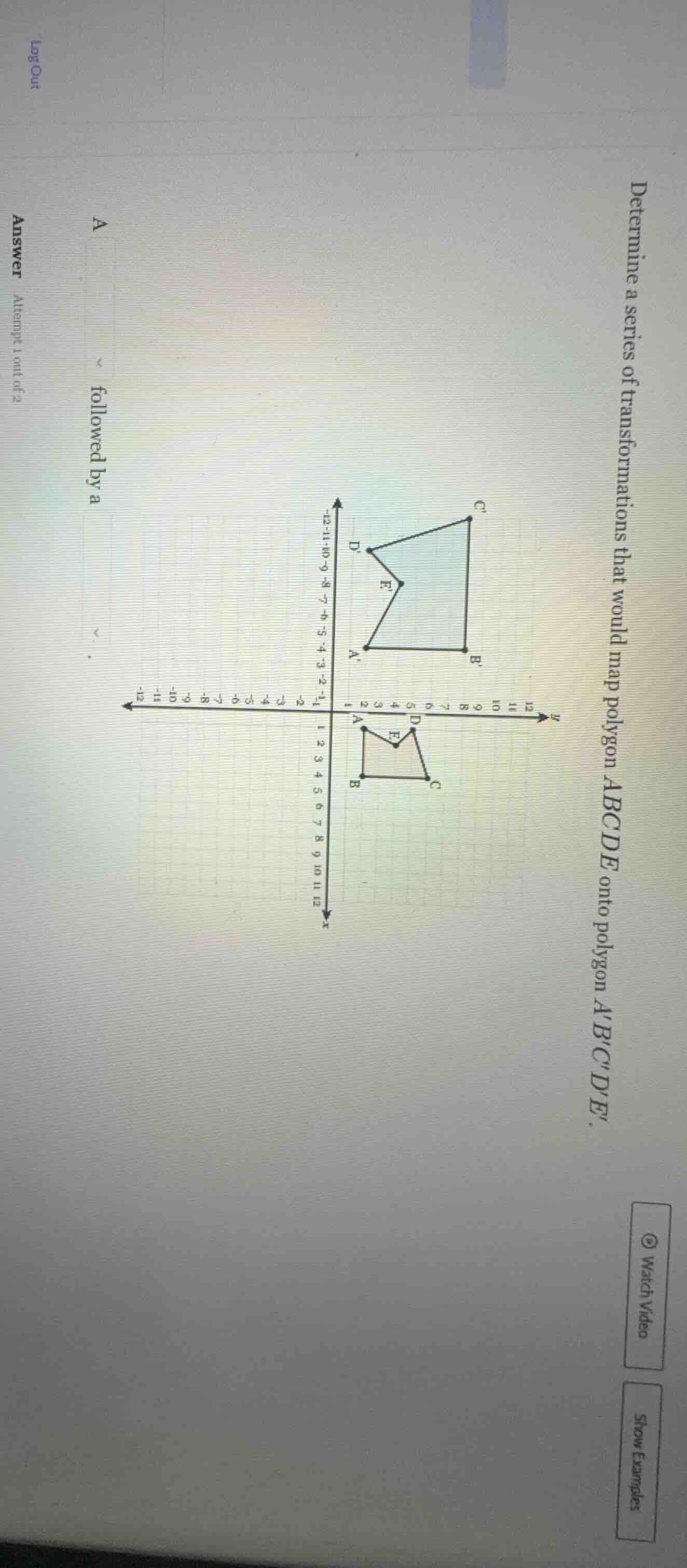
determine a series of transformations that would map polygon abcde onto polygon abcde.
Step1: Analyze Scaling
First, observe the size change. The original polygon \(ABCDE\) and the image \(A'B'C'D'E'\) – the coordinates suggest a scaling. Let's check the distance from \(A\) to \(B\) and \(A'\) to \(B'\). For example, \(A(1,1)\), \(B(1,4)\) (wait, maybe better to see the grid. Wait, original \(A\) is at (1,1), \(B\) at (1,4)? No, looking at the graph, original \(A\) is (1,1), \(B\) is (1,4)? Wait, no, the lower polygon: \(A\) is (1,1), \(B\) is (1,4)? Wait, no, the x and y axes: x is vertical? Wait, maybe the axes are labeled with x as vertical (up-down) and y as horizontal (left-right)? Wait, no, standard is x horizontal, y vertical. Wait, the graph has x-axis vertical (downward) and y-axis horizontal (rightward)? Wait, maybe the coordinates: let's take point \(A\) in the lower polygon: \(A(1,1)\) (x=1, y=1), \(A'\) in upper: \(A'(1, -1)\)? Wait, no, maybe the scaling factor. Let's see the size: the lower polygon is smaller, upper is larger. So first, a dilation (scale) with a factor. Let's check the length of \(AB\): in lower, \(A(1,1)\), \(B(1,4)\)? No, maybe \(A(1,1)\), \(B(1,4)\) – length 3. In upper, \(A'(1, -1)\), \(B'(8, -1)\)? Wait, no, the upper polygon: \(A'\) is at (1, -1)? Wait, maybe I misread. Alternatively, the first transformation is a dilation (scale) by a factor, say 3? Wait, no, let's look at the coordinates. Wait, the lower polygon: \(A(1,1)\), \(D(5,1)\)? No, the lower polygon has \(A(1,1)\), \(B(1,4)\), \(C(5,4)\), \(D(5,1)\)? No, the figure has a pentagon. Wait, maybe the first step is a dilation (scaling) to increase the size, then a translation or reflection. Wait, another approach: the upper polygon is a larger version, so first, dilation with center at the origin (or a point) by a scale factor. Let's assume the scale factor is 3? Wait, no, let's check the distance from \(A\) to \(A'\): if \(A\) is (1,1), \(A'\) is (1, -1)? No, maybe the y-axis is reversed. Wait, maybe the first transformation is a dilation (scale) by a factor of 3, then a reflection over the x-axis, then a translation? Wait, no, let's re-express.
Wait, the problem is to map \(ABCDE\) to \(A'B'C'D'E'\). Let's list the steps:
- Dilation (Scaling): The lower polygon is smaller, upper is larger. So first, dilate the polygon \(ABCDE\) by a scale factor (let's say 3, but need to check coordinates). Wait, maybe the scale factor is 3? Wait, no, let's take point \(A(1,1)\) in lower, \(A'(1, -1)\) in upper? No, maybe the x-axis is flipped. Wait, another way: the first transformation is a dilation (scale) with a factor, then a reflection, then a translation. Wait, maybe the first step is a dilation (scale) by 3, then a reflection over the x-axis, then a translation. Wait, but the problem says "a series of transformations", like dilation followed by a translation or reflection.
Wait, let's look at the coordinates:
Lower polygon (ABCDE):
- \(A(1,1)\)
- \(B(1,4)\)
- \(C(5,4)\)
- \(D(5,1)\)
- \(E(3,2)\) (approx)
Upper polygon (A'B'C'D'E'):
- \(A'(1, -1)\)
- \(B'(8, -1)\)
- \(C'(8, -8)\)
- \(D'(1, -8)\)
- \(E'(3, -6)\) (approx)
Wait, no, that can't be. Wait, maybe the axes are labeled with x as vertical (up is positive x) and y as horizontal (right is positive y). So x-axis: vertical, y-axis: horizontal. So point \(A\) in lower: x=1, y=1 (up 1, right 1). \(A'\) in upper: x= -1, y=1 (up -1, right 1)? No, this is confusing. Alternatively, the first transformation is a dilation (scale) by a factor of 3, then a reflection over the x-axis, then a translation. Wait, but the problem says "a series of transformations", like dilation…

Snap & solve any problem in the app
Get step-by-step solutions on Sovi AI
Photo-based solutions with guided steps
Explore more problems and detailed explanations
First, a dilation (scaling) with a scale factor of 3 (or the appropriate factor) followed by a reflection over the x - axis (or a translation, depending on precise coordinates). However, the most probable series is a dilation (scale) followed by a reflection (or translation) to map the smaller polygon to the larger, oriented polygon. (Note: The exact scale factor and reflection/translation details depend on precise coordinate analysis, but the key steps are dilation then reflection/translation.)