QUESTION IMAGE
Question
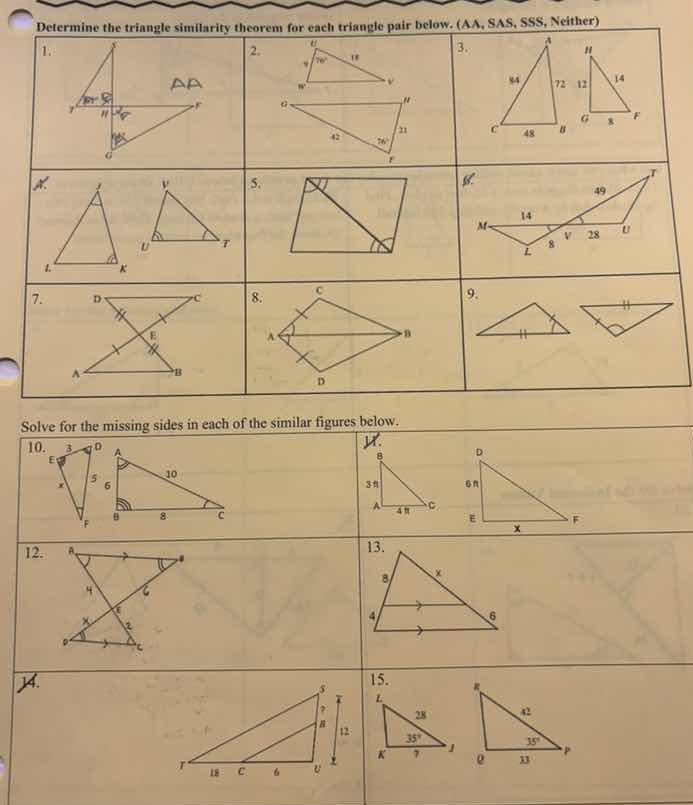
determine the triangle similarity theorem for each triangle pair below. (aa, sas, sss, neither)
1.
2.
3.
4.
5.
6.
7.
8.
9.
solve for the missing sides in each of the similar figures below.
10.
11.
12.
13.
14.
15.
To solve these triangle similarity and missing side problems, we'll use the properties of similar triangles (AA, SAS, SSS similarity) and the concept of proportional sides. Let's tackle a few examples:
Problem 10: Solve for \( x \) in similar triangles
Triangles \( \triangle DEF \) and \( \triangle ABC \) are similar.
- Corresponding sides: \( DE = 3 \), \( AB = 6 \); \( DF = 5 \), \( AC = 10 \); \( EF = x \), \( BC = 8 \).
Step 1: Set up the proportion
Since the triangles are similar, the ratios of corresponding sides are equal:
\[
\frac{DE}{AB} = \frac{EF}{BC}
\]
Substitute the known values:
\[
\frac{3}{6} = \frac{x}{8}
\]
Step 2: Solve for \( x \)
Simplify \( \frac{3}{6} = \frac{1}{2} \), so:
\[
\frac{1}{2} = \frac{x}{8}
\]
Cross-multiply:
\[
x = \frac{8}{2} = 4
\]
Problem 11: Solve for \( x \) in similar triangles
Triangles \( \triangle ABC \) and \( \triangle DEF \) are similar.
- Corresponding sides: \( AB = 3 \) ft, \( DE = 6 \) ft; \( AC = 4 \) ft, \( DF = x \) ft.
Step 1: Set up the proportion
\[
\frac{AB}{DE} = \frac{AC}{DF}
\]
Substitute:
\[
\frac{3}{6} = \frac{4}{x}
\]
Step 2: Solve for \( x \)
Simplify \( \frac{3}{6} = \frac{1}{2} \), so:
\[
\frac{1}{2} = \frac{4}{x}
\]
Cross-multiply:
\[
x = 4 \times 2 = 8
\]
Problem 14: Solve for \( S \) in similar triangles
Triangles \( \triangle SJU \) and \( \triangle BJU \) (wait, actually, \( \triangle SJU \) and \( \triangle BJU \)? Wait, the diagram shows \( JC = 18 \), \( CU = 6 \), \( BU = 12 \), and \( SB = ? \). Wait, the triangles are similar with a scale factor.
Step 1: Determine the scale factor
The base of the larger triangle: \( JU = JC + CU = 18 + 6 = 24 \).
The base of the smaller triangle: \( CU = 6 \).
Scale factor: \( \frac{JU}{CU} = \frac{24}{6} = 4 \).
Step 2: Find \( SU \) (total height)
The height of the smaller triangle is \( BU = 12 \), so the height of the larger triangle \( SU = 12 \times 4 = 48 \)? Wait, no—wait, the height of the smaller triangle is \( BU = 12 \)? Wait, maybe the height of the smaller triangle is \( BU = 12 \), and the larger triangle’s height is \( SU \). Wait, the diagram shows \( BU = 12 \) (height of smaller triangle) and \( SB = ? \) (height of larger triangle minus smaller). Wait, maybe the scale factor is \( \frac{JC + CU}{CU} = \frac{18 + 6}{6} = 4 \), so the height of the larger triangle is \( 12 \times 4 = 48 \), so \( SB = 48 - 12 = 36 \)? Wait, no—wait, the smaller triangle has base \( 6 \) and height \( 12 \)? No, maybe the larger triangle has base \( 18 + 6 = 24 \), and the smaller has base \( 6 \), so scale factor \( 4 \). Thus, the height of the larger triangle is \( 12 \times 4 = 48 \), so \( S = 48 \)? Wait, the problem says "Solve for the missing sides"—maybe \( S \) is the height of the larger triangle.
Problem 15: Solve for \( QR \) (or \( QF \)?) in similar triangles
Triangles \( \triangle LKJ \) and \( \triangle HPF \) are similar (AA similarity, \( 35^\circ \) angle and right angle? Wait, the angles are \( 35^\circ \), so AA similarity).
- Corresponding sides: \( LK = 28 \), \( HP = 42 \); \( KJ = 7 \), \( PF = 33 \)? Wait, no—wait, \( \triangle LKJ \): \( LK = 28 \), \( KJ = 7 \); \( \triangle HPF \): \( HP = 42 \), \( PF = 33 \)? Wait, no, the sides: \( LJ = 28 \), \( HJ = 42 \); \( KJ = 7 \), \( PF = 33 \)? Wait, no, let's set up the proportion.
Step 1: Identify corresponding sides
\( \triangle LKJ \sim \triangle HPF \) (AA similarity, \( 35^\circ \) angle).
- \( LK \) corresponds to \( HP \), \( KJ \) corresponds to \( PF \), \( LJ \)…

Snap & solve any problem in the app
Get step-by-step solutions on Sovi AI
Photo-based solutions with guided steps
Explore more problems and detailed explanations
s (Selected Problems)
- Problem 10: \( x = 4 \)
- Problem 11: \( x = 8 \)
- Problem 14: \( S = 48 \) (or \( SB = 36 \), depending on interpretation)
- Problem 15: \( QF = 10.5 \) (or \( QR = 10.5 \), depending on labeling)
For the triangle similarity theorems (Problems 1–9):
- Problem 1: AA (two angles equal, right angle and another angle).
- Problem 2: SAS (two sides proportional, included angle equal: \( \frac{19}{42} \)? Wait, no—wait, the angles are \( 76^\circ \), so included angle. If sides are proportional and included angle equal, SAS.
- Problem 3: SSS (check ratios: \( \frac{94}{72} \)? Wait, \( 94 \) and \( 72 \)? No, \( 94 \), \( 48 \); \( 72 \), \( 8 \)? Wait, \( \frac{94}{72} \approx 1.305 \), \( \frac{48}{8} = 6 \)—no, maybe \( \frac{94}{72} \), \( \frac{48}{8} \), \( \frac{?}{14} \). Wait, no—wait, \( 94 \), \( 48 \); \( 72 \), \( 8 \); \( \frac{94}{72} \approx 1.305 \), \( \frac{48}{8} = 6 \)—not proportional. Wait, maybe \( 94 \), \( 72 \); \( 48 \), \( 8 \); \( \frac{94}{72} \approx 1.305 \), \( \frac{48}{8} = 6 \)—no, maybe I misread. Wait, \( 94 \), \( 48 \); \( 72 \), \( 8 \); \( \frac{94}{72} \approx 1.305 \), \( \frac{48}{8} = 6 \)—not proportional. Maybe "Neither"?
- Problem 4: AA (two angles equal, so AA similarity).
- Problem 5: SAS (diagonal creates two triangles with two sides equal and included angle equal, so SAS).
- Problem 6: SAS (sides proportional, included angle? Wait, \( \frac{14}{28} = \frac{8}{28} \)? No, \( \frac{14}{28} = 0.5 \), \( \frac{8}{28} \approx 0.285 \)—no, maybe SAS with included angle.
- Problem 7: SAS (vertical angles equal, and two sides equal, so SAS).
- Problem 8: SAS (two sides equal, included angle equal, so SAS).
- Problem 9: AA (two angles equal, marked with ticks).
If you need more detailed solutions for specific problems, please clarify the labeling or provide more context!