QUESTION IMAGE
Question
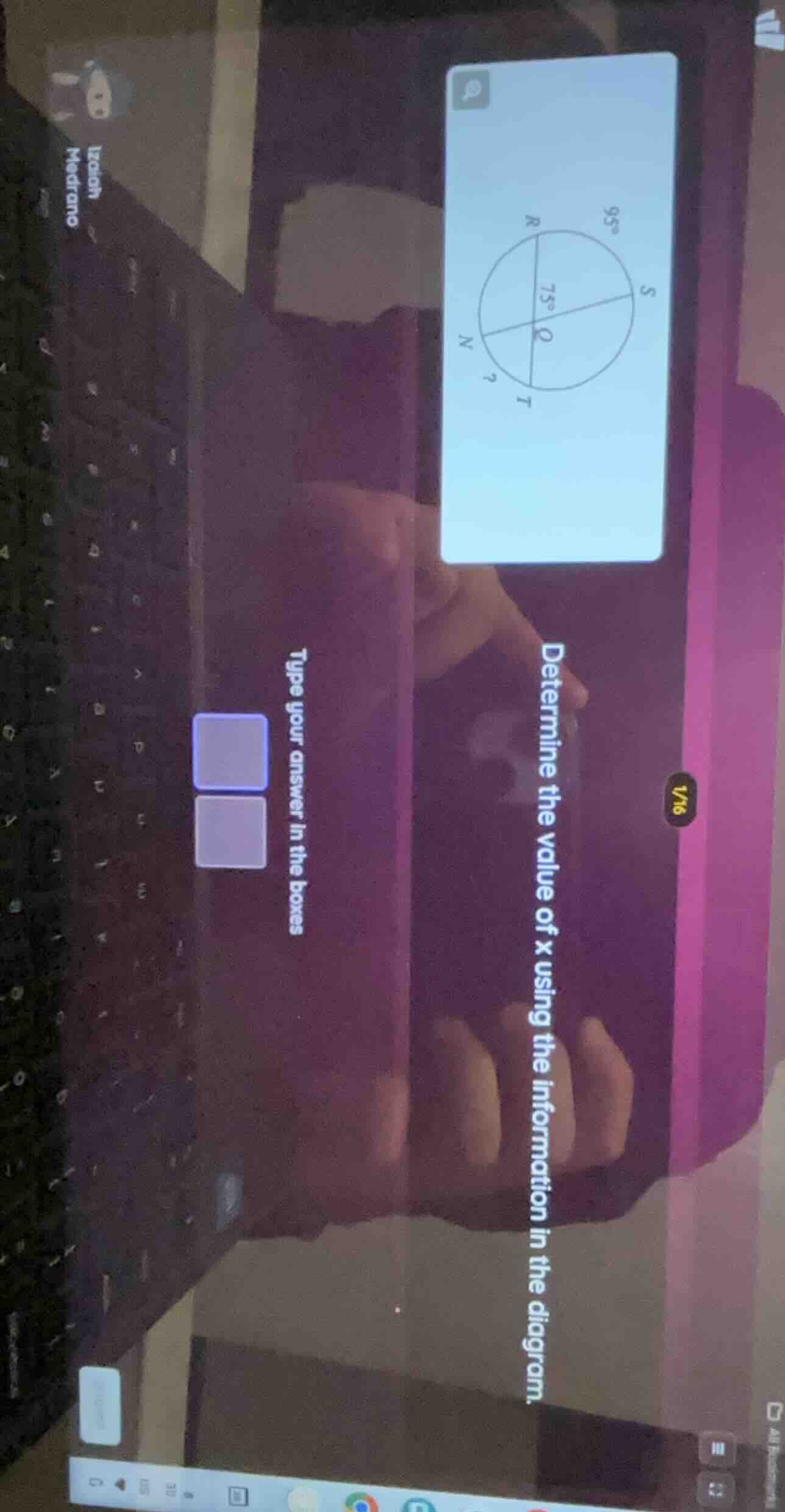
determine the value of x using the information in the diagram. type your answer in the boxes
Step1: Sum of circle angles is 360°
The total degrees around a circle is $360^\circ$.
Step2: Sum known angles
Add the given arc measures: $95^\circ + 75^\circ = 170^\circ$
Step3: Find supplementary pair
Angles opposite across diameters are supplementary pairs (sum to $180^\circ$). First find the arc opposite the unknown: $180^\circ - 95^\circ = 85^\circ$
Wait, correction: The two diameters create two pairs of vertical arcs. The unknown arc $x$ (arc $NT$) is supplementary to the $95^\circ$ arc? No, correct approach: The sum of all arcs is $360^\circ$. Let the unknown be $x$, and its vertical arc is $75^\circ$'s pair? No, re-express:
Step1: Total circle degrees = 360°
Total arcs: $95^\circ + 75^\circ + x + (180^\circ - 95^\circ) = 360^\circ$? No, simpler: The arc opposite $95^\circ$ is equal to $x$? No, vertical angles' arcs are equal. Wait, the two straight lines (diameters) mean that arc $RS$ and arc $NT$ are vertical? No, arc $RN$ is $75^\circ$, arc $RS$ is $95^\circ$, so arc $SN$ is $180^\circ - 95^\circ -75^\circ=10^\circ$? No, no: The circle is split by two diameters, so the sum of arcs on one straight line is $180^\circ$. So arc $RT$ is a straight line? No, $RQN$ is a diameter, so arc $RN$ + arc $NT$ + arc $TS$? No, $SQ T$ is a diameter. So arc $RS$ + arc $SN$ = $180^\circ$, so arc $SN = 180-95=85^\circ$. Then arc $SN$ is vertical to arc $RT$? No, arc $NT$ is unknown, arc $RN=75^\circ$, so arc $NT = 180^\circ -75^\circ$? No, no, the correct way:
Step1: Sum of all arcs = 360°
$$95^\circ + 75^\circ + x + (360^\circ -95^\circ -75^\circ -x) = 360^\circ$$ No, the two diameters create two pairs of equal arcs. The arc opposite $95^\circ$ is $x$, and arc opposite $75^\circ$ is $180^\circ -95^\circ$? No, no: When two diameters intersect, the sum of adjacent arcs on a straight line is $180^\circ$. So arc $RS$ ($95^\circ$) and arc $ST$ (unknown $x$) are not on a straight line. Wait, $RQN$ is a diameter, so arc $RN$ ($75^\circ$) + arc $NT$ ($x$) = $180^\circ$? No, $SQ T$ is a diameter, so arc $ST$ + arc $NT$ + arc $RN$? No, I made a mistake. The correct rule: When two chords (diameters) intersect at the center, the sum of all four arcs is $360^\circ$, and vertical arcs are equal? No, vertical central angles are equal, so their arcs are equal. So the arc opposite $95^\circ$ is $x$, and the arc opposite $75^\circ$ is $360^\circ - 95^\circ -95^\circ -75^\circ=95^\circ$? No, no:
Step1: Central angle sum = 360°
The central angles add to $360^\circ$. Let the unknown central angle (for arc $NT$) be $x$.
Step2: Calculate remaining angle
$$x = 360^\circ - 95^\circ - 75^\circ - (180^\circ - 95^\circ)$$
Wait, no, the angle opposite $95^\circ$ is equal to $x$? No, the angle adjacent to $75^\circ$ and $95^\circ$ is $180-75-95=10^\circ$? No, no, the two diameters mean that angle $RQS$ is $95^\circ$, angle $RQN$ is $75^\circ$, so angle $NQT$ is equal to angle $RQS$ (vertical angles) = $95^\circ$? No, vertical angles are equal. Oh! Right! Vertical central angles are congruent, so their intercepted arcs are congruent. Arc $RS$ is $95^\circ$, so its vertical arc $NT$ is also $95^\circ$? No, wait angle $RQS$ is $95^\circ$, so its vertical angle $NQT$ is also $95^\circ$, so arc $NT$ is $95^\circ$? But that can't be, because $RQN$ is a straight line, so angle $RQS + angle SQN = 180^\circ$, so angle $SQN = 180-95=85^\circ$, which is equal to angle $RQT$ (vertical angle). Then angle $RQN$ is $75^\circ$, which is angle $RQS + angle SQN$? No, $RQN$ is a straight line, so angle $RQS + angle SQN = 180^\circ$, so $95 + angle SQN=180$, so angle $SQ…

Snap & solve any problem in the app
Get step-by-step solutions on Sovi AI
Photo-based solutions with guided steps
Explore more problems and detailed explanations
$105^\circ$