QUESTION IMAGE
Question
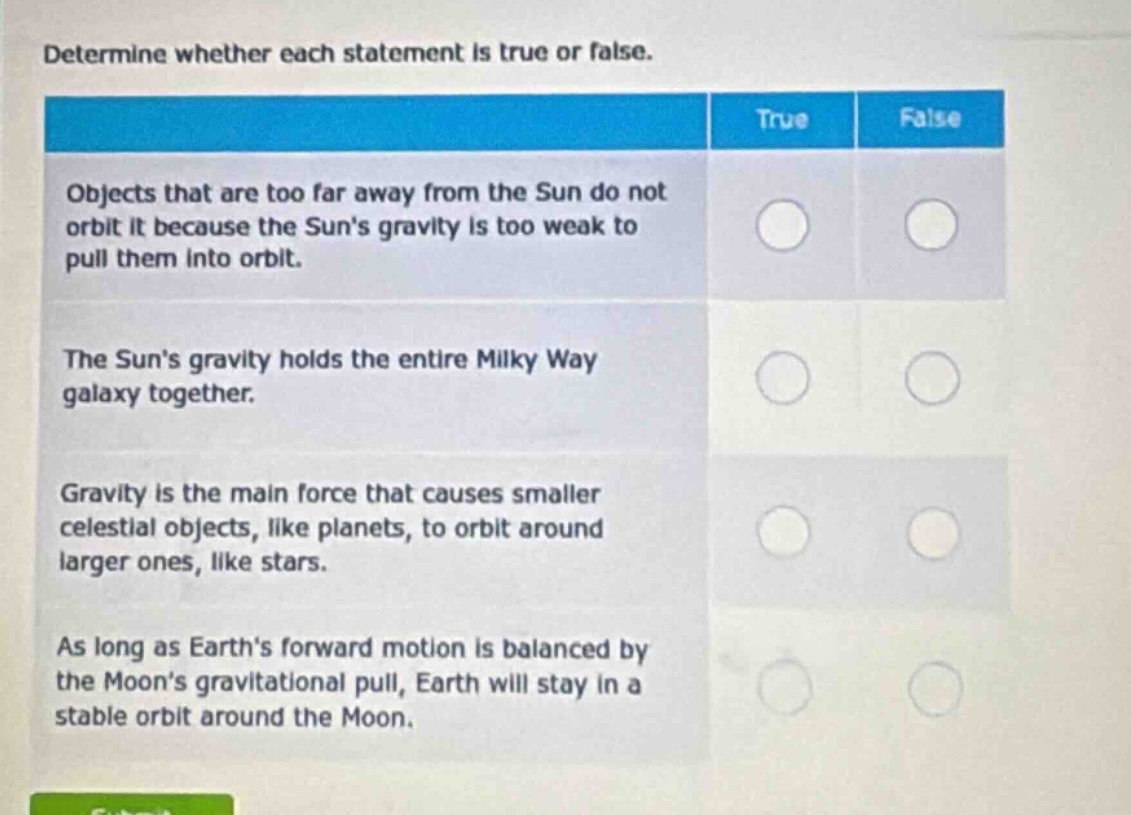
determine whether each statement is true or false.
objects that are too far away from the sun do not orbit it because the suns gravity is too weak to pull them into orbit.
the suns gravity holds the entire milky way galaxy together.
gravity is the main force that causes smaller celestial objects, like planets, to orbit around larger ones, like stars.
as long as earths forward motion is balanced by the moons gravitational pull, earth will stay in a stable orbit around the moon.
To determine the truth value of each statement, we analyze them based on gravitational principles:
Statement 1:
Objects too far from the Sun do not orbit it because the Sun’s gravity is too weak.
- The Sun’s gravitational influence weakens with distance (inverse - square law). For objects extremely far, the Sun’s gravity is insufficient to capture them into orbit.
- Answer for Statement 1: True
Statement 2:
The Sun’s gravity holds the entire Milky Way together.
- The Milky Way is held together by the gravity of a supermassive black hole at its center (Sagittarius A*), not the Sun’s gravity (the Sun is just one star in the galaxy).
- Answer for Statement 2: False
Statement 3:
Gravity causes smaller celestial objects (e.g., planets) to orbit larger ones (e.g., stars).
- Gravitational attraction between a more massive body (star) and a less massive body (planet) is the primary force driving orbital motion (e.g., Earth orbits the Sun due to gravity).
- Answer for Statement 3: True
Statement 4:
Earth stays in a stable orbit around the Moon (balanced by Earth’s forward motion and Moon’s gravity).
- The Moon is much less massive than Earth. Earth’s gravity holds the Moon in orbit around Earth, not the other way around.
- Answer for Statement 4: False
Final Answers (per statement):
- True
- False
- True
- False

Snap & solve any problem in the app
Get step-by-step solutions on Sovi AI
Photo-based solutions with guided steps
Explore more problems and detailed explanations
To determine the truth value of each statement, we analyze them based on gravitational principles:
Statement 1:
Objects too far from the Sun do not orbit it because the Sun’s gravity is too weak.
- The Sun’s gravitational influence weakens with distance (inverse - square law). For objects extremely far, the Sun’s gravity is insufficient to capture them into orbit.
- Answer for Statement 1: True
Statement 2:
The Sun’s gravity holds the entire Milky Way together.
- The Milky Way is held together by the gravity of a supermassive black hole at its center (Sagittarius A*), not the Sun’s gravity (the Sun is just one star in the galaxy).
- Answer for Statement 2: False
Statement 3:
Gravity causes smaller celestial objects (e.g., planets) to orbit larger ones (e.g., stars).
- Gravitational attraction between a more massive body (star) and a less massive body (planet) is the primary force driving orbital motion (e.g., Earth orbits the Sun due to gravity).
- Answer for Statement 3: True
Statement 4:
Earth stays in a stable orbit around the Moon (balanced by Earth’s forward motion and Moon’s gravity).
- The Moon is much less massive than Earth. Earth’s gravity holds the Moon in orbit around Earth, not the other way around.
- Answer for Statement 4: False
Final Answers (per statement):
- True
- False
- True
- False