QUESTION IMAGE
Question
- determine whether the function is linear or nonlinear.
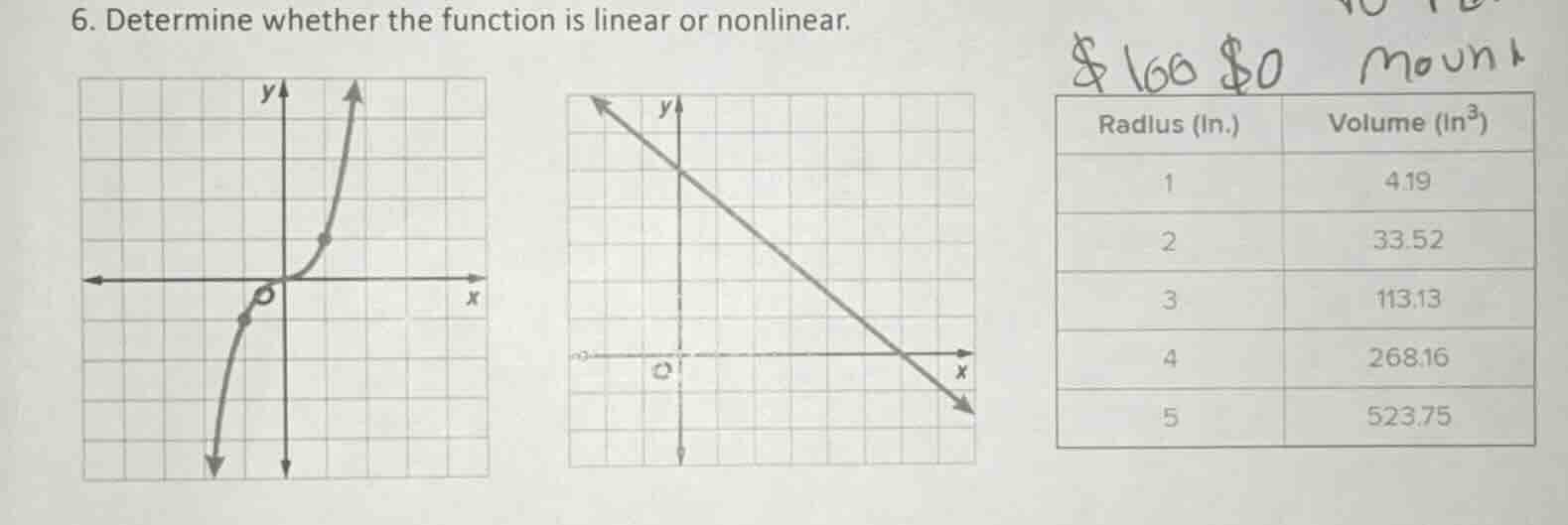
(there are two graphs and a table: the first graph is a curve passing through the origin with an open circle near the origin, the second graph is a straight line with a negative slope, and the table has columns radius (in.) with values 1, 2, 3, 4, 5 and volume (in³) with values 4.19, 33.52, 113.13, 268.16, 523.75)
First Graph (Left - Curved Line)
Step1: Recall linear function definition
A linear function has a constant rate of change (slope) and its graph is a straight line.
Step2: Analyze the first graph
The first graph shows a curved line (not straight). So, it does not have a constant slope.
Step1: Recall linear function definition
A linear function’s graph is a straight line with a constant slope.
Step2: Analyze the second graph
The second graph is a straight line, so it has a constant rate of change (slope).
Step1: Recall linear function property
For a linear function, the rate of change (difference in \( y \)-values divided by difference in \( x \)-values) should be constant.
Step2: Calculate rate of change between \( x = 1 \) and \( x = 2 \)
Volume change: \( 33.52 - 4.19 = 29.33 \), Radius change: \( 2 - 1 = 1 \), Rate: \( \frac{29.33}{1}=29.33 \)
Step3: Calculate rate of change between \( x = 2 \) and \( x = 3 \)
Volume change: \( 113.13 - 33.52 = 79.61 \), Radius change: \( 3 - 2 = 1 \), Rate: \( \frac{79.61}{1}=79.61 \)
Step4: Compare rates
Since \( 29.33
eq 79.61 \), the rate of change is not constant.

Snap & solve any problem in the app
Get step-by-step solutions on Sovi AI
Photo-based solutions with guided steps
Explore more problems and detailed explanations
Nonlinear