QUESTION IMAGE
Question
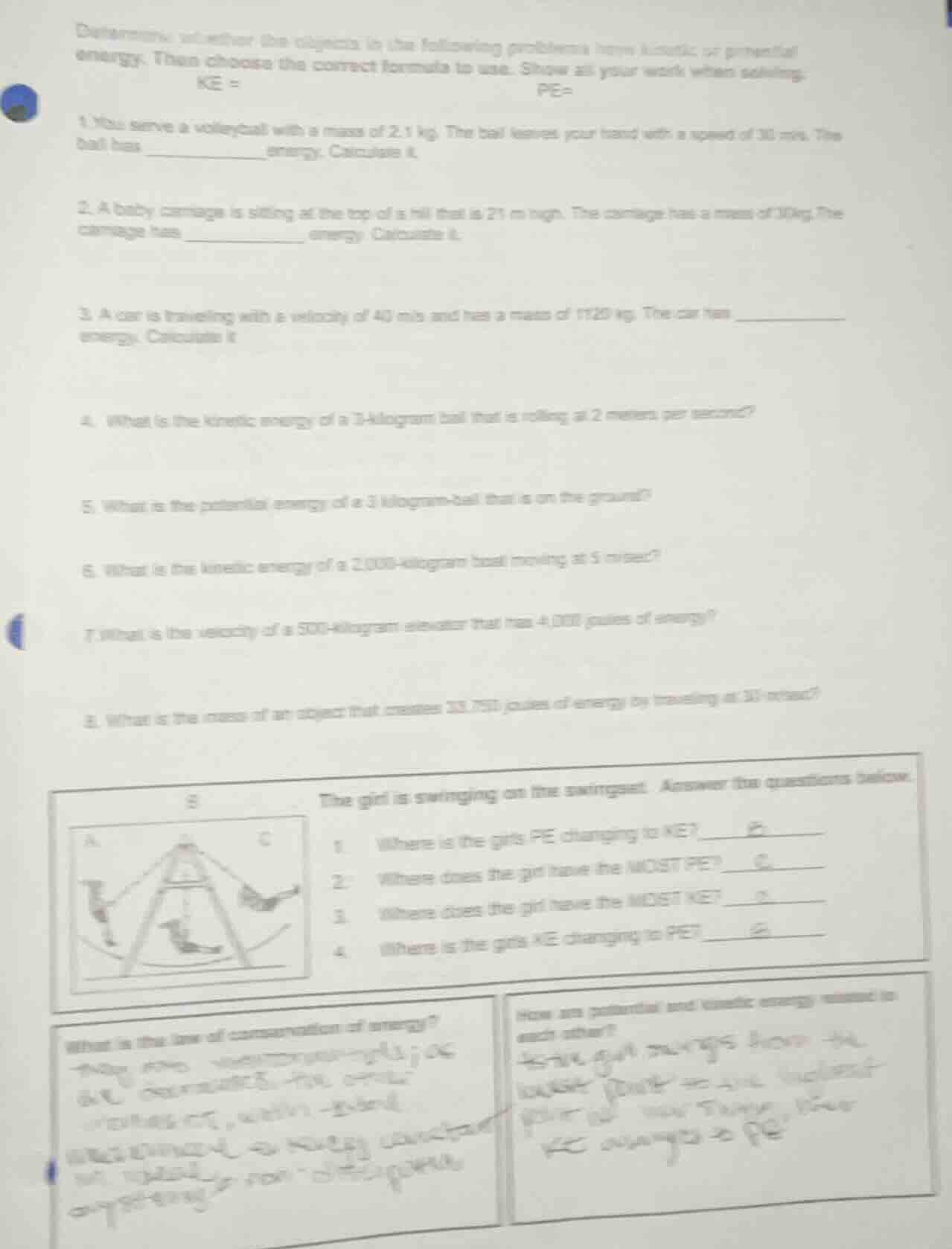
determine whether the objects in the following problems have kinetic or potential energy. then choose the correct formula to use. show all your work when solving.
ke =
pe=
- you serve a volleyball with a mass of 2.1 kg. the ball leaves your hand with a speed of 30 m/s. the ball has ____________ energy. calculate it.
- a baby carriage is sitting at the top of a hill that is 21 m high. the carriage has a mass of 10kg. the carriage has ____________ energy. calculate it.
- a car is traveling with a velocity of 40 m/s and has a mass of 1120 kg. the car has ____________ energy. calculate it
- what is the kinetic energy of a 3 - kilogram ball that is rolling at 2 meters per second?
- what is the potential energy of a 3 kilogram - ball that is on the ground?
- what is the kinetic energy of a 2,000 - kilogram boat moving at 5 m/sec?
- what is the velocity of a 500 - kilogram elevator that has 4,000 joules of energy?
- what is the mass of an object that creates 23,750 joules of energy by traveling at 35 m/sec?
b
the girl is swinging on the swing set. answer the questions below.
- where is the girls pe changing to ke? ____b____
- where does the girl have the most pe? ____c____
- where does the girl have the most ke? ____b____
- where is the girls ke changing to pe? ____b____
what is the law of conservation of energy?
how are potential and kinetic energy related to each other?
Problem 1:
Step1: Identify energy type (Kinetic, since moving)
Kinetic Energy formula: \( KE = \frac{1}{2}mv^2 \), where \( m = 2.1 \, \text{kg} \), \( v = 30 \, \text{m/s} \)
Step2: Substitute values into formula
\( KE = \frac{1}{2} \times 2.1 \times (30)^2 \)
\( KE = 0.5 \times 2.1 \times 900 \)
\( KE = 1.05 \times 900 = 945 \, \text{J} \)
Step1: Identify energy type (Potential, at height)
Potential Energy (Gravitational) formula: \( PE = mgh \), \( g = 9.8 \, \text{m/s}^2 \), \( m = 10 \, \text{kg} \), \( h = 21 \, \text{m} \)
Step2: Substitute values
\( PE = 10 \times 9.8 \times 21 \)
\( PE = 98 \times 21 = 2058 \, \text{J} \)
Step1: Identify energy type (Kinetic, moving)
Use \( KE = \frac{1}{2}mv^2 \), \( m = 1720 \, \text{kg} \), \( v = 40 \, \text{m/s} \)
Step2: Calculate
\( KE = \frac{1}{2} \times 1720 \times (40)^2 \)
\( KE = 860 \times 1600 = 1376000 \, \text{J} \)

Snap & solve any problem in the app
Get step-by-step solutions on Sovi AI
Photo-based solutions with guided steps
Explore more problems and detailed explanations
The ball has kinetic energy. Calculated value: \( 945 \, \text{J} \)