QUESTION IMAGE
Question
determine whether the pair of figures is similar. if so, find the scale factor. explain your reasoning.
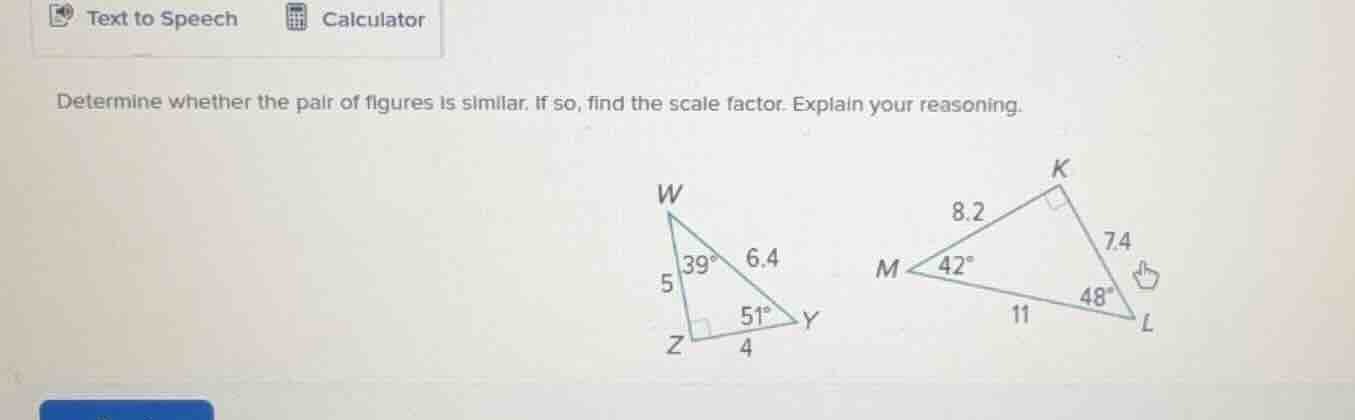
(image of two right triangles: triangle wzy with right angle at z, sides zw=5, zy=4, wy=6.4, angles at w: 39°, at y: 51°. triangle mkl with right angle at k, sides mk=8.2, kl=7.4, ml=11, angles at m: 42°, at l: 48°.)
Step1: Check Angles for Similarity
First, analyze the angles of both triangles. In triangle \( WZY \), we have a right angle at \( Z \) (\( 90^\circ \)), \( \angle W = 39^\circ \), so \( \angle Y = 180^\circ - 90^\circ - 39^\circ = 51^\circ \). In triangle \( MKL \), there is a right angle at \( K \) (\( 90^\circ \)), \( \angle M = 42^\circ \), so \( \angle L = 180^\circ - 90^\circ - 42^\circ = 48^\circ \)? Wait, no, wait. Wait, in triangle \( WZY \), angles are \( 90^\circ \), \( 39^\circ \), \( 51^\circ \). In triangle \( MKL \), angles: right angle at \( K \), \( \angle M = 42^\circ \), \( \angle L = 48^\circ \). Wait, that seems inconsistent? Wait, no, maybe I miscalculated. Wait, let's re - check triangle \( WZY \): \( \angle Z = 90^\circ \), \( \angle W = 39^\circ \), so \( \angle Y = 180 - 90 - 39 = 51^\circ \) (correct). Triangle \( MKL \): \( \angle K = 90^\circ \), \( \angle M = 42^\circ \), so \( \angle L = 180 - 90 - 42 = 48^\circ \). Wait, but in triangle \( WZY \), \( \angle Y = 51^\circ \), and in triangle \( MKL \), \( \angle L = 48^\circ \). Wait, maybe there's a mistake here. Wait, no, maybe the angle labels are different. Wait, let's check the sides. Wait, triangle \( WZY \): sides \( ZW = 5 \), \( ZY = 4 \), \( WY = 6.4 \). Triangle \( MKL \): sides \( MK = 8.2 \), \( KL = 7.4 \), \( ML = 11 \). Wait, maybe we should check the angle - angle (AA) similarity criterion. Let's find the angles correctly.
In triangle \( WZY \):
- \( \angle Z = 90^\circ \)
- \( \angle W = 39^\circ \)
- \( \angle Y = 51^\circ \)
In triangle \( MKL \):
- \( \angle K = 90^\circ \)
- Let's calculate \( \angle M \) and \( \angle L \) again. Wait, if \( \angle K = 90^\circ \), and let's see the angles: if we consider the angles, maybe the correspondence is different. Wait, maybe \( \angle Y = 51^\circ \) and \( \angle L = 48^\circ \) don't match? Wait, no, maybe I made a mistake in angle calculation. Wait, no, let's use the side lengths to check the ratios.
First, check the right - angled triangles. Triangle \( WZY \) is right - angled at \( Z \), with legs \( ZW = 5 \), \( ZY = 4 \), hypotenuse \( WY = 6.4 \). Triangle \( MKL \) is right - angled at \( K \), with legs \( MK = 8.2 \), \( KL = 7.4 \), hypotenuse \( ML = 11 \).
Wait, let's check the ratios of the sides. Let's see the ratios of the corresponding sides. Let's assume that triangle \( WZY \sim \) triangle \( MKL \) (or the other way around). Let's check the angles again. Wait, in triangle \( WZY \), angles are \( 90^\circ \), \( 39^\circ \), \( 51^\circ \). In triangle \( MKL \), angles: \( 90^\circ \), \( 42^\circ \), \( 48^\circ \). These angle measures don't match. Wait, this can't be. Wait, maybe there's a typo in my angle calculation. Wait, no, let's re - examine the triangle \( MKL \). The angle at \( M \) is \( 42^\circ \), angle at \( K \) is \( 90^\circ \), so angle at \( L \) is \( 180 - 90 - 42=48^\circ \). In triangle \( WZY \), angle at \( Y \) is \( 51^\circ \), angle at \( W \) is \( 39^\circ \), angle at \( Z \) is \( 90^\circ \). So the angles are not the same. Wait, but that contradicts. Wait, maybe I misread the angles. Wait, looking at the triangle \( WZY \): \( \angle W = 39^\circ \), \( \angle Z = 90^\circ \), \( \angle Y = 51^\circ \). Triangle \( MKL \): \( \angle M = 42^\circ \), \( \angle K = 90^\circ \), \( \angle L = 48^\circ \). These angle sets are different, so the triangles are not similar? But that seems odd. Wait, maybe I made a mistake. Wait, let's check the side lengths. Let's calculate the ratios of the sides.
For triangle \( WZY \): side…

Snap & solve any problem in the app
Get step-by-step solutions on Sovi AI
Photo-based solutions with guided steps
Explore more problems and detailed explanations
The pair of triangles is not similar because their corresponding angles are not equal (the angle measures of the two triangles do not match the requirements of the AA similarity criterion, and the ratios of corresponding sides are also not equal).