QUESTION IMAGE
Question
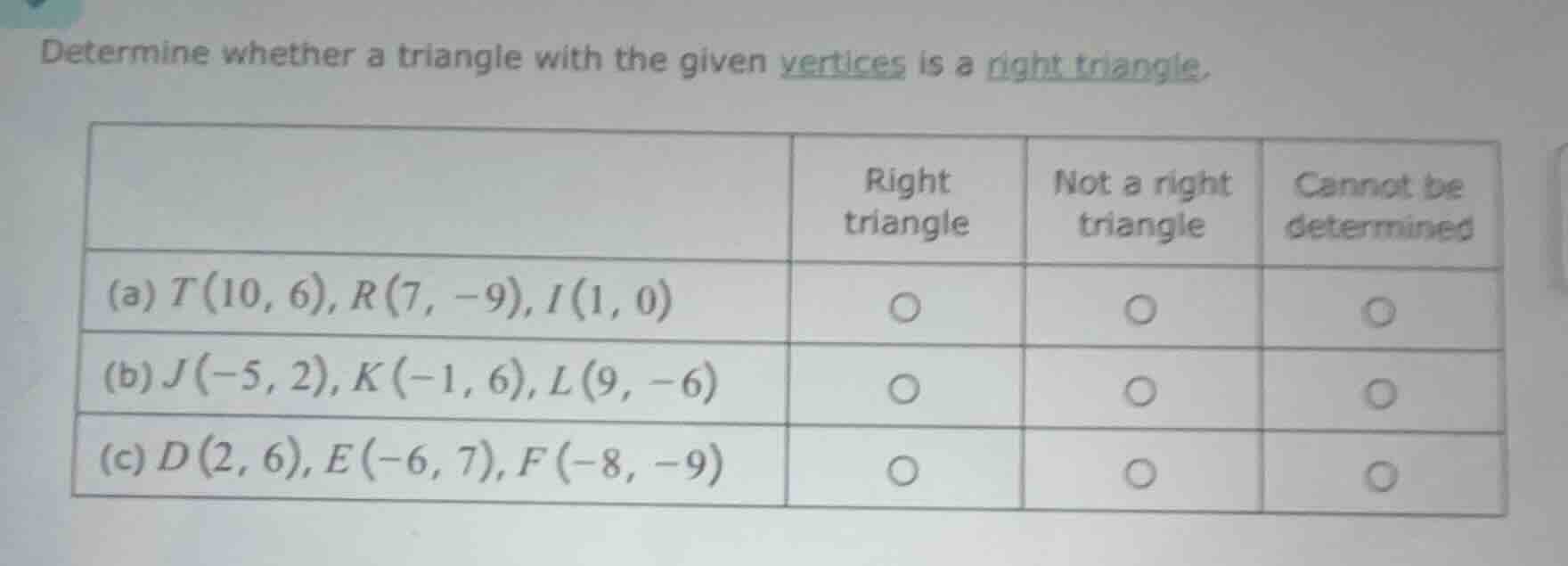
determine whether a triangle with the given vertices is a right triangle.
(a) $t(10, 6), r(7, -9), i(1, 0)$
(b) $j(-5, 2), k(-1, 6), l(9, -6)$
(c) $d(2, 6), e(-6, 7), f(-8, -9)$
options for each:
right triangle
not a right triangle
cannot be determined
For each set of vertices, we will calculate the squared lengths of all three sides using the distance formula squared: $d^2=(x_2-x_1)^2+(y_2-y_1)^2$, then check if the Pythagorean theorem holds ($a^2+b^2=c^2$, where $c^2$ is the largest squared length).
---
(a) Step1: Calculate $TR^2$
$TR^2=(10-7)^2+(6-(-9))^2=3^2+15^2=9+225=234$
(a) Step2: Calculate $TI^2$
$TI^2=(10-1)^2+(6-0)^2=9^2+6^2=81+36=117$
(a) Step3: Calculate $RI^2$
$RI^2=(7-1)^2+(-9-0)^2=6^2+(-9)^2=36+81=117$
(a) Step4: Check Pythagorean theorem
$117+117=234$, so $TI^2+RI^2=TR^2$
---
(b) Step1: Calculate $JK^2$
$JK^2=(-5-(-1))^2+(2-6)^2=(-4)^2+(-4)^2=16+16=32$
(b) Step2: Calculate $JL^2$
$JL^2=(-5-9)^2+(2-(-6))^2=(-14)^2+8^2=196+64=260$
(b) Step3: Calculate $KL^2$
$KL^2=(-1-9)^2+(6-(-6))^2=(-10)^2+12^2=100+144=244$
(b) Step4: Check Pythagorean theorem
$32+244=276
eq260$, so no match
---
(c) Step1: Calculate $DE^2$
$DE^2=(2-(-6))^2+(6-7)^2=8^2+(-1)^2=64+1=65$
(c) Step2: Calculate $DF^2$
$DF^2=(2-(-8))^2+(6-(-9))^2=10^2+15^2=100+225=325$
(c) Step3: Calculate $EF^2$
$EF^2=(-6-(-8))^2+(7-(-9))^2=2^2+16^2=4+256=260$
(c) Step4: Check Pythagorean theorem
$65+260=325$, so $DE^2+EF^2=DF^2$

Snap & solve any problem in the app
Get step-by-step solutions on Sovi AI
Photo-based solutions with guided steps
Explore more problems and detailed explanations
(a) Right triangle
(b) Not a right triangle
(c) Right triangle