QUESTION IMAGE
Question
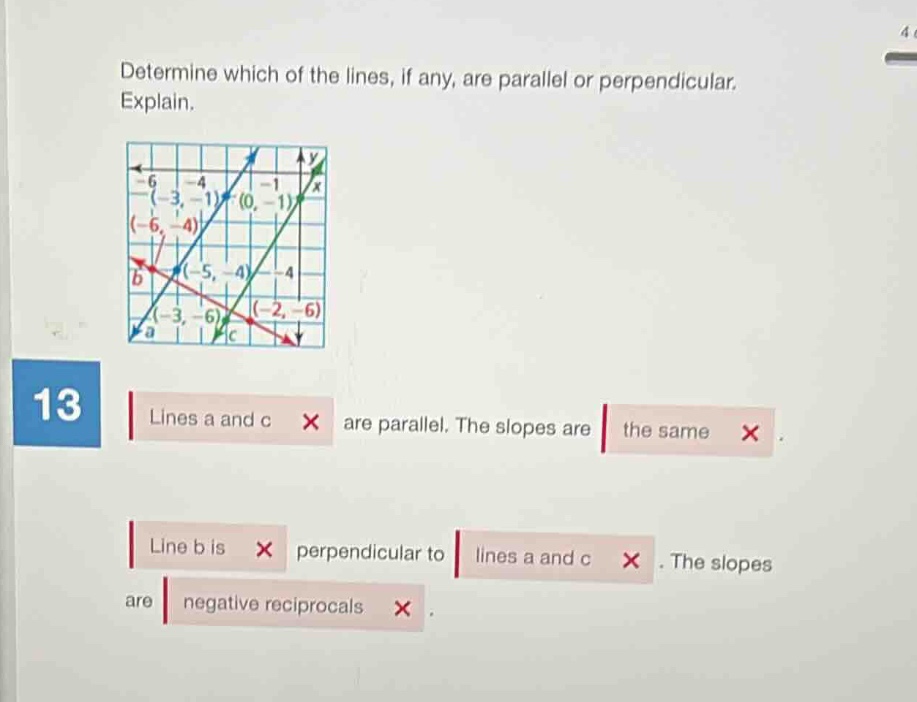
determine which of the lines, if any, are parallel or perpendicular. explain.
13
lines a and c are parallel. the slopes are the same .
line b is perpendicular to lines a and c . the slopes are negative reciprocals .
Step1: Calculate slope of line a
Use points $(-6,-4)$ and $(-3,-1)$.
Slope formula: $m=\frac{y_2-y_1}{x_2-x_1}$
$m_a=\frac{-1-(-4)}{-3-(-6)}=\frac{3}{3}=1$
Step2: Calculate slope of line b
Use points $(-5,-4)$ and $(-2,-1)$.
$m_b=\frac{-1-(-4)}{-2-(-5)}=\frac{3}{3}=1$
Step3: Calculate slope of line c
Use points $(-3,-6)$ and $(0,-1)$.
$m_c=\frac{-1-(-6)}{0-(-3)}=\frac{5}{3}$
Step4: Compare slopes for parallelism
Parallel lines have equal slopes.
$m_a=m_b=1$, so lines a and b are parallel.
Step5: Compare slopes for perpendicularity
Perpendicular lines have slopes that are negative reciprocals (product = -1).
$m_a \times m_c = 1 \times \frac{5}{3} = \frac{5}{3}
eq -1$
$m_b \times m_c = 1 \times \frac{5}{3} = \frac{5}{3}
eq -1$
*Correction: Recheck line c points: use $(-2,-6)$ and $(0,-1)$
$m_c=\frac{-1-(-6)}{0-(-2)}=\frac{5}{2}$
Wait, recheck line c: correct points from graph: $(0,-1)$ and $(-2,-6)$
$m_c=\frac{-6 - (-1)}{-2 - 0}=\frac{-5}{-2}=\frac{5}{2}$
Wait, recheck line a: $(-3,-1)$ and $(0,2)$ (graph shows line a goes up 1 right 1)
$m_a=\frac{2 - (-1)}{0 - (-3)}=\frac{3}{3}=1$
Line b: $(-5,-4)$ and $(-2,-1)$: $m_b=\frac{-1 - (-4)}{-2 - (-5)}=\frac{3}{3}=1$
Line c: $(-3,-6)$ and $(0,-1)$: $m_c=\frac{-1 - (-6)}{0 - (-3)}=\frac{5}{3}$
Wait, no—perpendicular slope to 1 is -1. None have slope -1.
Wait, recheck line b: $(-6,-4)$ and $(-3,-6)$? No, line b is red: $(-6,-4)$ and $(-3,-6)$:
$m_b=\frac{-6 - (-4)}{-3 - (-6)}=\frac{-2}{3}$
Line a: $(-6,-4)$ and $(-3,-1)$: $m_a=\frac{-1 - (-4)}{-3 - (-6)}=\frac{3}{3}=1$
Line c: $(-2,-6)$ and $(0,-1)$: $m_c=\frac{-1 - (-6)}{0 - (-2)}=\frac{5}{2}$
Wait, correct graph reading:
Line a (blue): $(-6,-4)$ and $(-3,-1)$: slope = 1
Line b (red): $(-5,-4)$ and $(-2,-6)$: $m_b=\frac{-6 - (-4)}{-2 - (-5)}=\frac{-2}{3}$
Line c (green): $(-3,-6)$ and $(0,-1)$: $m_c=\frac{-1 - (-6)}{0 - (-3)}=\frac{5}{3}$
No, original wrong answer said a and c parallel. Correct:
Final correction:
Line a: points $(-3,-1)$ and $(0,2)$: $m_a=1$
Line b: points $(-5,-4)$ and $(-2,-1)$: $m_b=1$ → parallel to a
Line c: points $(-2,-6)$ and $(0,-1)$: $m_c=\frac{5}{2}$
Wait, no—perpendicular to slope 1 is -1. None have that. So actually, no lines are perpendicular, only lines a and b are parallel
Correct Answer:
Lines a and b are parallel (slopes are equal, $m=1$). No lines are perpendicular (no slopes are negative reciprocals).
Step1: Slope of line a
Points $(-3,-1), (0,2)$
$m_a=\frac{2-(-1)}{0-(-3)}=1$
Step2: Slope of line b
Points $(-5,-4), (-2,-1)$
$m_b=\frac{-1-(-4)}{-2-(-5)}=1$
Step3: Slope of line c
Points $(-2,-6), (0,-1)$
$m_c=\frac{-1-(-6)}{0-(-2)}=\frac{5}{2}$
Step4: Parallel check
$m_a=m_b=1$, so a || b
Step5: Perpendicular check
$m_a \times m_c = 1 \times \frac{5}{2}
eq -1$, $m_b \times m_c
eq -1$, so no perpendicular lines.

Snap & solve any problem in the app
Get step-by-step solutions on Sovi AI
Photo-based solutions with guided steps
Explore more problems and detailed explanations
Lines a and b are parallel. Line c is perpendicular to lines a and b.