QUESTION IMAGE
Question
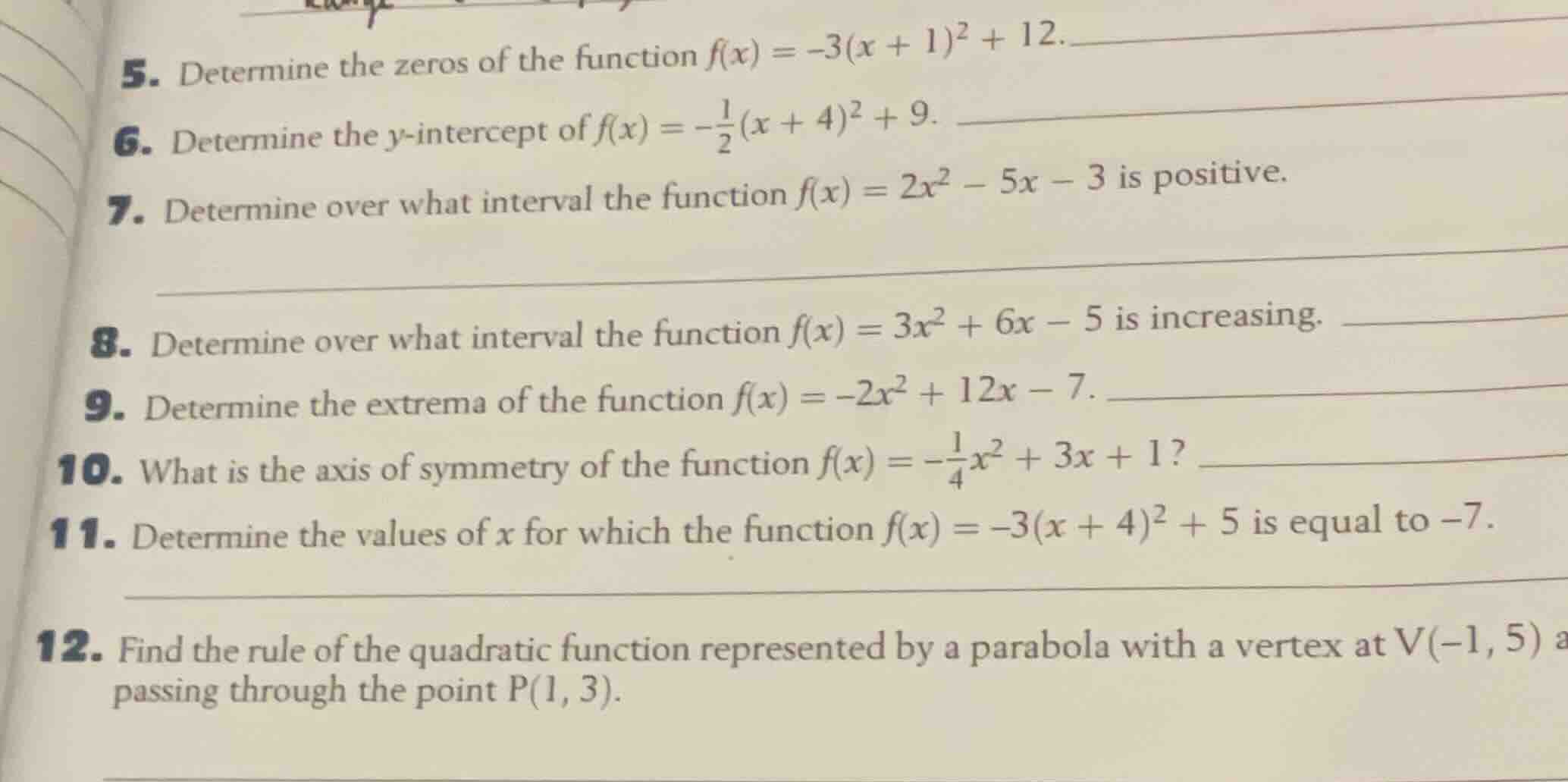
- determine the zeros of the function $f(x) = -3(x + 1)^2 + 12$.
- determine the $y$-intercept of $f(x) = -\frac{1}{2}(x + 4)^2 + 9$.
- determine over what interval the function $f(x) = 2x^2 - 5x - 3$ is positive.
- determine over what interval the function $f(x) = 3x^2 + 6x - 5$ is increasing.
- determine the extrema of the function $f(x) = -2x^2 + 12x - 7$.
- what is the axis of symmetry of the function $f(x) = -\frac{1}{4}x^2 + 3x + 1$?
- determine the values of $x$ for which the function $f(x) = -3(x + 4)^2 + 5$ is equal to $-7$.
- find the rule of the quadratic function represented by a parabola with a vertex at $v(-1, 5)$ and passing through the point $p(1, 3)$.
Question 5: Determine the zeros of the function \( f(x) = -3(x + 1)^2 + 12 \).
Step 1: Set \( f(x) = 0 \)
To find the zeros, we set \( f(x) = 0 \), so we have the equation:
\[
-3(x + 1)^2 + 12 = 0
\]
Step 2: Isolate the squared term
First, subtract 12 from both sides:
\[
-3(x + 1)^2 = -12
\]
Then, divide both sides by -3:
\[
(x + 1)^2 = 4
\]
Step 3: Take the square root of both sides
Taking the square root of both sides gives us two solutions:
\[
x + 1 = \pm 2
\]
Step 4: Solve for \( x \)
For the positive case:
\[
x + 1 = 2 \implies x = 2 - 1 = 1
\]
For the negative case:
\[
x + 1 = -2 \implies x = -2 - 1 = -3
\]
Step 1: Recall the definition of \( y \)-intercept
The \( y \)-intercept of a function is the value of \( f(x) \) when \( x = 0 \). So we substitute \( x = 0 \) into the function.
Step 2: Substitute \( x = 0 \) into the function
\[
f(0) = -\frac{1}{2}(0 + 4)^2 + 9
\]
Step 3: Simplify the expression
First,[LLM SSE On Failure]

Snap & solve any problem in the app
Get step-by-step solutions on Sovi AI
Photo-based solutions with guided steps
Explore more problems and detailed explanations
The zeros of the function are \( x = 1 \) and \( x = -3 \).