QUESTION IMAGE
Question
determining the effect of outliers
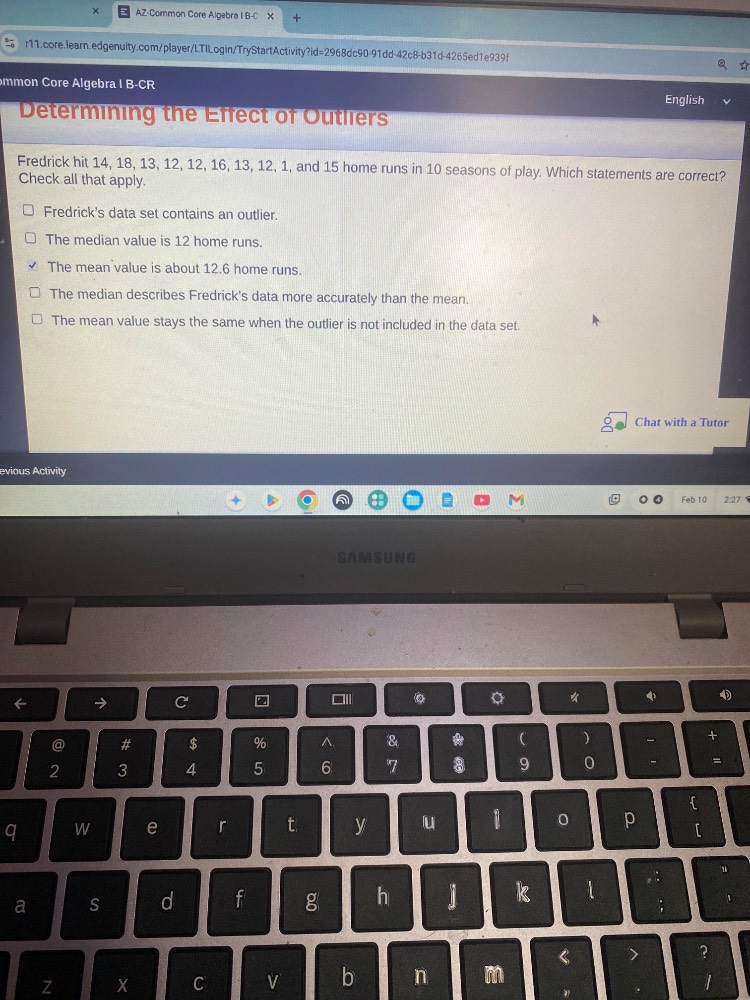
fredrick hit 14, 18, 13, 12, 12, 16, 13, 12, 1, and 15 home runs in 10 seasons of play. which statements are correct?
check all that apply.
□ fredricks data set contains an outlier.
□ the median value is 12 home runs.
☑ the mean value is about 12.6 home runs.
□ the median describes fredricks data more accurately than the mean.
□ the mean value stays the same when the outlier is not included in the data set.
Step1: Identify outlier in data
Data set: $1, 12, 12, 12, 13, 13, 14, 15, 16, 18$
The value $1$ is far from other values, so it is an outlier.
Step2: Calculate median of data
For 10 values, median = $\frac{5^{th}+6^{th}}{2} = \frac{13+13}{2}=13$
Step3: Calculate mean of full data
Mean = $\frac{1+12+12+12+13+13+14+15+16+18}{10} = \frac{126}{10}=12.6$
Step4: Calculate mean without outlier
Mean (no outlier) = $\frac{12+12+12+13+13+14+15+16+18}{9} = \frac{125}{9}\approx13.89$
Step5: Compare median/mean accuracy
Since there is an outlier, median (unaffected by outlier) describes data better than mean.

Snap & solve any problem in the app
Get step-by-step solutions on Sovi AI
Photo-based solutions with guided steps
Explore more problems and detailed explanations
- Fredrick's data set contains an outlier.
- The mean value is about 12.6 home runs.
- The median describes Fredrick's data more accurately than the mean.