QUESTION IMAGE
Question
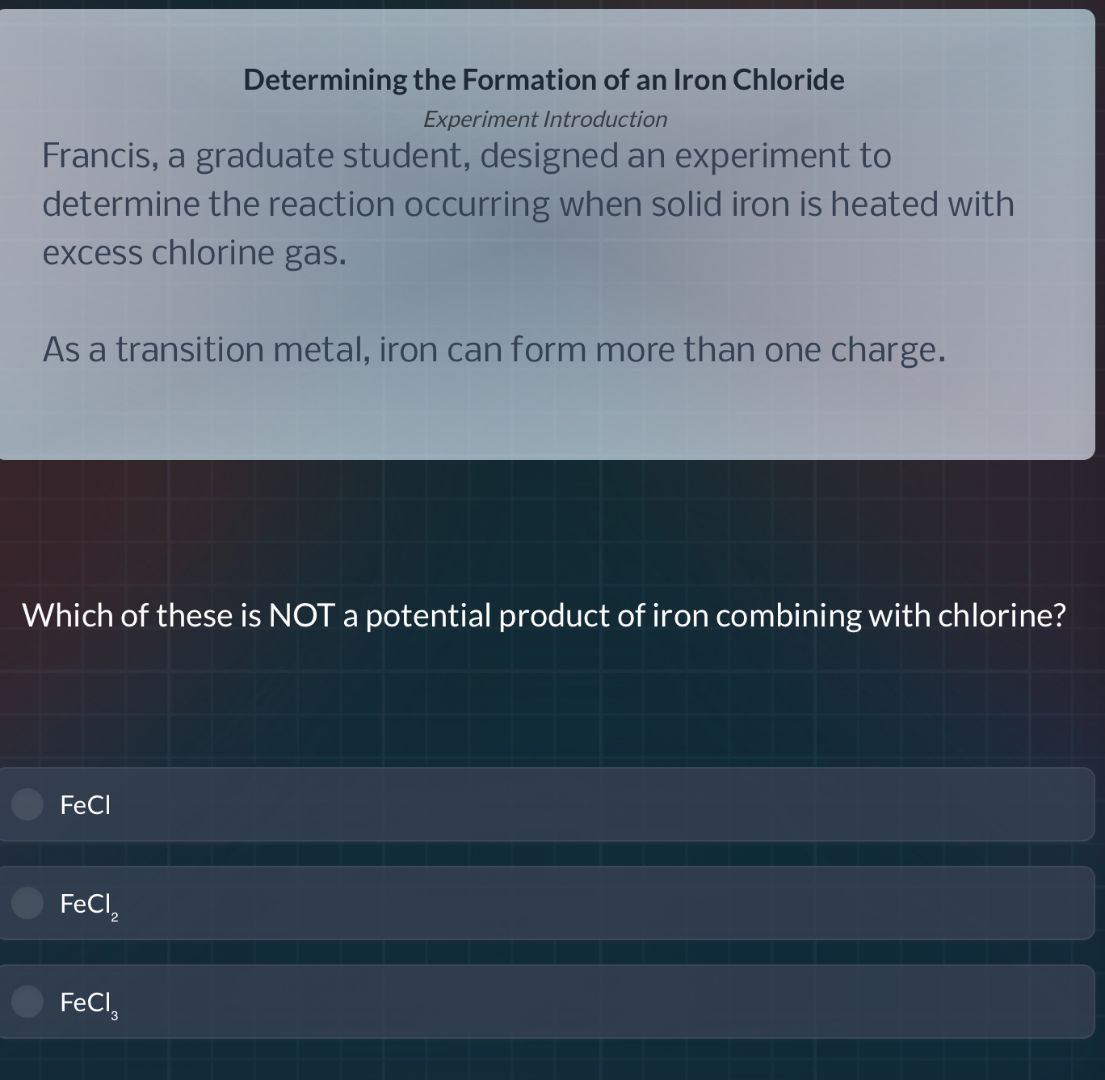
determining the formation of an iron chloride
experiment introduction
francis, a graduate student, designed an experiment to
determine the reaction occurring when solid iron is heated with
excess chlorine gas.
as a transition metal, iron can form more than one charge.
which of these is not a potential product of iron combining with chlorine?
fecl
fecl₂
fecl₃
Brief Explanations
Iron (Fe) is a transition metal with common oxidation states of +2 (ferrous) and +3 (ferric). Chlorine (Cl) has an oxidation state of -1 in chlorides. For a neutral compound, the sum of oxidation states must be zero.
- For $\text{FeCl}_2$: Let Fe's oxidation state be $x$. Then $x + 2\times(-1)=0\implies x = +2$, which is a valid state for Fe.
- For $\text{FeCl}_3$: Let Fe's oxidation state be $x$. Then $x + 3\times(-1)=0\implies x = +3$, which is a valid state for Fe.
- For $\text{FeCl}$: Let Fe's oxidation state be $x$. Then $x + (-1)=0\implies x = +1$. Iron rarely (if ever) forms a +1 oxidation state in simple chlorides, and the common stable oxidation states for Fe in chlorides are +2 and +3. So $\text{FeCl}$ is not a potential product.

Snap & solve any problem in the app
Get step-by-step solutions on Sovi AI
Photo-based solutions with guided steps
Explore more problems and detailed explanations
A. FeCl