QUESTION IMAGE
Question
determining the formation of a sulfur oxide
conclusion
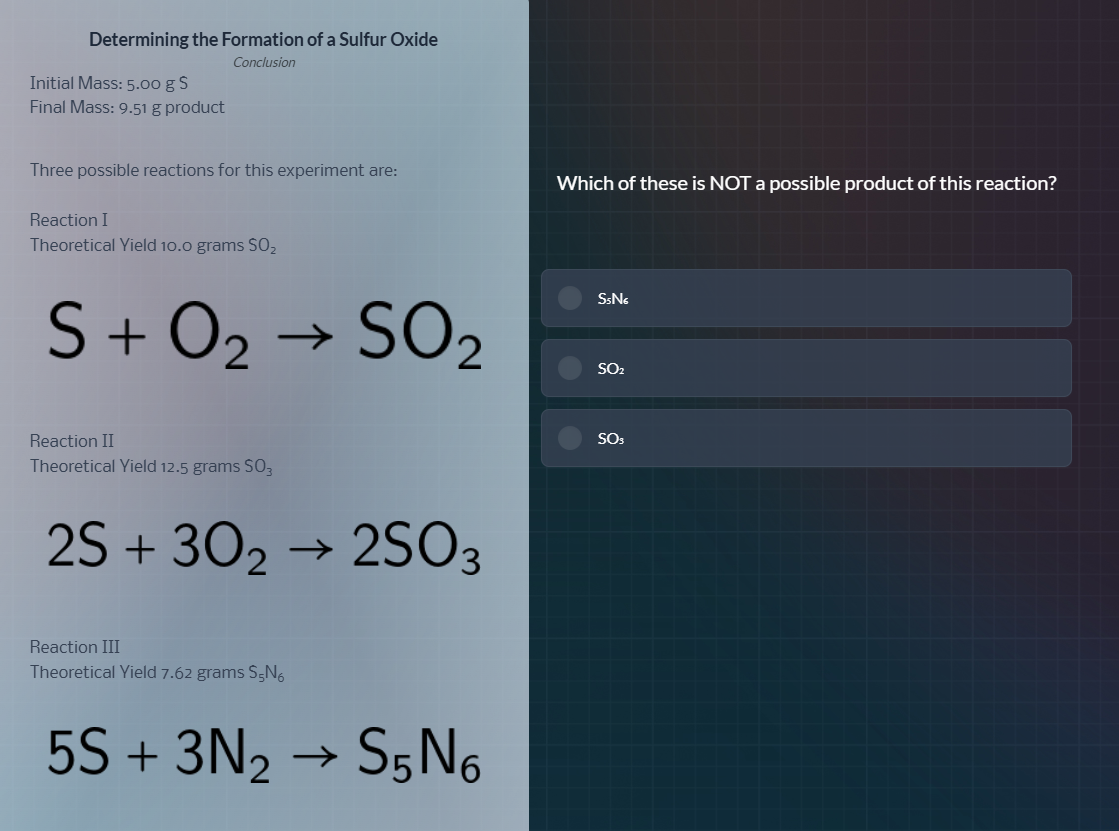
initial mass: 5.00 g s
final mass: 9.51 g product
three possible reactions for this experiment are:
reaction i
theoretical yield 10.0 grams so₂
s + o₂ → so₂
reaction ii
theoretical yield 12.5 grams so₃
2s + 3o₂ → 2so₃
reaction iii
theoretical yield 7.62 grams s₅n₆
5s + 3n₂ → s₅n₆
which of these is not a possible product of this reaction?
s₅n₆
so₂
so₃
The initial reactant is sulfur (S) and the experiment is about forming a sulfur oxide, which implies the product should contain sulfur and oxygen. \( \text{S}_5\text{N}_6 \) contains sulfur and nitrogen, not oxygen, so it's not a sulfur oxide. The other options (\( \text{SO}_2 \), \( \text{SO}_3 \)) are sulfur oxides as they contain S and O. Also, the final mass of the product is 9.51 g. The theoretical yield of \( \text{S}_5\text{N}_6 \) is 7.62 g, and 9.51 g is closer to the theoretical yields of \( \text{SO}_2 \) (10.0 g) or \( \text{SO}_3 \) (12.5 g) than to 7.62 g, further indicating \( \text{S}_5\text{N}_6 \) is not the product here.

Snap & solve any problem in the app
Get step-by-step solutions on Sovi AI
Photo-based solutions with guided steps
Explore more problems and detailed explanations
\( \text{S}_5\text{N}_6 \) (the option with \( \text{S}_5\text{N}_6 \))