QUESTION IMAGE
Question
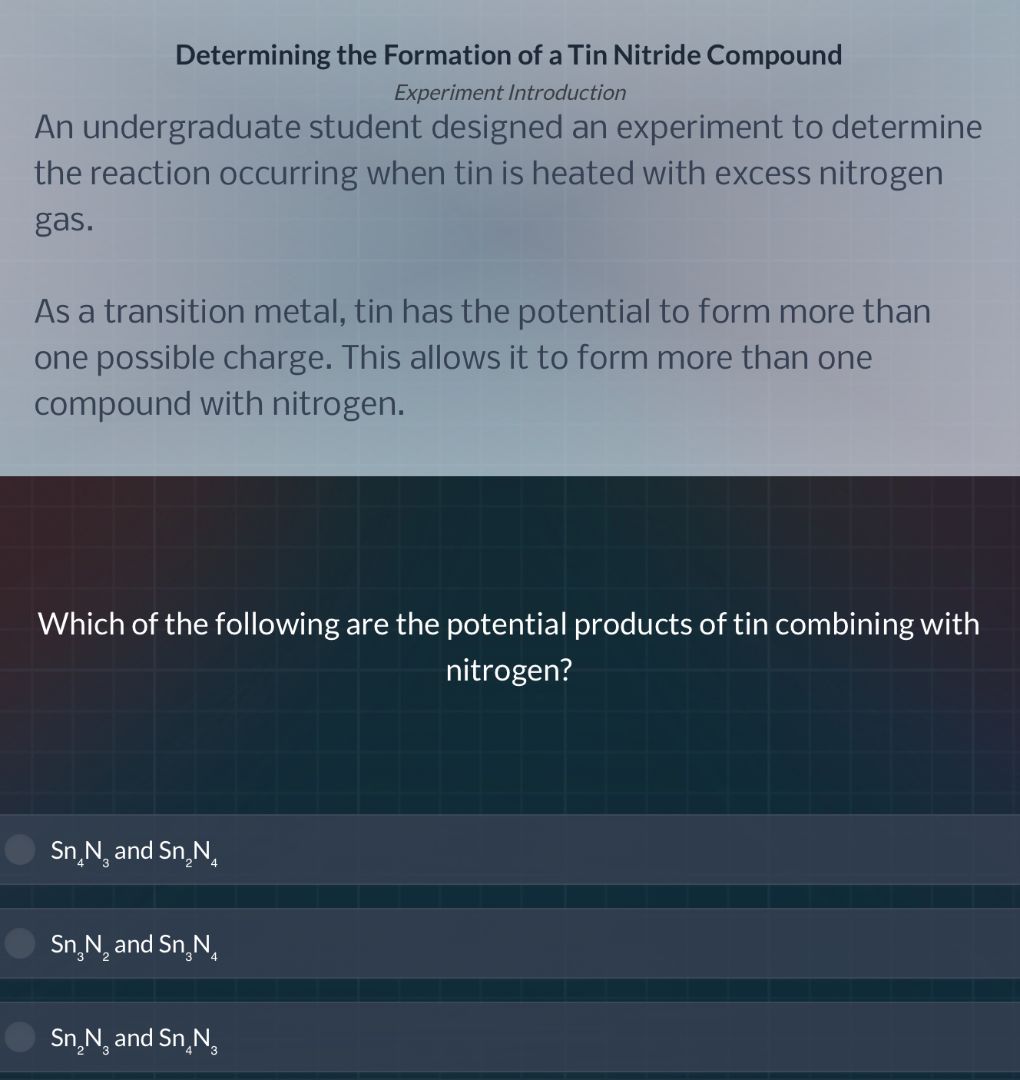
determining the formation of a tin nitride compound
experiment introduction
an undergraduate student designed an experiment to determine
the reaction occurring when tin is heated with excess nitrogen
gas.
as a transition metal, tin has the potential to form more than
one possible charge. this allows it to form more than one
compound with nitrogen.
which of the following are the potential products of tin combining with
nitrogen?
sn₄n₃ and sn₂n₄
sn₃n₂ and sn₃n₄
sn₂n₃ and sn₄n₃
To solve this, we analyze the possible charges of tin (a transition metal, can have multiple oxidation states) and nitrogen (usually -3 in nitrides).
Step 1: Recall Nitrogen's Charge
Nitrogen in nitrides typically has an oxidation state of \(-3\) (since it gains 3 electrons to achieve a stable octet).
Step 2: Analyze Tin's Possible Charges
Tin (Sn) can have common oxidation states like \(+2\) (stannous) and \(+4\) (stannic). We use the rule that the sum of oxidation states in a neutral compound is zero.
For \( \text{Sn}_2\text{N}_3 \):
Let \( x \) be Sn’s oxidation state.
\( 2x + 3(-3) = 0 \)
\( 2x - 9 = 0 \)
\( 2x = 9 \) → Not an integer (invalid, since oxidation states are integers for main groups/transition metals in simple compounds). Wait, correction: Nitrogen is \(-3\), so let's re - calculate for each option:
Option 1: \( \text{Sn}_4\text{N}_3 \) and \( \text{Sn}_2\text{N}_4 \)
- For \( \text{Sn}_4\text{N}_3 \):
\( 4x + 3(-3) = 0 \) → \( 4x = 9 \) → \( x = \frac{9}{4} \) (not a common Sn charge).
- For \( \text{Sn}_2\text{N}_4 \): Simplify to \( \text{SnN}_2 \) (divide by 2). \( x + 2(-3)=0 \) → \( x = 6 \) (not a common Sn charge).
Option 2: \( \text{Sn}_3\text{N}_2 \) and \( \text{Sn}_3\text{N}_4 \)
- For \( \text{Sn}_3\text{N}_2 \):
\( 3x + 2(-3)=0 \) → \( 3x = 6 \) → \( x = +2 \) (valid, stannous).
- For \( \text{Sn}_3\text{N}_4 \):
\( 3x + 4(-3)=0 \) → \( 3x = 12 \) → \( x = +4 \) (valid, stannic).
Option 3: \( \text{Sn}_2\text{N}_3 \) and \( \text{Sn}_4\text{N}_3 \)
- For \( \text{Sn}_2\text{N}_3 \):
\( 2x + 3(-3)=0 \) → \( 2x = 9 \) → \( x = 4.5 \) (invalid).
- For \( \text{Sn}_4\text{N}_3 \): As before, \( x=\frac{9}{4} \) (invalid).
Only \( \text{Sn}_3\text{N}_2 \) (Sn²⁺) and \( \text{Sn}_3\text{N}_4 \) (Sn⁴⁺) have valid, common oxidation states for tin.

Snap & solve any problem in the app
Get step-by-step solutions on Sovi AI
Photo-based solutions with guided steps
Explore more problems and detailed explanations
B. \( \text{Sn}_3\text{N}_2 \) and \( \text{Sn}_3\text{N}_4 \)