QUESTION IMAGE
Question
determining linear inequalities with no solution
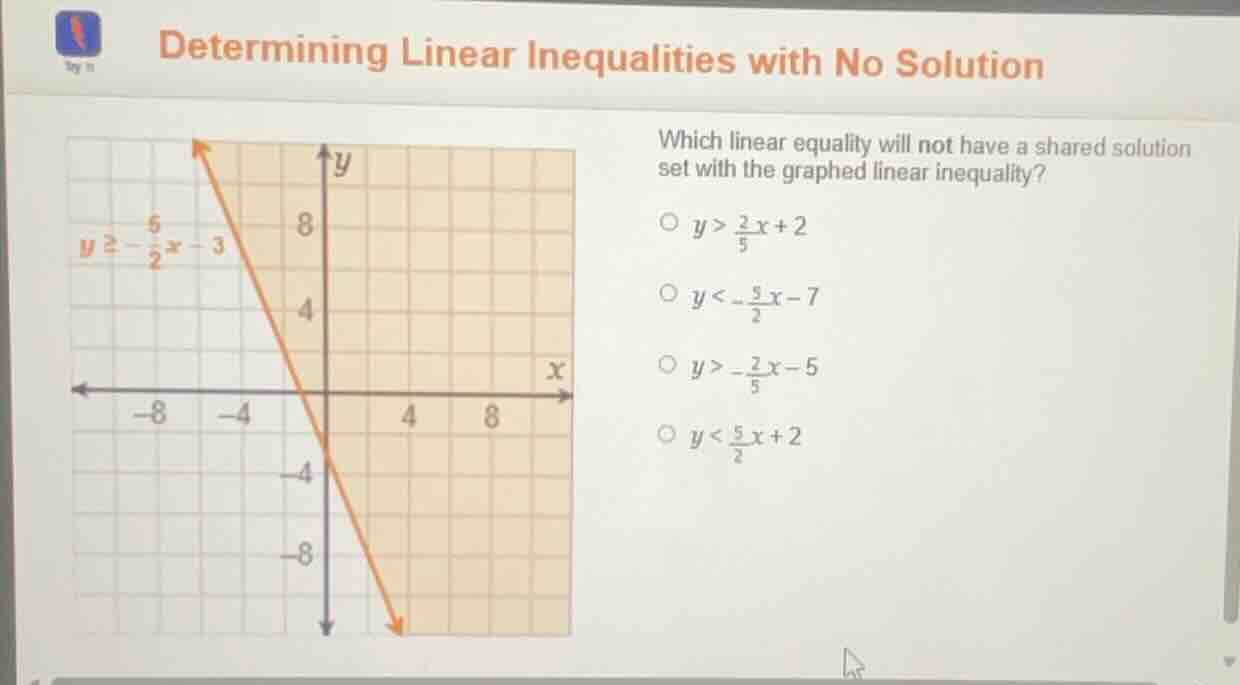
which linear equality will not have a shared solution set with the graphed linear inequality?
$y \geq -\frac{5}{2}x - 3$
$\circ\\ y > \frac{2}{5}x + 2$
$\circ\\ y < -\frac{5}{2}x - 7$
$\circ\\ y > -\frac{2}{5}x - 5$
$\circ\\ y < \frac{5}{2}x + 2$
Step1: Identify graphed inequality details
The graphed line is $y = -\frac{5}{2}x - 3$, with a shaded region above the line, so the inequality is $y \geq -\frac{5}{2}x - 3$. Its slope is $m_1 = -\frac{5}{2}$.
Step2: Analyze parallel options
Two options have the same slope: $y < -\frac{5}{2}x - 7$. Parallel lines never intersect.
Step3: Compare y-intercepts
The graphed inequality has a y-intercept of $-3$, the parallel option has a y-intercept of $-7$. Since $y \geq -\frac{5}{2}x - 3$ is always above $y = -\frac{5}{2}x - 7$, and the option is $y < -\frac{5}{2}x - 7$, there is no overlap in solution sets.
Step4: Verify non-parallel options
Non-parallel lines intersect, so their solution sets will overlap, meaning they have shared solutions.

Snap & solve any problem in the app
Get step-by-step solutions on Sovi AI
Photo-based solutions with guided steps
Explore more problems and detailed explanations
B. $y < -\frac{5}{2}x - 7$