QUESTION IMAGE
Question
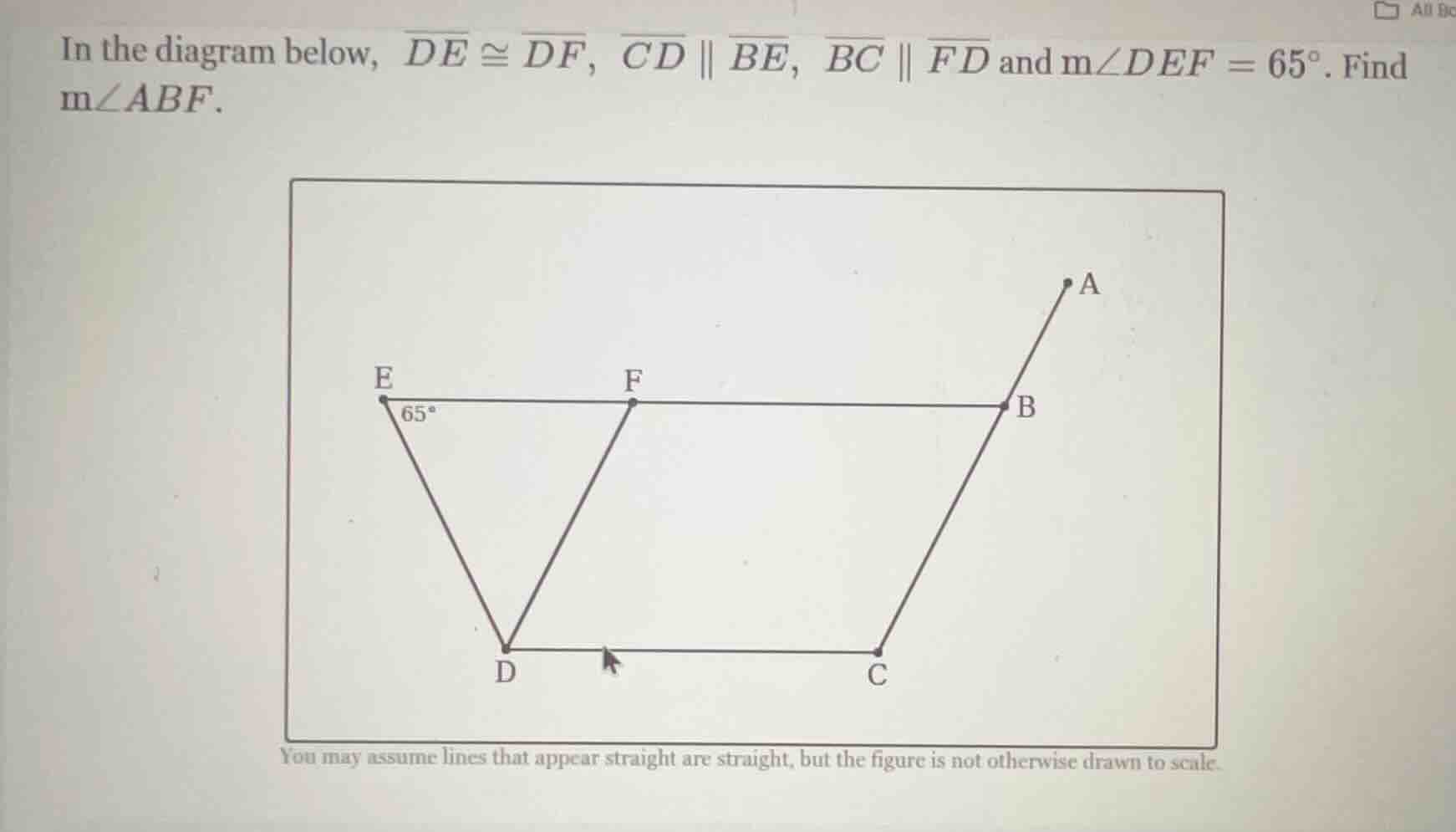
in the diagram below, \\(\overline{de} \cong \overline{df}\\), \\(\overline{cd} \parallel \overline{be}\\), \\(\overline{bc} \parallel \overline{fd}\\) and \\(\text{m}\angle def = 65^\circ\\). find \\(\text{m}\angle abf\\).
you may assume lines that appear straight are straight, but the figure is not otherwise drawn to scale.
Step1: Identify isosceles triangle properties
Given $\overline{DE} \cong \overline{DF}$, $\triangle DEF$ is isosceles with $\angle DEF = \angle DFE = 65^\circ$.
Step2: Calculate $\angle EDF$
Sum of angles in a triangle is $180^\circ$.
$\angle EDF = 180^\circ - 65^\circ - 65^\circ = 50^\circ$
Step3: Use parallelogram angle property
Since $\overline{CD} \parallel \overline{BE}$ and $\overline{BC} \parallel \overline{FD}$, $BCDF$ is a parallelogram. Opposite angles are equal, so $\angle CBF = \angle EDF = 50^\circ$.
Step4: Calculate supplementary angle
$\angle ABF$ and $\angle CBF$ are supplementary (linear pair).
$\angle ABF = 180^\circ - 50^\circ = 130^\circ$

Snap & solve any problem in the app
Get step-by-step solutions on Sovi AI
Photo-based solutions with guided steps
Explore more problems and detailed explanations
$\boldsymbol{130^\circ}$