QUESTION IMAGE
Question
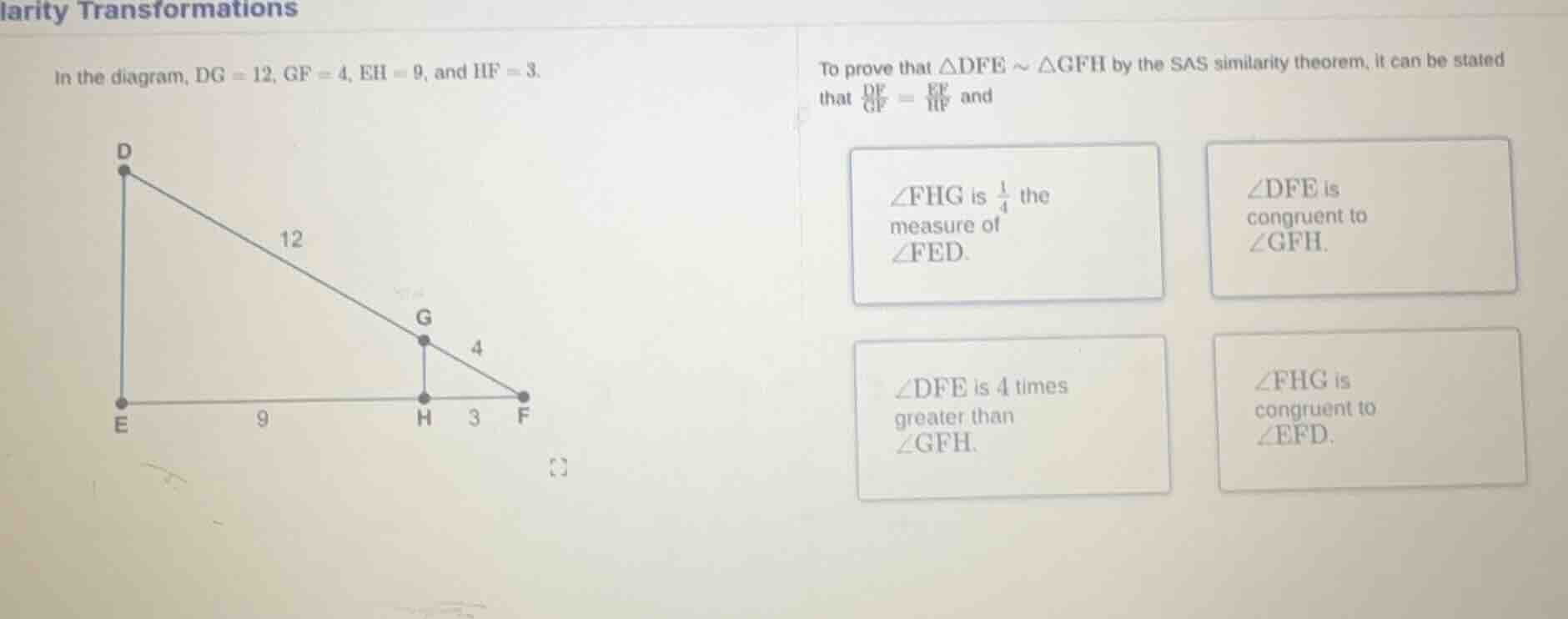
in the diagram, dg = 12, gf = 4, eh = 9, and hf = 3. to prove that $\triangle dfe \sim \triangle gfh$ by the sas similarity theorem, it can be stated that $\frac{df}{gf} = \frac{ef}{hf}$ and \
$\angle fhg$ is $\frac{1}{4}$ the measure of $\angle fed$. \
$\angle dfe$ is congruent to $\angle gfh$. \
$\angle dfe$ is 4 times greater than $\angle gfh$. \
$\angle fhg$ is congruent to $\angle efd$.
Step1: Recall SAS Similarity Theorem
The SAS (Side - Angle - Side) similarity theorem states that if two sides of one triangle are in proportion to two sides of another triangle and the included angles are congruent, then the triangles are similar.
First, we find the lengths of \(DF\) and \(EF\). We know that \(DG = 12\), \(GF=4\), so \(DF=DG + GF=12 + 4=16\). Also, \(EH = 9\), \(HF = 3\), so \(EF=EH+HF = 9 + 3=12\).
Now, we calculate the ratios \(\frac{DF}{GF}\) and \(\frac{EF}{HF}\). \(\frac{DF}{GF}=\frac{16}{4} = 4\) and \(\frac{EF}{HF}=\frac{12}{3}=4\). So, \(\frac{DF}{GF}=\frac{EF}{HF}\).
For the SAS similarity theorem, we need the included angle between the sides \(DF\) and \(EF\) in \(\triangle DFE\) and the included angle between the sides \(GF\) and \(HF\) in \(\triangle GFH\) to be congruent. The included angle for \(\triangle DFE\) is \(\angle DFE\) and the included angle for \(\triangle GFH\) is \(\angle GFH\). So, we need \(\angle DFE\cong\angle GFH\).
Let's analyze the other options:
- Option 1: \(\angle FHG\) and \(\angle FED\) are not related to the included angles for the SAS similarity of \(\triangle DFE\) and \(\triangle GFH\), so this is incorrect.
- Option 3: We don't need \(\angle DFE\) to be 4 times greater than \(\angle GFH\), we need them to be congruent, so this is incorrect.
- Option 4: \(\angle FHG\) and \(\angle EFD\) are not the included angles for the similarity, so this is incorrect.

Snap & solve any problem in the app
Get step-by-step solutions on Sovi AI
Photo-based solutions with guided steps
Explore more problems and detailed explanations
\(\angle DFE\) is congruent to \(\angle GFH\)