QUESTION IMAGE
Question
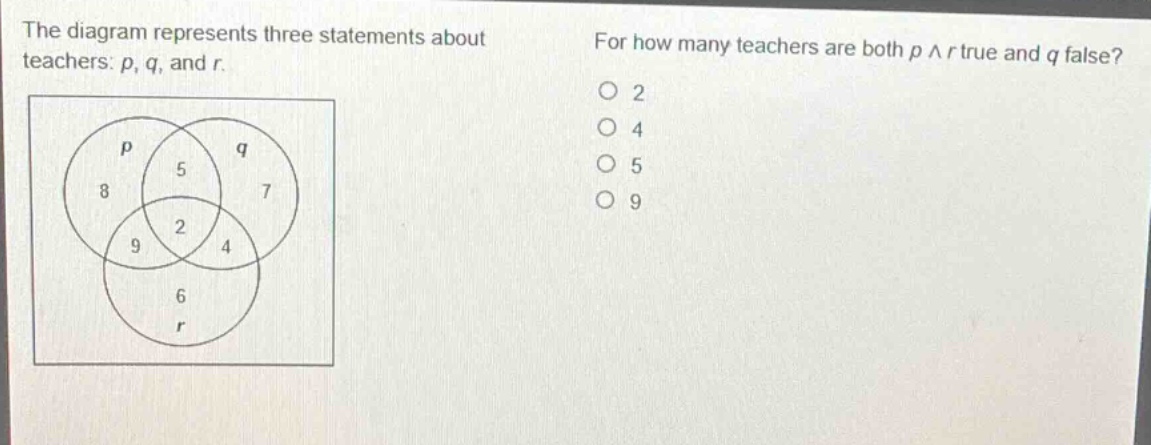
the diagram represents three statements about teachers: p, q, and r. for how many teachers are both ( p land r ) true and q false?
options: 2, 4, 5, 9
Step1: Understand \( p \wedge r \) and \( q \) false
\( p \wedge r \) means the region where both \( p \) and \( r \) are true. \( q \) false means the region not in \( q \).
Step2: Identify the regions
The regions where \( p \) and \( r \) are true and \( q \) is false are the part of \( p \cap r \) not overlapping with \( q \) (the number 9) and the part of \( p \cap r \cap
eg q \)? Wait, actually, the regions for \( p \wedge r \) (both \( p \) and \( r \)) and \( q \) false (not in \( q \)) are the two parts: the part of \( p \cap r \) not in \( q \) (which is 9) and the part? Wait, no. Wait, \( p \wedge r \) is the intersection of \( p \) and \( r \). So the regions in \( p \) and \( r \) are 9 (only \( p \) and \( r \)) and 2 (all three). But \( q \) false means not in \( q \). So the regions in \( p \) and \( r \) and not in \( q \) are 9 (only \( p \) and \( r \)) and wait, no: the 2 is in all three (so in \( q \)), so we need to exclude that. Wait, no: \( p \wedge r \) is true when both \( p \) and \( r \) are true. So the regions where \( p \) and \( r \) are true are the intersection of \( p \) and \( r \), which includes the part with 2 (all three) and 9 (only \( p \) and \( r \)). But \( q \) false means not in \( q \), so we need to exclude the part where \( q \) is true (i.e., the part with 2, which is in \( q \)). Wait, no: the 2 is in all three, so it's in \( q \). So the regions where \( p \) and \( r \) are true and \( q \) is false are the part of \( p \cap r \) not in \( q \) (which is 9) and the part of \( p \cap r \) that's also in \(
eg q \). Wait, actually, the Venn diagram: \( p \) is the left circle, \( r \) is the bottom circle, \( q \) is the right circle. So \( p \wedge r \) is the intersection of \( p \) and \( r \), which has two parts: the part only in \( p \) and \( r \) (9) and the part in all three (2). But \( q \) false means not in \( q \), so we need to exclude the part that's in \( q \) (the 2). Wait, no: the 2 is in \( q \), so to have \( q \) false, we need to take the part of \( p \wedge r \) that's not in \( q \). So that's the 9 (only \( p \) and \( r \)) and wait, is there another part? Wait, the 6 is only in \( r \), not in \( p \). The 8 is only in \( p \), not in \( r \). Wait, no: \( p \wedge r \) is \( p \) and \( r \), so the regions where both \( p \) and \( r \) are true are the two regions: 9 (only \( p \) and \( r \)) and 2 (all three). But \( q \) false means not in \( q \), so the 2 is in \( q \) (since it's in all three, including \( q \)), so we exclude that. Wait, no: the 2 is in \( q \), so \( q \) is true there. So we need the regions where \( p \) and \( r \) are true (so in \( p \cap r \)) and \( q \) is false (so not in \( q \)). So that's the part of \( p \cap r \) not in \( q \), which is 9, and also the part of \( p \cap r \) that's in \(
eg q \). Wait, but also, is there a part of \( p \cap r \) that's not in \( q \)? Wait, the 9 is only in \( p \) and \( r \) (not in \( q \)), and the 2 is in all three (so in \( q \)). Wait, but also, is there a part of \( p \) and \( r \) that's not in \( q \)? Wait, no, the intersection of \( p \) and \( r \) is two parts: 9 (only \( p \) and \( r \)) and 2 (all three). So to have \( q \) false, we take the part of \( p \cap r \) not in \( q \), which is 9, and also, wait, is there another part? Wait, the 6 is only in \( r \), not in \( p \), so that's not \( p \wedge r \). The 8 is only in \( p \), not in \( r \), so that's not \( p \wedge r \). So the regions where \( p \wedge r \) is true (both \( p \) and \( r \))…

Snap & solve any problem in the app
Get step-by-step solutions on Sovi AI
Photo-based solutions with guided steps
Explore more problems and detailed explanations
9