QUESTION IMAGE
Question
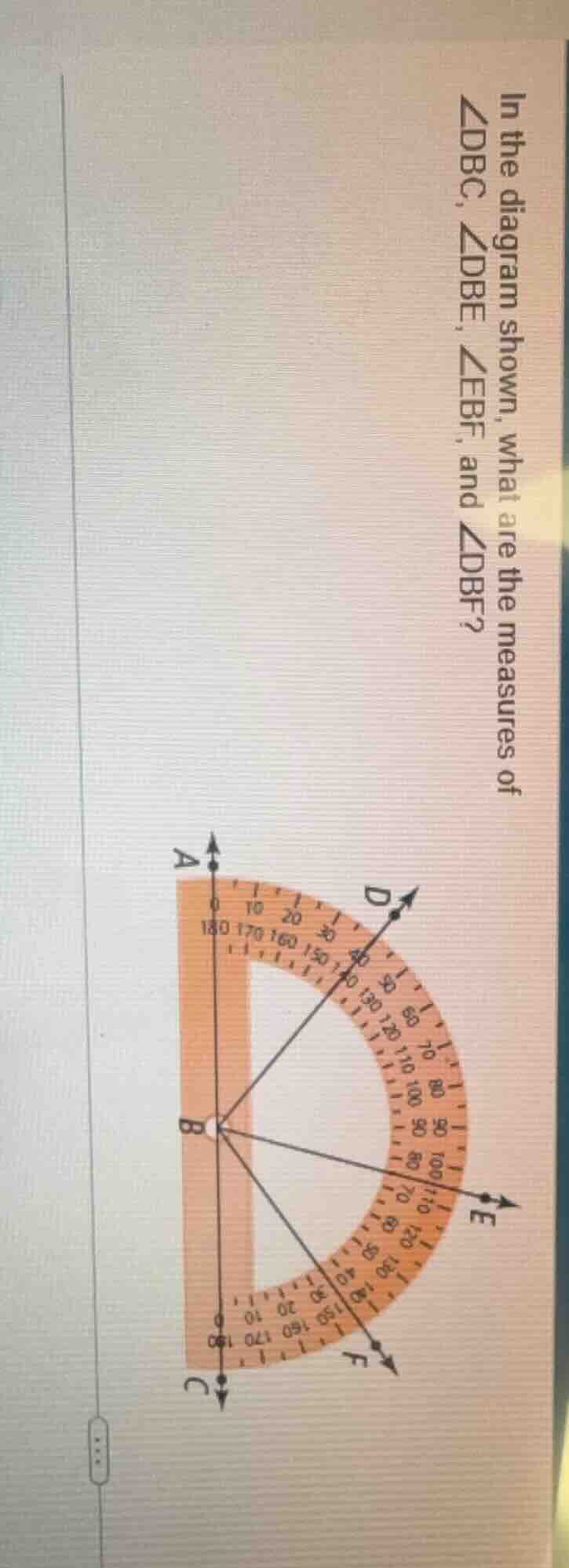
in the diagram shown, what are the measures of \\(\angle dbc\\), \\(\angle dbe\\), \\(\angle ebf\\), and \\(\angle dbf\\)?
Step1: Analyze ∠DBC
Since \( \angle ABC = 180^\circ \) (straight line) and \( \angle ABD \) can be read from the protractor. From the diagram, \( \angle ABD = 40^\circ \), so \( \angle DBC=180^\circ - 40^\circ = 140^\circ \).
Step2: Analyze ∠DBE
Looking at the protractor, the angle between \( BD \) and \( BE \): the measure from \( BD \) (40° mark) to \( BE \) (90° mark, since \( BE \) is at 90° from \( BA \)?) Wait, actually, from the protractor, \( BD \) is at 40° from \( BA \), \( BE \) is at 90° from \( BA \)? Wait, no, the protractor has markings. Let's see, \( BA \) is 0°, \( BD \) is at 40° (from the top scale), \( BE \) is at 90°? Wait, no, the bottom scale: \( BA \) is 180°, \( BC \) is 0°. Wait, maybe better: \( \angle DBE \): \( BD \) to \( BE \). From the diagram, \( BD \) is at 40° (top scale: 0° at \( BA \), so \( BD \) is 40° from \( BA \)), \( BE \) is at 90° from \( BA \)? Wait, no, the angle between \( BD \) and \( BE \): if \( BD \) is 40° from \( BA \), and \( BE \) is 90° from \( BA \), then \( \angle DBE = 90^\circ - 40^\circ = 50^\circ \). Wait, or looking at the protractor's inner scale: \( BD \) is at 40°, \( BE \) is at 90°? Wait, maybe the protractor has \( BA \) as 0° (top) and \( BC \) as 180° (bottom). So \( BD \) is at 40° (top scale: 0 + 40), \( BE \) is at 90° (top scale: 0 + 90), so \( \angle DBE = 90 - 40 = 50^\circ \).
Step3: Analyze ∠EBF
From the protractor, \( BE \) is at 90° (top scale), \( BF \) is at 140° (top scale)? Wait, no, let's check the bottom scale. Wait, maybe \( BE \) is at 90° from \( BA \), \( BF \) is at 140° from \( BA \)? Wait, no, the angle between \( BE \) and \( BF \): \( BE \) is at 90°, \( BF \) is at 140°? No, looking at the diagram, \( BF \) is at 140° from \( BA \)? Wait, no, the protractor markings: \( BD \) is 40°, \( BE \) is 90°, \( BF \) is 140°? Wait, no, the angle between \( BE \) and \( BF \): \( 140^\circ - 90^\circ = 50^\circ \)? Wait, no, maybe I messed up. Wait, let's re - examine. The straight line \( AC \), \( BA \) is top, \( BC \) is bottom. The protractor has top scale (0° at \( BA \), increasing to 180° at \( BC \)) and bottom scale (180° at \( BA \), decreasing to 0° at \( BC \)). So \( BD \): top scale 40°, so bottom scale 140°. \( BE \): top scale 90°, bottom scale 90°. \( BF \): top scale 140°, bottom scale 40°. So \( \angle EBF \): between \( BE \) (top 90°) and \( BF \) (top 140°), so \( 140^\circ - 90^\circ = 50^\circ \)? Wait, no, maybe \( \angle EBF \) is \( 140 - 90 = 50^\circ \)? Wait, no, let's do it properly. \( \angle EBF \): \( BE \) to \( BF \). If \( BE \) is at 90° (from \( BA \)), \( BF \) is at 140° (from \( BA \)), then \( \angle EBF = 140 - 90 = 50^\circ \).
Step4: Analyze ∠DBF
\( \angle DBF \): \( BD \) to \( BF \). \( BD \) is at 40° (from \( BA \)), \( BF \) is at 140° (from \( BA \)), so \( \angle DBF = 140^\circ - 40^\circ = 100^\circ \). Wait, or using the bottom scale: \( BD \) is 140° (bottom scale), \( BF \) is 40° (bottom scale), so \( \angle DBF = 140 - 40 = 100^\circ \).
Wait, maybe my initial analysis was wrong. Let's start over.
Correct approach:
- \( \angle DBC \): Since \( BA \perp BC \)? No, \( BA \) and \( BC \) are a straight line, so \( \angle ABC = 180^\circ \). The angle between \( BD \) and \( BA \) is \( 40^\circ \) (from the protractor, top scale: \( BA \) is 0°, \( BD \) is at 40°). So \( \angle ABD = 40^\circ \), therefore \( \angle DBC = 180^\circ - 40^\circ = 140^\circ \).
- \( \angle DBE \): The angle between \( BD \) and \( BE \). \( BE \) is at 90° from \( BA \) (since it's a right angl…

Snap & solve any problem in the app
Get step-by-step solutions on Sovi AI
Photo-based solutions with guided steps
Explore more problems and detailed explanations
\( \angle DBC = 140^\circ \), \( \angle DBE = 50^\circ \), \( \angle EBF = 50^\circ \), \( \angle DBF = 100^\circ \)