QUESTION IMAGE
Question
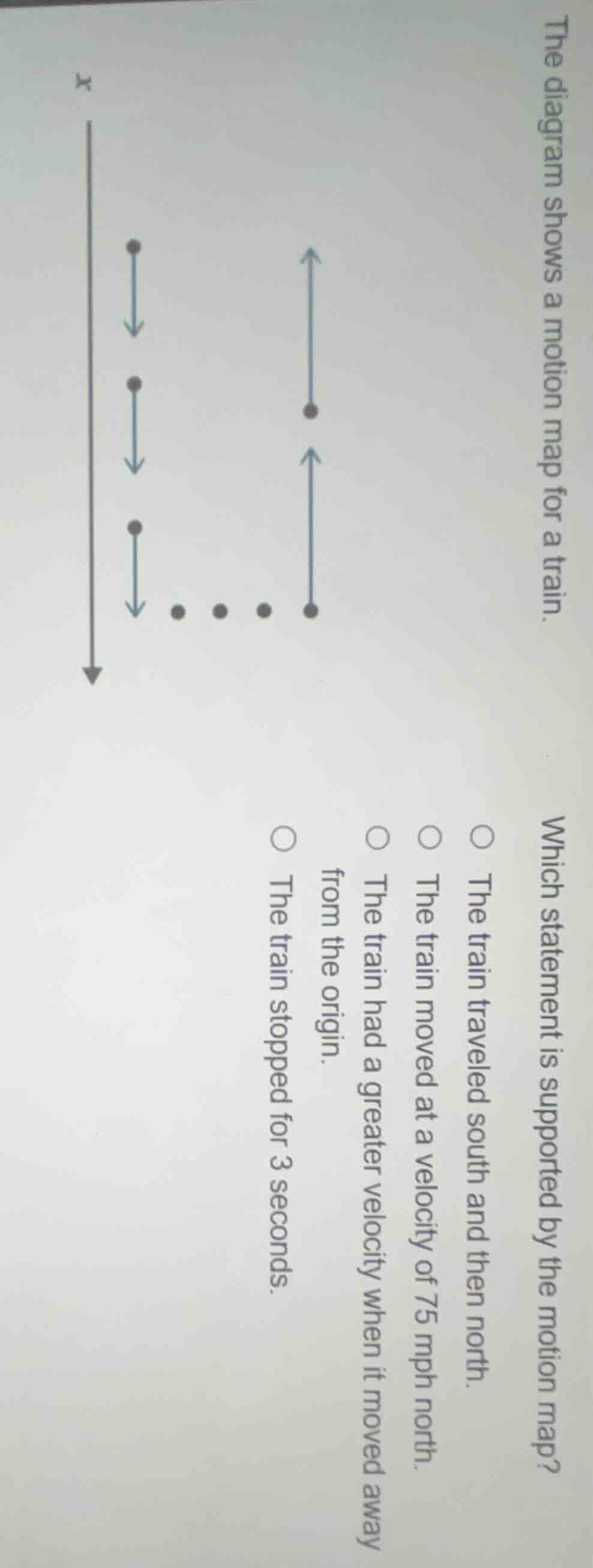
the diagram shows a motion map for a train.
which statement is supported by the motion map?
○ the train traveled south and then north.
○ the train moved at a velocity of 75 mph north.
○ the train had a greater velocity when it moved away from the origin.
○ the train stopped for 3 seconds.
Brief Explanations
- Analyze the motion map: The direction of the x - axis (with the arrow downwards, assuming down is south or a direction, and the dots with arrows. The first set of dots (with upward arrows) and then dots with downward arrows. Wait, actually, in a motion map, the length of the velocity vectors (arrows) and the spacing of the dots (positions at equal time intervals) matter. But looking at the options:
- Option "The train traveled south and then north": The arrows (velocity vectors) direction: if we assume the x - axis direction (the long line with arrow down) as south, then the first part (dots with upward arrows? Wait, no, maybe the direction of the velocity arrows. Wait, the first set of dots (the ones with longer upward arrows) and then dots with downward arrows (shorter? Or same? Wait, the key is the direction of motion. But actually, the correct reasoning: The motion map shows that the train first had motion in one direction (say north, if the x - axis arrow is south) and then south? No, wait, maybe the arrows: the first dots (the ones with upward arrows) and then dots with downward arrows. But the correct option is "The train had a greater velocity when it moved away from the origin" – no, wait, no. Wait, let's re - evaluate. Wait, the motion map: the spacing between dots (positions at each time step) and the length of velocity vectors. If the velocity vectors (arrows) are longer when moving away from the origin (the starting point), then the speed (magnitude of velocity) is greater. So the option "The train had a greater velocity when it moved away from the origin" is supported because the length of the velocity arrows (vectors) is longer when moving in the direction away from the origin (assuming the origin is the starting dot). The other options: "The train traveled south and then north" – the direction of arrows: if the x - axis arrow is down (south), then upward arrows would be north? But the dots with downward arrows are in a different column. No, maybe the first part (dots with upward arrows) are moving north (opposite to x - axis direction) and then dots with downward arrows (same as x - axis direction, south). But the length of arrows: the upward arrows are longer, so when moving north (away from origin? Or towards? Wait, maybe the origin is the bottom dot. So when moving up (north), the arrows are longer, so velocity magnitude is greater. So the statement "The train had a greater velocity when it moved away from the origin" is correct. The other options: "The train traveled south and then north" – the direction of motion: if the x - axis arrow is down (south), then the first motion (upward arrows) is north, then downward arrows (south), but the option says south and then north, which is reversed. "The train moved at a velocity of 75 mph north" – no speed value is given. "The train stopped for 3 seconds" – there are no dots with zero velocity (arrows of length zero) for 3 seconds. So the correct option is "The train had a greater velocity when it moved away from the origin".

Snap & solve any problem in the app
Get step-by-step solutions on Sovi AI
Photo-based solutions with guided steps
Explore more problems and detailed explanations
The train had a greater velocity when it moved away from the origin.