QUESTION IMAGE
Question
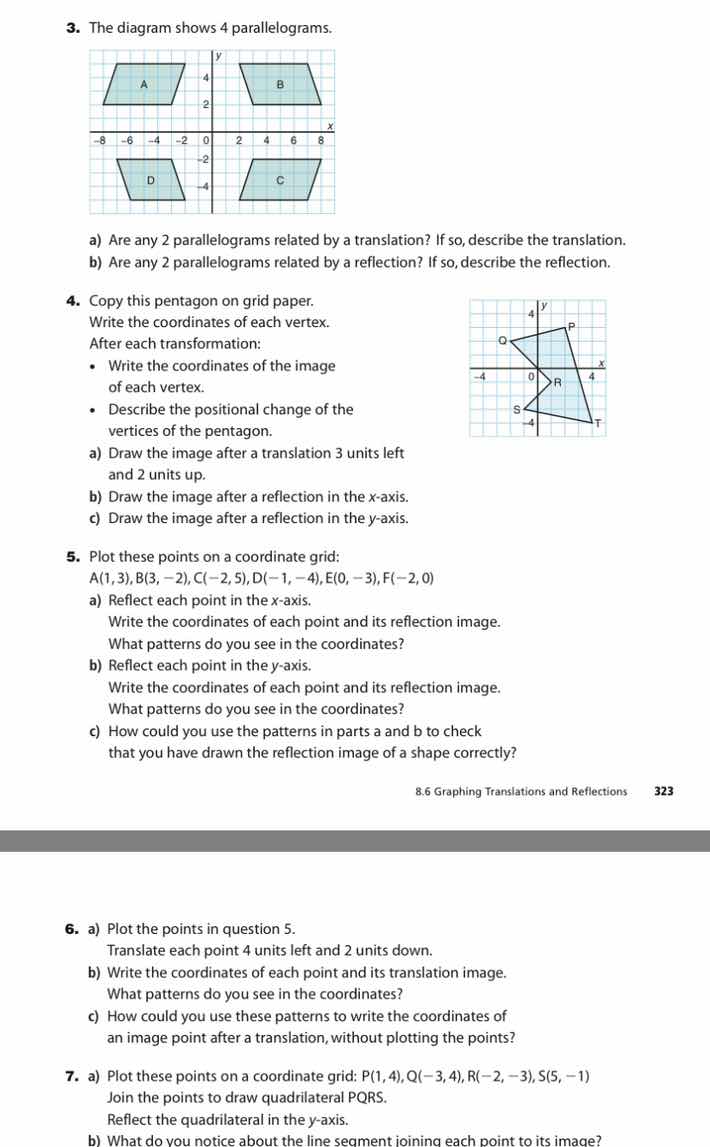
- the diagram shows 4 parallelograms.
a) are any 2 parallelograms related by a translation? if so, describe the translation.
b) are any 2 parallelograms related by a reflection? if so, describe the reflection.
- copy this pentagon on grid paper.
write the coordinates of each vertex.
after each transformation:
- write the coordinates of the image of each vertex.
- describe the positional change of the vertices of the pentagon.
a) draw the image after a translation 3 units left and 2 units up.
b) draw the image after a reflection in the x - axis.
c) draw the image after a reflection in the y - axis.
- plot these points on a coordinate grid: a(1, 3), b(3, -2), c(-2, 5), d(-1, -4), e(0, -3), f(-2, 0)
a) reflect each point in the x - axis.
write the coordinates of each point and its reflection image.
what patterns do you see in the coordinates?
b) reflect each point in the y - axis.
write the coordinates of each point and its reflection image.
what patterns do you see in the coordinates?
c) how could you use the patterns in parts a and b to check that you have drawn the reflection image of a shape correctly?
- a) plot the points in question 5.
translate each point 4 units left and 2 units down.
b) write the coordinates of each point and its translation image.
what patterns do you see in the coordinates?
c) how could you use these patterns to write the coordinates of an image point after a translation, without plotting the points?
- a) plot these points on a coordinate grid: p(1, 4), q(-3, 4), r(-2, -3), s(5, -1)
join the points to draw quadrilateral pqrs.
reflect the quadrilateral in the y - axis.
b) what do you notice about the line segment joining each point to its image?
Since the user has provided a set of problems related to coordinate geometry transformations (translations, reflections) and plotting points, we'll address one of the sub - questions. Let's take question 5a as an example.
Question 5a: Reflect each point in the x - axis. Write the coordinates of each point and its reflection image. What patterns do you see in the coordinates?
Step - by - Step Explanation:
Step 1: Recall the rule for reflection over the x - axis
The rule for reflecting a point \((x,y)\) over the \(x\) - axis is that the \(x\) - coordinate remains the same, and the \(y\) - coordinate changes its sign. Mathematically, if we have a point \(P(x,y)\), its reflection over the \(x\) - axis, denoted as \(P'(x, - y)\).
Step 2: Apply the rule to each point
- For point \(A(1,3)\):
Using the reflection rule over the \(x\) - axis, the \(x\) - coordinate \(x = 1\) stays the same, and the \(y\) - coordinate \(y = 3\) becomes \(-3\). So the reflection of \(A\) is \(A'(1,-3)\).
- For point \(B(3, - 2)\):
The \(x\) - coordinate \(x = 3\) remains unchanged, and the \(y\) - coordinate \(y=-2\) becomes \(-(-2)=2\). So the reflection of \(B\) is \(B'(3,2)\).
- For point \(C(-2,5)\):
The \(x\) - coordinate \(x = - 2\) stays the same, and the \(y\) - coordinate \(y = 5\) becomes \(-5\). So the reflection of \(C\) is \(C'(-2,-5)\).
- For point \(D(-1,-4)\):
The \(x\) - coordinate \(x=-1\) remains the same, and the \(y\) - coordinate \(y = - 4\) becomes \(-(-4)=4\). So the reflection of \(D\) is \(D'(-1,4)\).
- For point \(E(0,-3)\):
The \(x\) - coordinate \(x = 0\) stays the same, and the \(y\) - coordinate \(y=-3\) becomes \(-(-3)=3\). So the reflection of \(E\) is \(E'(0,3)\).
- For point \(F(-2,0)\):
The \(x\) - coordinate \(x=-2\) remains the same, and the \(y\) - coordinate \(y = 0\) becomes \(-0 = 0\). So the reflection of \(F\) is \(F'(-2,0)\).
Step 3: Identify the pattern
When we reflect a point \((x,y)\) over the \(x\) - axis to get \((x,-y)\), we observe that the \(x\) - coordinate of the original point and its reflection is the same, while the \(y\) - coordinate of the reflection is the negative of the \(y\) - coordinate of the original point.
Coordinates and their Reflections:
| Original Point | Coordinates | Reflection over \(x\) - axis | Coordinates of Reflection |
|---|---|---|---|
| \(B\) | \((3,-2)\) | \(B'\) | \((3,2)\) |
| \(C\) | \((-2,5)\) | \(C'\) | \((-2,-5)\) |
| \(D\) | \((-1,-4)\) | \(D'\) | \((-1,4)\) |
| \(E\) | \((0,-3)\) | \(E'\) | \((0,3)\) |
| \(F\) | \((-2,0)\) | \(F'\) | \((-2,0)\) |
Pattern:
For a point \((x,y)\) reflected over the \(x\) - axis, the image is \((x,-y)\). That is, the \(x\) - coordinate remains unchanged, and the \(y\) - coordinate is multiplied by \(-1\).

Snap & solve any problem in the app
Get step-by-step solutions on Sovi AI
Photo-based solutions with guided steps
Explore more problems and detailed explanations
for 5a:
- Coordinates and their reflections:
- \(A(1,3)\) reflects to \(A'(1,-3)\)
- \(B(3,-2)\) reflects to \(B'(3,2)\)
- \(C(-2,5)\) reflects to \(C'(-2,-5)\)
- \(D(-1,-4)\) reflects to \(D'(-1,4)\)
- \(E(0,-3)\) reflects to \(E'(0,3)\)
- \(F(-2,0)\) reflects to \(F'(-2,0)\)
- Pattern: When a point \((x,y)\) is reflected over the \(x\) - axis, the \(x\) - coordinate stays the same (\(x\) - coordinate: \(x
ightarrow x\)) and the \(y\) - coordinate changes sign (\(y\) - coordinate: \(y
ightarrow - y\)), so the reflection of \((x,y)\) is \((x,-y)\).