QUESTION IMAGE
Question
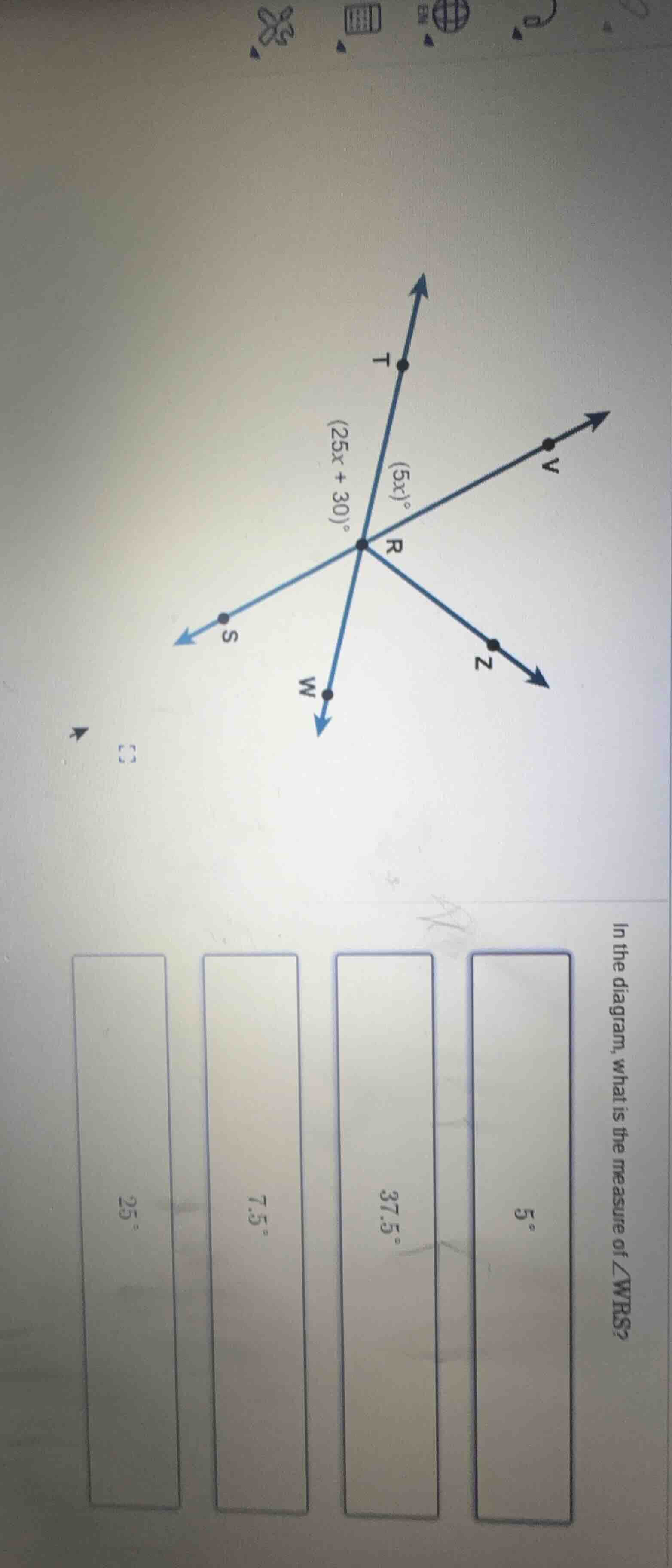
in the diagram, what is the measure of ∠wrs? the diagram shows intersecting lines with angles (5x)° and (25x + 30)° at point r. the options are 5°, 37.5°, 7.5°, 25°.
Step1: Identify supplementary angles
Angles \((25x + 30)^\circ\) and \((5x)^\circ\) are supplementary (they form a linear pair), so their sum is \(180^\circ\).
\[
(25x + 30) + 5x = 180
\]
Step2: Solve for \(x\)
Combine like terms:
\[
30x + 30 = 180
\]
Subtract 30 from both sides:
\[
30x = 150
\]
Divide by 30:
\[
x = 5
\]
Step3: Find \(\angle WRS\)
First, find the measure of the angle related to \(\angle WRS\). Wait, actually, looking at the diagram, \(\angle WRS\) should be equal to \((5x)^\circ\) (vertical angles or adjacent? Wait, no, let's re - check. Wait, the angle \((25x + 30)\) and \((5x)\) are supplementary. After finding \(x = 5\), let's find the angle that is equal to \(\angle WRS\). Wait, maybe \(\angle WRS\) is equal to the angle opposite or adjacent. Wait, actually, when \(x = 5\), the angle \((5x)^\circ=5\times5 = 25^\circ\)? Wait, no, wait, maybe I made a mistake. Wait, let's re - examine the diagram. The angle \((25x + 30)\) and \((5x)\) are supplementary. So \(25x+30 + 5x=180\), \(30x=150\), \(x = 5\). Then, if we look at \(\angle WRS\), maybe it's equal to the angle that is vertical or adjacent. Wait, maybe the angle \(\angle WRS\) is equal to \((5x)^\circ\) when \(x = 5\), \(5x=25^\circ\)? But wait, the options have \(37.5^\circ\), \(7.5^\circ\), etc. Wait, maybe I misidentified the angles. Wait, maybe the angle \((25x + 30)\) and \((5x)\) are actually adjacent and form a linear pair, but maybe \(\angle WRS\) is related to another angle. Wait, no, let's re - do the equation. Wait, maybe the two angles \((25x + 30)\) and \((5x)\) are actually vertical angles? No, vertical angles are equal. Wait, the diagram shows two lines intersecting, so \((25x + 30)\) and \((5x)\) are supplementary (linear pair). So \(25x+30+5x = 180\), \(30x=150\), \(x = 5\). Then, if we want to find \(\angle WRS\), maybe it's equal to the angle that is \((25x + 30)\) or \((5x)\) or another angle. Wait, maybe I made a mistake in the angle relationship. Wait, perhaps the angle \(\angle WRS\) is equal to \(\frac{1}{2}\) of the supplementary angle? No, wait, let's look at the options. The options are \(5^\circ\), \(7.5^\circ\), \(25^\circ\), \(37.5^\circ\). Wait, if \(x = 5\), \(5x = 25^\circ\), but that's one of the options. Wait, but maybe the angle \(\angle WRS\) is not \(5x\) but another angle. Wait, maybe the two angles \((25x + 30)\) and \((5x)\) are actually vertical angles? No, vertical angles are equal. So if they are vertical angles, \(25x+30=5x\), \(20x=- 30\), which is not possible. So they must be supplementary. So \(x = 5\), \(5x = 25^\circ\). But wait, the option \(25^\circ\) is there. Wait, maybe that's the answer. Wait, but let's check again.
Wait, maybe the angle \(\angle WRS\) is equal to \((5x)^\circ\). When \(x = 5\), \(5x=25^\circ\). So the measure of \(\angle WRS\) is \(25^\circ\).

Snap & solve any problem in the app
Get step-by-step solutions on Sovi AI
Photo-based solutions with guided steps
Explore more problems and detailed explanations
\(25^\circ\)