QUESTION IMAGE
Question
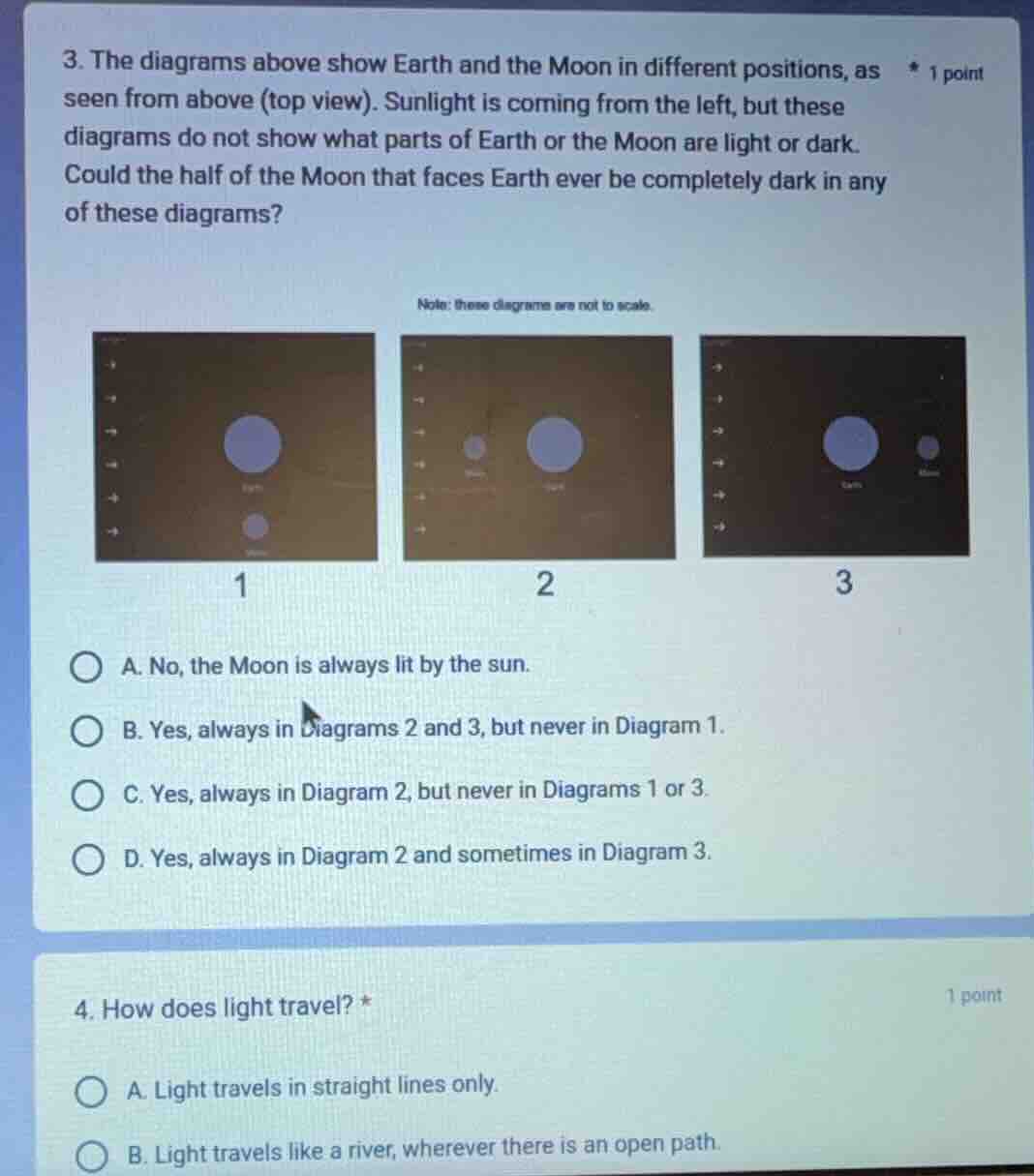
- the diagrams above show earth and the moon in different positions, as seen from above (top view). sunlight is coming from the left, but these diagrams do not show what parts of earth or the moon are light or dark. could the half of the moon that faces earth ever be completely dark in any of these diagrams?note: these diagrams are not to scale.123a. no, the moon is always lit by the sun.b. yes, always in diagrams 2 and 3, but never in diagram 1.c. yes, always in diagram 2, but never in diagrams 1 or 3.d. yes, always in diagram 2 and sometimes in diagram 3.4. how does light travel? *a. light travels in straight lines only.b. light travels like a river, wherever there is an open path.
Response
Question 3
Brief Explanations
- For the Moon's Earth-facing half to be completely dark, the Moon must be positioned such that the sunlit side faces directly away from Earth, which occurs during a new moon (when the Moon is between Earth and the Sun).
- Diagram 2: The Moon is between Earth and the Sun, so its sunlit side is opposite Earth—its Earth-facing half is always completely dark.
- Diagram 1: The Moon is below Earth (from the top view), so part of its sunlit side faces Earth; its Earth-facing half cannot be fully dark.
- Diagram 3: The Moon is to the right of Earth. If it is at the correct position in its orbit (a new moon variant from this top view), its sunlit side could face away from Earth, making its Earth-facing half completely dark in some cases.
Brief Explanations
Light travels in straight lines through a uniform medium. It only changes direction when refracted, reflected, or diffracted, but its primary propagation is in straight paths. The claim that it travels "like a river" is incorrect, as light does not follow open paths arbitrarily.

Snap & solve any problem in the app
Get step-by-step solutions on Sovi AI
Photo-based solutions with guided steps
Explore more problems and detailed explanations
D. Yes, always in Diagram 2 and sometimes in Diagram 3.
---