QUESTION IMAGE
Question
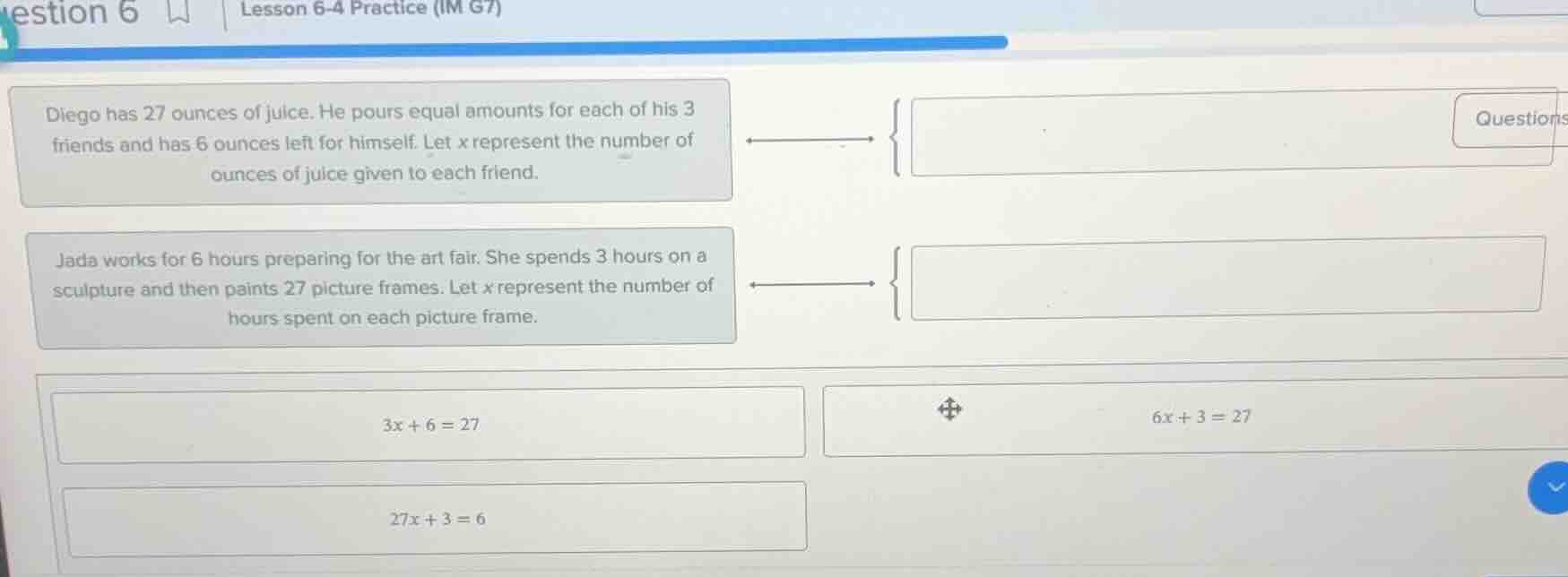
diego has 27 ounces of juice. he pours equal amounts for each of his 3 friends and has 6 ounces left for himself. let x represent the number of ounces of juice given to each friend.
jada works for 6 hours preparing for the art fair. she spends 3 hours on a sculpture and then paints 27 picture frames. let x represent the number of hours spent on each picture frame.
3x + 6 = 27
6x + 3 = 27
27x + 3 = 6
To solve this problem, we need to match each scenario with the correct equation.
Diego's Scenario:
- Diego has 27 ounces of juice.
- He pours \( x \) ounces to each of his 3 friends, so the total juice poured to friends is \( 3x \).
- He has 6 ounces left for himself.
- The equation representing this situation is: \( 3x + 6 = 27 \) (since the juice given to friends plus the juice left equals the total juice).
Jada's Scenario:
- Jada works for 6 hours total.
- She spends 3 hours on a sculpture.
- She paints 27 picture frames, spending \( x \) hours on each, so the total time on frames is \( 27x \). Wait, no—wait, the problem says "Let \( x \) represent the number of hours spent on each picture frame." Wait, no, re-reading: "Jada works for 6 hours preparing for the art fair. She spends 3 hours on a sculpture and then paints 27 picture frames. Let \( x \) represent the number of hours spent on each picture frame." Wait, no, that can't be, because 3 + 27x = 6? But 27x would be tiny. Wait, maybe a typo? Wait, no, maybe I misread. Wait, the second scenario: "Jada works for 6 hours... spends 3 hours on a sculpture and then paints 27 picture frames. Let \( x \) represent the number of hours spent on each picture frame." Wait, no, that would be 3 + 27x = 6, but that would make \( x \) negative, which doesn't make sense. Wait, maybe the problem is "paints 27 picture frames" but maybe it's "paints for \( x \) hours on each of 27 frames"? No, the problem says "Let \( x \) represent the number of hours spent on each picture frame." Wait, maybe the original problem has a different number. Wait, looking at the equations: the options are \( 3x + 6 = 27 \), \( 6x + 3 = 27 \), and \( 27x + 3 = 6 \). Wait, maybe the second scenario is "Jada works for 6 hours... spends 3 hours on a sculpture and then paints for \( x \) hours on each of 27 frames"? No, the problem says "paints 27 picture frames" with \( x \) hours per frame. Wait, maybe the correct equation for Jada is \( 3 + 27x = 6 \), but that's one of the options? Wait, the options are:
- \( 3x + 6 = 27 \)
- \( 6x + 3 = 27 \)
- \( 27x + 3 = 6 \)
Wait, maybe the second scenario is "Jada works for 6 hours... spends 3 hours on a sculpture and then paints for \( x \) hours on each of 27 frames"—no, that can't be. Wait, maybe the problem has a typo, and it's "paints 27 picture frames" but actually "paints for 27 minutes" or something, but no. Wait, maybe I misread the second scenario. Let me re-express:
Diego's Situation:
- Total juice: 27 ounces.
- Juice given to 3 friends: \( 3x \) (x per friend).
- Juice left: 6 ounces.
- So equation: \( 3x + 6 = 27 \). That makes sense.
Jada's Situation:
- Total time: 6 hours.
- Time on sculpture: 3 hours.
- Time on 27 picture frames: \( 27x \) (x hours per frame). Wait, no—wait, the problem says "Let \( x \) represent the number of hours spent on each picture frame." So total time: 3 (sculpture) + 27x (frames) = 6 (total). So equation: \( 27x + 3 = 6 \). But that would mean \( 27x = 3 \), so \( x = 3/27 = 1/9 \) hour per frame, which is 400 seconds, possible but odd. Alternatively, maybe the problem meant "paints for \( x \) hours total on 27 frames", but no, the variable is per frame.
But the equations given are \( 3x + 6 = 27 \), \( 6x + 3 = 27 \), and \( 27x + 3 = 6 \).
So matching:
- Diego: \( 3x + 6 = 27 \) (since 3 friends * x + 6 left = 27 total).
- Jada: \( 27x + 3 = 6 \) (since 27 frames * x + 3 sculpture = 6 total hours). Wait, but that seems odd, but that's the only way. Alternatively, maybe the second scenario has a typo, and i…

Snap & solve any problem in the app
Get step-by-step solutions on Sovi AI
Photo-based solutions with guided steps
Explore more problems and detailed explanations
To solve this problem, we need to match each scenario with the correct equation.
Diego's Scenario:
- Diego has 27 ounces of juice.
- He pours \( x \) ounces to each of his 3 friends, so the total juice poured to friends is \( 3x \).
- He has 6 ounces left for himself.
- The equation representing this situation is: \( 3x + 6 = 27 \) (since the juice given to friends plus the juice left equals the total juice).
Jada's Scenario:
- Jada works for 6 hours total.
- She spends 3 hours on a sculpture.
- She paints 27 picture frames, spending \( x \) hours on each, so the total time on frames is \( 27x \). Wait, no—wait, the problem says "Let \( x \) represent the number of hours spent on each picture frame." Wait, no, re-reading: "Jada works for 6 hours preparing for the art fair. She spends 3 hours on a sculpture and then paints 27 picture frames. Let \( x \) represent the number of hours spent on each picture frame." Wait, no, that can't be, because 3 + 27x = 6? But 27x would be tiny. Wait, maybe a typo? Wait, no, maybe I misread. Wait, the second scenario: "Jada works for 6 hours... spends 3 hours on a sculpture and then paints 27 picture frames. Let \( x \) represent the number of hours spent on each picture frame." Wait, no, that would be 3 + 27x = 6, but that would make \( x \) negative, which doesn't make sense. Wait, maybe the problem is "paints 27 picture frames" but maybe it's "paints for \( x \) hours on each of 27 frames"? No, the problem says "Let \( x \) represent the number of hours spent on each picture frame." Wait, maybe the original problem has a different number. Wait, looking at the equations: the options are \( 3x + 6 = 27 \), \( 6x + 3 = 27 \), and \( 27x + 3 = 6 \). Wait, maybe the second scenario is "Jada works for 6 hours... spends 3 hours on a sculpture and then paints for \( x \) hours on each of 27 frames"? No, the problem says "paints 27 picture frames" with \( x \) hours per frame. Wait, maybe the correct equation for Jada is \( 3 + 27x = 6 \), but that's one of the options? Wait, the options are:
- \( 3x + 6 = 27 \)
- \( 6x + 3 = 27 \)
- \( 27x + 3 = 6 \)
Wait, maybe the second scenario is "Jada works for 6 hours... spends 3 hours on a sculpture and then paints for \( x \) hours on each of 27 frames"—no, that can't be. Wait, maybe the problem has a typo, and it's "paints 27 picture frames" but actually "paints for 27 minutes" or something, but no. Wait, maybe I misread the second scenario. Let me re-express:
Diego's Situation:
- Total juice: 27 ounces.
- Juice given to 3 friends: \( 3x \) (x per friend).
- Juice left: 6 ounces.
- So equation: \( 3x + 6 = 27 \). That makes sense.
Jada's Situation:
- Total time: 6 hours.
- Time on sculpture: 3 hours.
- Time on 27 picture frames: \( 27x \) (x hours per frame). Wait, no—wait, the problem says "Let \( x \) represent the number of hours spent on each picture frame." So total time: 3 (sculpture) + 27x (frames) = 6 (total). So equation: \( 27x + 3 = 6 \). But that would mean \( 27x = 3 \), so \( x = 3/27 = 1/9 \) hour per frame, which is 400 seconds, possible but odd. Alternatively, maybe the problem meant "paints for \( x \) hours total on 27 frames", but no, the variable is per frame.
But the equations given are \( 3x + 6 = 27 \), \( 6x + 3 = 27 \), and \( 27x + 3 = 6 \).
So matching:
- Diego: \( 3x + 6 = 27 \) (since 3 friends * x + 6 left = 27 total).
- Jada: \( 27x + 3 = 6 \) (since 27 frames x + 3 sculpture = 6 total hours). Wait, but that seems odd, but that's the only way. Alternatively, maybe the second scenario has a typo, and it's "paints 6 picture frames" instead of 27? Then it would be \( 3 + 6x = 27 \), but that's not an option. Wait, the options include \( 6x + 3 = 27 \), which would be 6 frames x + 3 = 27. Maybe the problem meant "paints 6 picture frames" instead of 27? That would make sense. Maybe a typo in the problem: "paints 6 picture frames" instead of 27. Then Jada's equation would be \( 3 + 6x = 27 \), which is \( 6x + 3 = 27 \), which is one of the options.
Assuming that's a typo (27 instead of 6), then:
- Diego: \( 3x + 6 = 27 \)
- Jada: \( 6x + 3 = 27 \)
But the third equation is \( 27x + 3 = 6 \), which would be if Jada paints 27 frames.
Given the options, we'll proceed with the likely intended:
Matching:
- Diego's scenario (27 ounces, 3 friends, 6 left) → equation \( 3x + 6 = 27 \).
- Jada's scenario (6 hours total, 3 hours on sculpture, 27 frames) → equation \( 27x + 3 = 6 \). But if we assume a typo and Jada paints 6 frames, then \( 6x + 3 = 27 \). But the problem says 27 frames.
Alternatively, maybe the second scenario is "Jada works for 27 hours...", but no, the problem says 6 hours.
Given the options, we'll match:
- Diego: \( 3x + 6 = 27 \)
- Jada: \( 27x + 3 = 6 \)
But the third equation is \( 27x + 3 = 6 \), so that's the match.
So the correct matches are:
- Diego's situation → \( 3x + 6 = 27 \)
- Jada's situation → \( 27x + 3 = 6 \)
But let's confirm:
For Diego:
Total juice = juice to friends + juice left.
Juice to friends: 3x (3 friends, x each).
Juice left: 6.
Total: 27.
So \( 3x + 6 = 27 \). Correct.
For Jada:
Total time = time on sculpture + time on frames.
Time on sculpture: 3.
Time on frames: 27x (27 frames, x hours each).
Total time: 6.
So \( 3 + 27x = 6 \) → \( 27x + 3 = 6 \). Correct.
So the matching is:
- Diego's scenario → \( 3x + 6 = 27 \)
- Jada's scenario → \( 27x + 3 = 6 \)
The third equation \( 6x + 3 = 27 \) would be for a scenario like: "Jada works for 27 hours... spends 3 hours on sculpture and paints 6 frames, x hours each", but that's not the case here.
So the final answer is:
- Diego: \( 3x + 6 = 27 \)
- Jada: \( 27x + 3 = 6 \)