QUESTION IMAGE
Question
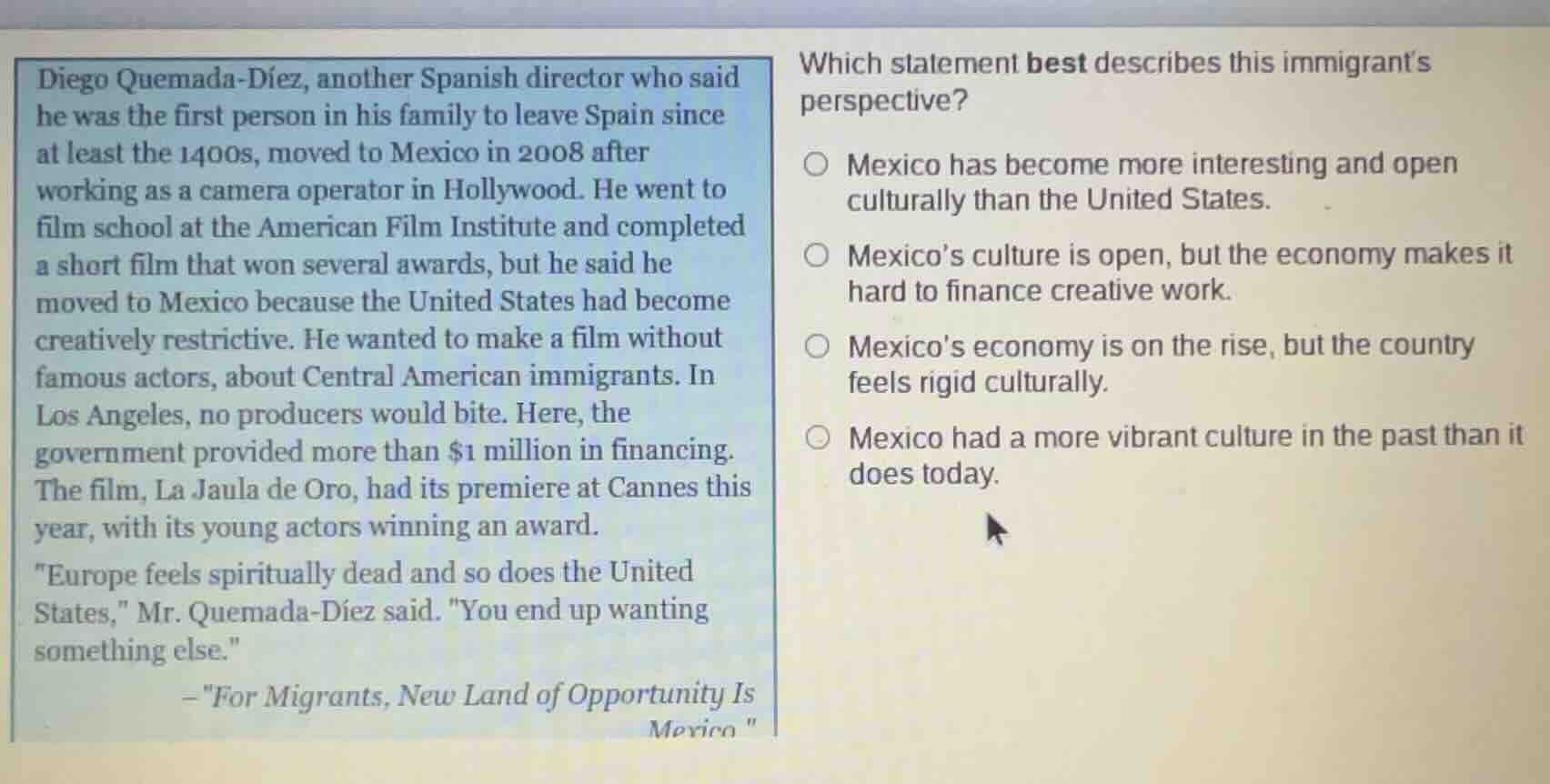
diego quemada-díez, another spanish director who said he was the first person in his family to leave spain since at least the 1400s, moved to mexico in 2008 after working as a camera operator in hollywood. he went to film school at the american film institute and completed a short film that won several awards, but he said he moved to mexico because the united states had become creatively restrictive. he wanted to make a film without famous actors, about central american immigrants. in los angeles, no producers would bite. here, the government provided more than $1 million in financing. the film, la jaula de oro, had its premiere at cannes this year, with its young actors winning an award. \europe feels spiritually dead and so does the united states,\ mr. quemada-díez said. \you end up wanting something else.\ - \for migrants, new land of opportunity is mexico\ which statement best describes this immigrant’s perspective? mexico has become more interesting and open culturally than the united states. mexico’s culture is open, but the economy makes it hard to finance creative work. mexico’s economy is on the rise, but the country feels rigid culturally. mexico had a more vibrant culture in the past than it does today.
- Analyze Option 1: The passage doesn't compare Mexico's and the US's cultural openness directly in terms of "more interesting and open" in this context, and the main issue for him was creative restrictions and financing, not just cultural comparison. Eliminate.
- Analyze Option 2: The text says he moved to Mexico because the US was creatively restrictive, and in Mexico, the government provided financing (implying US economy made financing creative work hard, while Mexico's culture allowed his creative vision as he could make a film without famous actors, showing cultural openness). This matches.
- Analyze Option 3: The passage shows Mexico was open culturally (he could pursue his creative project) and had financing support, so "culturally rigid" is wrong. Eliminate.
- Analyze Option 4: The passage focuses on his current view of Mexico as a place for creative work, not a comparison of Mexico's past and present culture. Eliminate.

Snap & solve any problem in the app
Get step-by-step solutions on Sovi AI
Photo-based solutions with guided steps
Explore more problems and detailed explanations
B. Mexico’s culture is open, but the economy makes it hard to finance creative work.