QUESTION IMAGE
Question
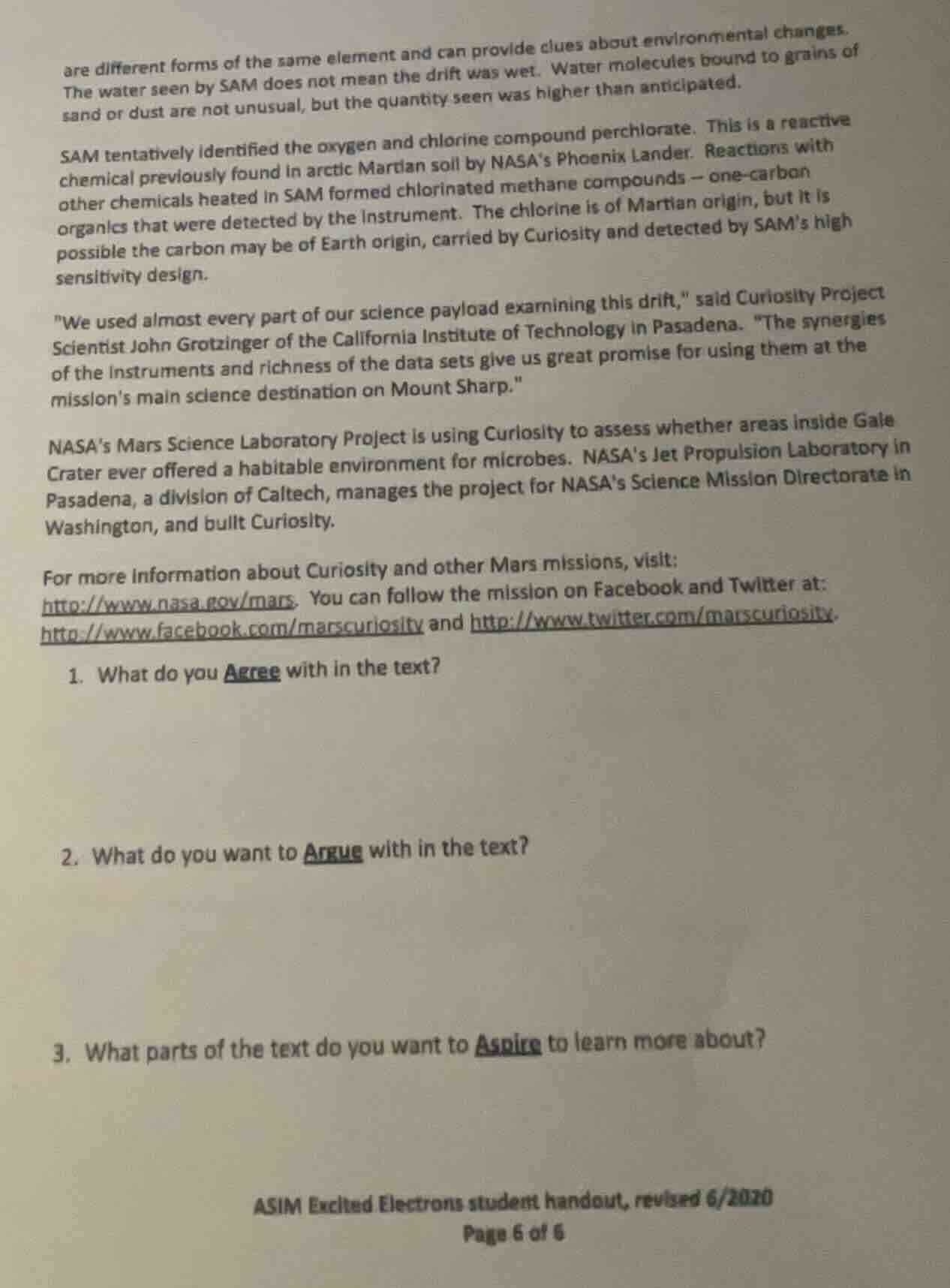
are different forms of the same element and can provide clues about environmental changes. the water seen by sam does not mean the drift was wet. water molecules bound to grains of sand or dust are not unusual, but the quantity seen was higher than anticipated. sam tentatively identified the oxygen and chlorine compound perchlorate. this is a reactive chemical previously found in arctic martian soil by nasa’s phoenix lander. reactions with other chemicals heated in sam formed chlorinated methane compounds — one - carbon organics that were detected by the instrument. the chlorine is of martian origin, but it is possible the carbon may be of earth origin, carried by curiosity and detected by sam’s high sensitivity design. \we used almost every part of our science payload examining this drift,\ said curiosity project scientist john grotzinger of the california institute of technology in pasadena. \the synergies of the instruments and richness of the data sets give us great promise for using them at the mission’s main science destination on mount sharp.\ nasa’s mars science laboratory project is using curiosity to assess whether areas inside gale crater ever offered a habitable environment for microbes. nasa’s jet propulsion laboratory in pasadena, a division of caltech, manages the project for nasa’s science mission directorate in washington, and built curiosity. for more information about curiosity and other mars missions, visit: http://www.nasa.gov/mars. you can follow the mission on facebook and twitter at: http://www.facebook.com/marscuriosity and http://www.twitter.com/marscuriosity. 1. what do you agree with in the text? 2. what do you want to argue with in the text? 3. what parts of the text do you want to aspire to learn more about? asim excited electrons student handout, revised 6/2020 page 6 of 6
1. What do you Agree with in the text?
The text presents scientific findings from NASA's Curiosity mission, like the identification of perchlorate and the use of multiple instruments for analysis. These are based on scientific research and mission data, so agreeing with the use of comprehensive scientific payloads (like SAM) to study Martian soil and the mission's goal to assess habitability is reasonable, as such methods follow scientific exploration protocols.
The text states that the carbon in detected compounds "may be of Earth origin, carried by Curiosity". This is a speculative claim without strong evidence. Arguing here could be about the lack of concrete proof for this origin of carbon—there's no detailed explanation of how carbon from Earth would be carried by Curiosity and end up in Martian soil samples, so the claim's basis is weak.
The text mentions reactions with perchlorate and other chemicals forming chlorinated methane compounds, and the possible Earth - origin of carbon. Aspiring to learn more could be about the specific chemical reactions involving perchlorate (how exactly it reacts with other chemicals to form chlorinated methane), and more details on how carbon could be carried by Curiosity (if it is from Earth) and the methods to confirm the origin of carbon (Earth or Martian). Also, learning about the long - term implications of finding such chemicals for the habitability of Mars would be interesting.

Snap & solve any problem in the app
Get step-by-step solutions on Sovi AI
Photo-based solutions with guided steps
Explore more problems and detailed explanations
I agree with the idea that using almost every part of the science payload (like SAM) to examine the Martian drift is a good approach for thorough scientific exploration, and that the mission's goal to assess if Gale Crater was habitable for microbes is a valid scientific objective. Also, the detection of chemicals (like perchlorate and chlorinated methane compounds) through scientific instruments follows proper scientific research methods.