QUESTION IMAGE
Question
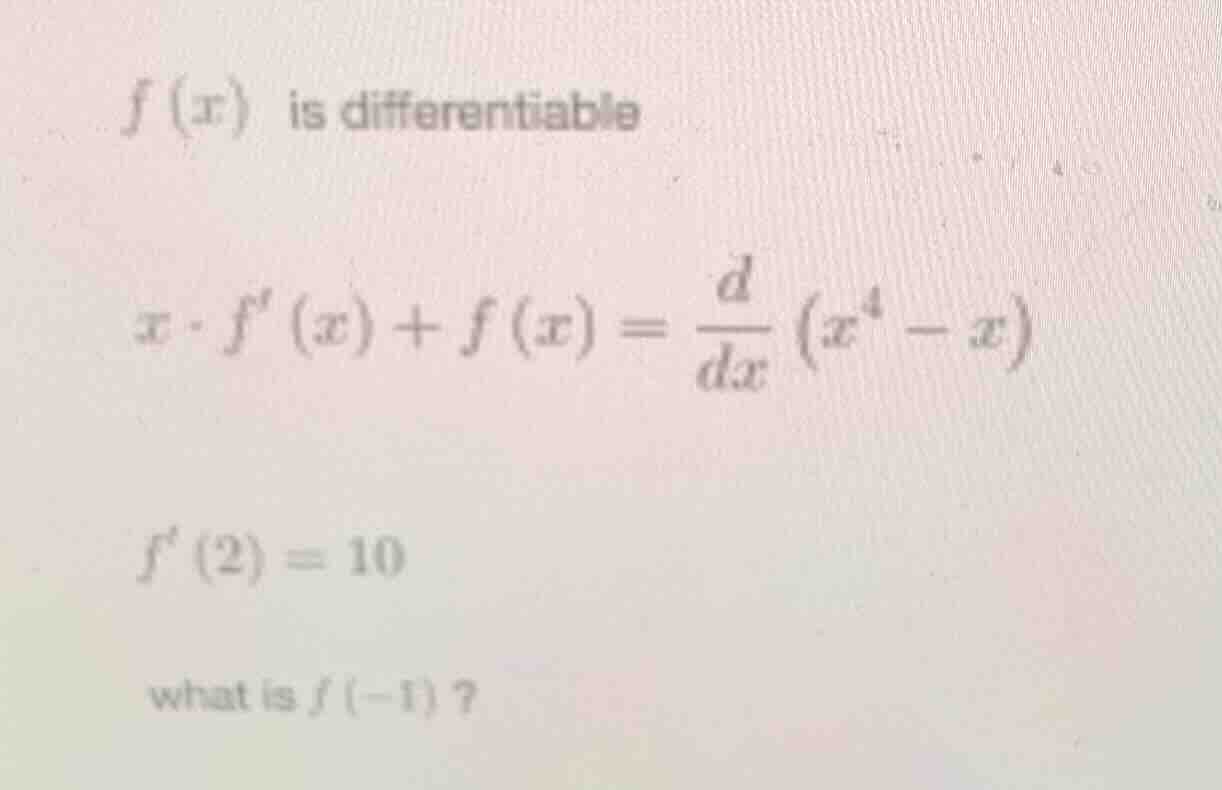
f(x) is differentiable
x·f(x) + f(x) = \frac{d}{dx}(x^4 - x)
f(2) = 10
what is f(-1)?
Step1: Recognize the left - hand side as a product rule
We know that the product rule of differentiation states that \(\frac{d}{dx}(u(x)v(x))=u^{\prime}(x)v(x)+u(x)v^{\prime}(x)\). Notice that the left - hand side of the equation \(x\cdot f^{\prime}(x)+f(x)\) can be written as \(\frac{d}{dx}(x\cdot f(x))\) because if we let \(u(x) = x\) and \(v(x)=f(x)\), then \(\frac{d}{dx}(x\cdot f(x))=x\cdot f^{\prime}(x)+1\cdot f(x)=x\cdot f^{\prime}(x)+f(x)\).
The right - hand side is \(\frac{d}{dx}(x^{4}-x)\). Using the power rule \(\frac{d}{dx}(x^{n})=nx^{n - 1}\), we have \(\frac{d}{dx}(x^{4}-x)=4x^{3}-1\).
So our equation becomes \(\frac{d}{dx}(x\cdot f(x))=4x^{3}-1\).
Step2: Integrate both sides with respect to \(x\)
Integrating the left - hand side \(\int\frac{d}{dx}(x\cdot f(x))dx=x\cdot f(x)+C_1\) (by the fundamental theorem of calculus, the integral of a derivative is the original function).
Integrating the right - hand side \(\int(4x^{3}-1)dx\). Using the power rule for integration \(\int x^{n}dx=\frac{x^{n + 1}}{n+1}+C\) (\(n
eq - 1\)), we get \(\int(4x^{3}-1)dx = 4\cdot\frac{x^{4}}{4}-x+C=x^{4}-x + C\).
So we have \(x\cdot f(x)=x^{4}-x + C\).
Step3: Solve for \(f(x)\)
Divide both sides of the equation \(x\cdot f(x)=x^{4}-x + C\) by \(x\) (for \(x
eq0\)): \(f(x)=x^{3}-1+\frac{C}{x}\).
Step4: Find the value of \(C\) using \(f^{\prime}(2) = 10\)
First, find the derivative of \(f(x)\). If \(f(x)=x^{3}-1+\frac{C}{x}=x^{3}-1 + Cx^{-1}\), then \(f^{\prime}(x)=3x^{2}-Cx^{-2}=3x^{2}-\frac{C}{x^{2}}\).
We know that \(f^{\prime}(2) = 10\). Substitute \(x = 2\) into \(f^{\prime}(x)\):
\(f^{\prime}(2)=3(2)^{2}-\frac{C}{(2)^{2}}=12-\frac{C}{4}\)
Since \(f^{\prime}(2) = 10\), we set up the equation \(12-\frac{C}{4}=10\).
Subtract 12 from both sides: \(-\frac{C}{4}=10 - 12=-2\).
Multiply both sides by \(- 4\): \(C = 8\).
Step5: Find the function \(f(x)\)
Now that we know \(C = 8\), our function \(f(x)=x^{3}-1+\frac{8}{x}\) (for \(x
eq0\)).
Step6: Evaluate \(f(-1)\)
Substitute \(x=-1\) into \(f(x)\):
\(f(-1)=(-1)^{3}-1+\frac{8}{-1}=-1 - 1-8=-10\)

Snap & solve any problem in the app
Get step-by-step solutions on Sovi AI
Photo-based solutions with guided steps
Explore more problems and detailed explanations
\(f(-1)=-10\)