QUESTION IMAGE
Question
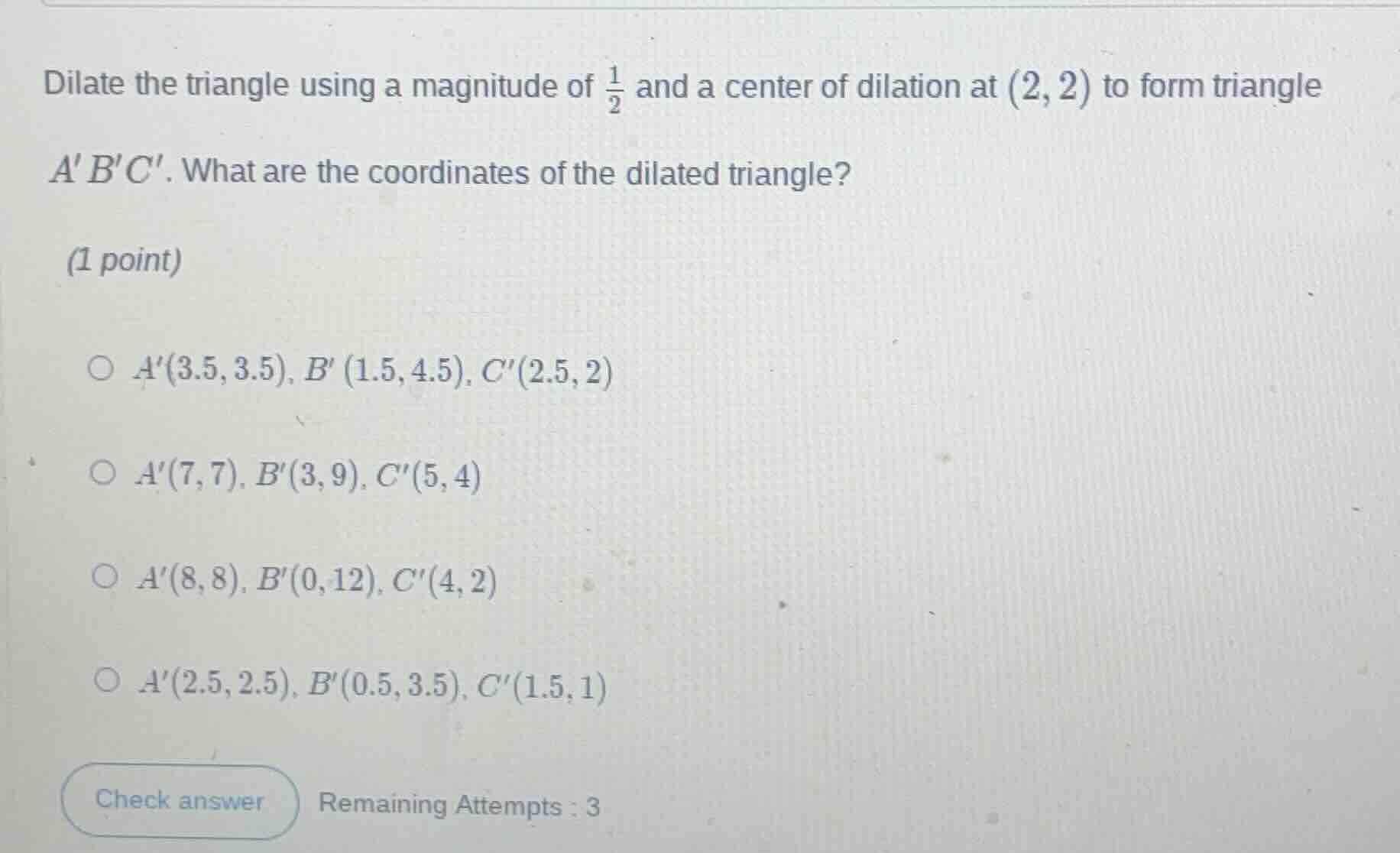
dilate the triangle using a magnitude of \\(\frac{1}{2}\\) and a center of dilation at \\((2, 2)\\) to form triangle \\(abc\\). what are the coordinates of the dilated triangle? (1 point) \\(\circ\\) \\(a(3.5, 3.5), b(1.5, 4.5), c(2.5, 2)\\) \\(\circ\\) \\(a(7, 7), b(3, 9), c(5, 4)\\) \\(\circ\\) \\(a(8, 8), b(0, 12), c(4, 2)\\) \\(\circ\\) \\(a(2.5, 2.5), b(0.5, 3.5), c(1.5, 1)\\) check answer remaining attempts : 3
To solve the problem of dilating a triangle with a scale factor of \(\frac{1}{2}\) and center of dilation at \((2, 2)\), we need to know the original coordinates of the triangle \(ABC\). However, since the options are given, we can work backwards or analyze the options.
Key Formula for Dilation:
If the center of dilation is \((h, k)\) and the scale factor is \(r\), then the coordinates of the dilated point \((x', y')\) from the original point \((x, y)\) are given by:
\[
x' = h + r(x - h)
\]
\[
y' = k + r(y - k)
\]
Let's Analyze the Options:
We can test each option to see if it satisfies the dilation formula with \(r = \frac{1}{2}\) and \((h, k) = (2, 2)\).
Option 1: \(A'(3.5, 3.5)\), \(B'(1.5, 4.5)\), \(C'(2.5, 2)\)
Let's check for point \(A'\):
\[
x' = 2 + \frac{1}{2}(x - 2) \implies 3.5 = 2 + \frac{1}{2}(x - 2) \implies 1.5 = \frac{1}{2}(x - 2) \implies x - 2 = 3 \implies x = 5
\]
\[
y' = 2 + \frac{1}{2}(y - 2) \implies 3.5 = 2 + \frac{1}{2}(y - 2) \implies 1.5 = \frac{1}{2}(y - 2) \implies y - 2 = 3 \implies y = 5
\]
So original \(A\) would be \((5, 5)\).
For point \(B'\):
\[
x' = 2 + \frac{1}{2}(x - 2) \implies 1.5 = 2 + \frac{1}{2}(x - 2) \implies -0.5 = \frac{1}{2}(x - 2) \implies x - 2 = -1 \implies x = 1
\]
\[
y' = 2 + \frac{1}{2}(y - 2) \implies 4.5 = 2 + \frac{1}{2}(y - 2) \implies 2.5 = \frac{1}{2}(y - 2) \implies y - 2 = 5 \implies y = 7
\]
So original \(B\) would be \((1, 7)\).
For point \(C'\):
\[
x' = 2 + \frac{1}{2}(x - 2) \implies 2.5 = 2 + \frac{1}{2}(x - 2) \implies 0.5 = \frac{1}{2}(x - 2) \implies x - 2 = 1 \implies x = 3
\]
\[
y' = 2 + \frac{1}{2}(y - 2) \implies 2 = 2 + \frac{1}{2}(y - 2) \implies 0 = \frac{1}{2}(y - 2) \implies y - 2 = 0 \implies y = 2
\]
So original \(C\) would be \((3, 2)\).
Now, let's check the other options to see if they make sense.
Option 2: \(A'(7, 7)\), \(B'(3, 9)\), \(C'(5, 4)\)
Using the dilation formula:
For \(A'\):
\[
7 = 2 + \frac{1}{2}(x - 2) \implies 5 = \frac{1}{2}(x - 2) \implies x - 2 = 10 \implies x = 12
\]
\[
7 = 2 + \frac{1}{2}(y - 2) \implies 5 = \frac{1}{2}(y - 2) \implies y - 2 = 10 \implies y = 12
\]
Original \(A\) would be \((12, 12)\), which is unlikely as the dilated coordinates are larger than the center, implying a scale factor greater than 1, but we need a scale factor of \(\frac{1}{2}\). So this option is incorrect.
Option 3: \(A'(8, 8)\), \(B'(0, 12)\), \(C'(4, 2)\)
For \(A'\):
\[
8 = 2 + \frac{1}{2}(x - 2) \implies 6 = \frac{1}{2}(x - 2) \implies x - 2 = 12 \implies x = 14
\]
\[
8 = 2 + \frac{1}{2}(y - 2) \implies 6 = \frac{1}{2}(y - 2) \implies y - 2 = 12 \implies y = 14
\]
Original \(A\) would be \((14, 14)\), again implying a scale factor greater than 1. Incorrect.
Option 4: \(A'(2.5, 2.5)\), \(B'(0.5, 3.5)\), \(C'(1.5, 1)\)
For \(A'\):
\[
2.5 = 2 + \frac{1}{2}(x - 2) \implies 0.5 = \frac{1}{2}(x - 2) \implies x - 2 = 1 \implies x = 3
\]
\[
2.5 = 2 + \frac{1}{2}(y - 2) \implies 0.5 = \frac{1}{2}(y - 2) \implies y - 2 = 1 \implies y = 3
\]
Original \(A\) would be \((3, 3)\).
For \(B'\):
\[
0.5 = 2 + \frac{1}{2}(x - 2) \implies -1.5 = \frac{1}{2}(x - 2) \implies x - 2 = -3 \implies x = -1
\]
\[
3.5 = 2 + \frac{1}{2}(y - 2) \implies 1.5 = \frac{1}{2}(y - 2) \implies y - 2 = 3 \implies y = 5
\]
Original \(B\) would be \((-1, 5)\).
For \(C'\):
\[
1.5 = 2 + \frac{1}{2}(x - 2) \implies -0.5 = \frac{1}{2}(x - 2) \implies x - 2 = -1 \implies x = 1
\]
\[
1 = 2 + \frac{1}{2}(y - 2) \implies -1 = \frac{1}{2}(y - 2) \implies y - 2 = -2 \implies y = 0
\]
Original \(C\) would be \((1, 0)\).
Now, comparing the original coordinates fr…

Snap & solve any problem in the app
Get step-by-step solutions on Sovi AI
Photo-based solutions with guided steps
Explore more problems and detailed explanations
To solve the problem of dilating a triangle with a scale factor of \(\frac{1}{2}\) and center of dilation at \((2, 2)\), we need to know the original coordinates of the triangle \(ABC\). However, since the options are given, we can work backwards or analyze the options.
Key Formula for Dilation:
If the center of dilation is \((h, k)\) and the scale factor is \(r\), then the coordinates of the dilated point \((x', y')\) from the original point \((x, y)\) are given by:
\[
x' = h + r(x - h)
\]
\[
y' = k + r(y - k)
\]
Let's Analyze the Options:
We can test each option to see if it satisfies the dilation formula with \(r = \frac{1}{2}\) and \((h, k) = (2, 2)\).
Option 1: \(A'(3.5, 3.5)\), \(B'(1.5, 4.5)\), \(C'(2.5, 2)\)
Let's check for point \(A'\):
\[
x' = 2 + \frac{1}{2}(x - 2) \implies 3.5 = 2 + \frac{1}{2}(x - 2) \implies 1.5 = \frac{1}{2}(x - 2) \implies x - 2 = 3 \implies x = 5
\]
\[
y' = 2 + \frac{1}{2}(y - 2) \implies 3.5 = 2 + \frac{1}{2}(y - 2) \implies 1.5 = \frac{1}{2}(y - 2) \implies y - 2 = 3 \implies y = 5
\]
So original \(A\) would be \((5, 5)\).
For point \(B'\):
\[
x' = 2 + \frac{1}{2}(x - 2) \implies 1.5 = 2 + \frac{1}{2}(x - 2) \implies -0.5 = \frac{1}{2}(x - 2) \implies x - 2 = -1 \implies x = 1
\]
\[
y' = 2 + \frac{1}{2}(y - 2) \implies 4.5 = 2 + \frac{1}{2}(y - 2) \implies 2.5 = \frac{1}{2}(y - 2) \implies y - 2 = 5 \implies y = 7
\]
So original \(B\) would be \((1, 7)\).
For point \(C'\):
\[
x' = 2 + \frac{1}{2}(x - 2) \implies 2.5 = 2 + \frac{1}{2}(x - 2) \implies 0.5 = \frac{1}{2}(x - 2) \implies x - 2 = 1 \implies x = 3
\]
\[
y' = 2 + \frac{1}{2}(y - 2) \implies 2 = 2 + \frac{1}{2}(y - 2) \implies 0 = \frac{1}{2}(y - 2) \implies y - 2 = 0 \implies y = 2
\]
So original \(C\) would be \((3, 2)\).
Now, let's check the other options to see if they make sense.
Option 2: \(A'(7, 7)\), \(B'(3, 9)\), \(C'(5, 4)\)
Using the dilation formula:
For \(A'\):
\[
7 = 2 + \frac{1}{2}(x - 2) \implies 5 = \frac{1}{2}(x - 2) \implies x - 2 = 10 \implies x = 12
\]
\[
7 = 2 + \frac{1}{2}(y - 2) \implies 5 = \frac{1}{2}(y - 2) \implies y - 2 = 10 \implies y = 12
\]
Original \(A\) would be \((12, 12)\), which is unlikely as the dilated coordinates are larger than the center, implying a scale factor greater than 1, but we need a scale factor of \(\frac{1}{2}\). So this option is incorrect.
Option 3: \(A'(8, 8)\), \(B'(0, 12)\), \(C'(4, 2)\)
For \(A'\):
\[
8 = 2 + \frac{1}{2}(x - 2) \implies 6 = \frac{1}{2}(x - 2) \implies x - 2 = 12 \implies x = 14
\]
\[
8 = 2 + \frac{1}{2}(y - 2) \implies 6 = \frac{1}{2}(y - 2) \implies y - 2 = 12 \implies y = 14
\]
Original \(A\) would be \((14, 14)\), again implying a scale factor greater than 1. Incorrect.
Option 4: \(A'(2.5, 2.5)\), \(B'(0.5, 3.5)\), \(C'(1.5, 1)\)
For \(A'\):
\[
2.5 = 2 + \frac{1}{2}(x - 2) \implies 0.5 = \frac{1}{2}(x - 2) \implies x - 2 = 1 \implies x = 3
\]
\[
2.5 = 2 + \frac{1}{2}(y - 2) \implies 0.5 = \frac{1}{2}(y - 2) \implies y - 2 = 1 \implies y = 3
\]
Original \(A\) would be \((3, 3)\).
For \(B'\):
\[
0.5 = 2 + \frac{1}{2}(x - 2) \implies -1.5 = \frac{1}{2}(x - 2) \implies x - 2 = -3 \implies x = -1
\]
\[
3.5 = 2 + \frac{1}{2}(y - 2) \implies 1.5 = \frac{1}{2}(y - 2) \implies y - 2 = 3 \implies y = 5
\]
Original \(B\) would be \((-1, 5)\).
For \(C'\):
\[
1.5 = 2 + \frac{1}{2}(x - 2) \implies -0.5 = \frac{1}{2}(x - 2) \implies x - 2 = -1 \implies x = 1
\]
\[
1 = 2 + \frac{1}{2}(y - 2) \implies -1 = \frac{1}{2}(y - 2) \implies y - 2 = -2 \implies y = 0
\]
Original \(C\) would be \((1, 0)\).
Now, comparing the original coordinates from Option 1 (\(A(5, 5)\), \(B(1, 7)\), \(C(3, 2)\)) and Option 4 (\(A(3, 3)\), \(B(-1, 5)\), \(C(1, 0)\)), we can see that Option 1 gives more reasonable original coordinates (positive and within a reasonable range) and the dilated coordinates are closer to the center of dilation \((2, 2)\) as expected with a scale factor of \(\frac{1}{2}\).
Final Answer:
The correct option is:
\(A'(3.5, 3.5)\), \(B'(1.5, 4.5)\), \(C'(2.5, 2)\)