QUESTION IMAGE
Question
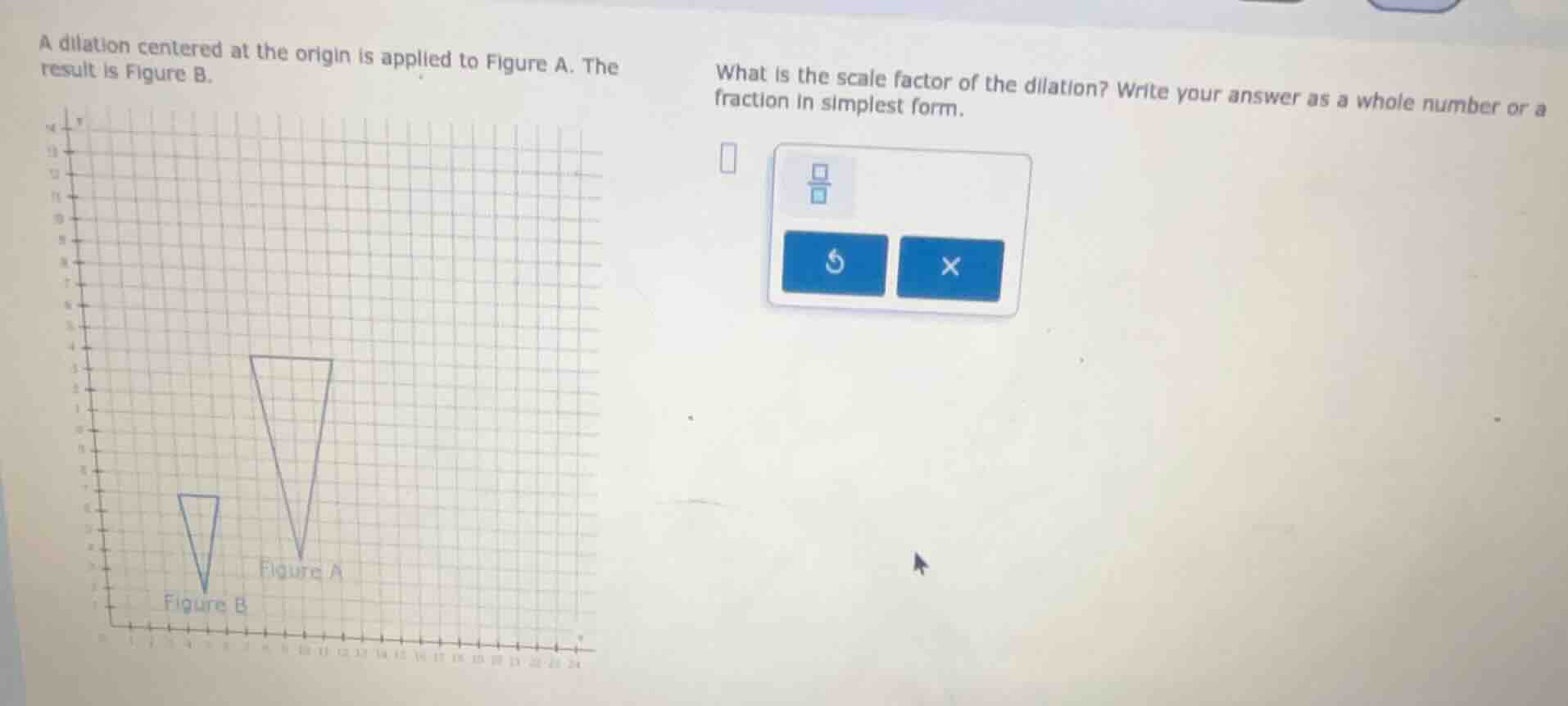
a dilation centered at the origin is applied to figure a. the result is figure b. what is the scale factor of the dilation? write your answer as a whole number or a fraction in simplest form.
Step1: Identify coordinates of a vertex
Let's take the bottom vertex of Figure A and Figure B. For Figure B, let's say the bottom vertex is at \((4, 2)\) (approximate from grid). For Figure A, the bottom vertex is at \((8, 4)\) (approximate from grid). Wait, actually, dilation scale factor \(k\) is given by \(k=\frac{\text{length of corresponding side in image (Figure B)}}{\text{length of corresponding side in pre - image (Figure A)}}\). Let's find the height of the triangles. Let's assume the height of Figure B (from bottom vertex to top) is \(h_B\) and height of Figure A is \(h_A\). From the grid, if Figure B's height is, say, 4 units (from \(y = 2\) to \(y=6\)) and Figure A's height is 8 units (from \(y = 4\) to \(y = 12\))? Wait, no, let's re - examine. Wait, maybe Figure B is the image? Wait, no, the problem says "A dilation centered at the origin is applied to Figure A. The result is Figure B." So Figure A is pre - image, Figure B is image. Wait, no, maybe I got it reversed. Wait, let's take a vertex. Let's say in Figure A, a top vertex: let's assume Figure A has a top vertex at \((8, 4)\) and Figure B has a top vertex at \((4, 2)\). Wait, no, let's count the grid squares. Let's take the base of the triangle. Suppose in Figure A, the base length is, say, 4 units (from \(x = 6\) to \(x = 10\), so length \(10 - 6=4\)) and in Figure B, the base length is 2 units (from \(x = 3\) to \(x = 5\), length \(5 - 3 = 2\)). Wait, no, maybe better to take the distance from the origin? Wait, dilation centered at origin, so the scale factor \(k\) is \(k=\frac{\text{coordinate of image point}}{\text{coordinate of pre - image point}}\) for corresponding points. Let's take a vertex of Figure A, say \((8, 4)\) (pre - image) and the corresponding vertex of Figure B, say \((4, 2)\) (image). Then \(k=\frac{4}{8}=\frac{1}{2}\)? Wait, no, wait: if dilation is from Figure A to Figure B, then \(k=\frac{\text{image coordinate}}{\text{pre - image coordinate}}\). Wait, let's check the height. Let's say the height of Figure A (from bottom vertex to top) is \(h_A\) and height of Figure B is \(h_B\). If Figure A's bottom vertex is at \((8, 2)\) and top vertex at \((8, 10)\), so height \(h_A=10 - 2 = 8\). Figure B's bottom vertex is at \((4, 2)\) and top vertex at \((4, 6)\), so height \(h_B=6 - 2=4\). Then scale factor \(k=\frac{h_B}{h_A}=\frac{4}{8}=\frac{1}{2}\)? Wait, no, wait the problem says "A dilation centered at the origin is applied to Figure A. The result is Figure B." So Figure A is pre - image, Figure B is image. So scale factor \(k=\frac{\text{length of Figure B}}{\text{length of Figure A}}\). Wait, but maybe I had it reversed. Wait, let's take a point. Let's say in Figure A, a vertex is at \((8, 4)\) and in Figure B, the corresponding vertex is at \((4, 2)\). Then \(k=\frac{4}{8}=\frac{1}{2}\)? Wait, no, if Figure A is pre - image, Figure B is image, then \(k=\frac{\text{image coordinate}}{\text{pre - image coordinate}}\). So for \(x\) - coordinate: \(x_B=k\times x_A\), \(y_B = k\times y_A\). So if \(x_A = 8\), \(x_B = 4\), then \(k=\frac{x_B}{x_A}=\frac{4}{8}=\frac{1}{2}\). Similarly for \(y\) - coordinate: \(y_A = 4\), \(y_B = 2\), \(k=\frac{y_B}{y_A}=\frac{2}{4}=\frac{1}{2}\). So the scale factor is \(\frac{1}{2}\)? Wait, no, wait maybe Figure A is larger and Figure B is smaller, so scale factor less than 1. Wait, let's confirm. Let's take the height of the triangle. Suppose Figure A has height \(h_A\) and Figure B has height \(h_B\). If Figure A's height is, say, 8 units (from \(y = 2\) to \(y = 10\)) and Figure B's height is 4 units (from…

Snap & solve any problem in the app
Get step-by-step solutions on Sovi AI
Photo-based solutions with guided steps
Explore more problems and detailed explanations
\(\frac{1}{2}\)