QUESTION IMAGE
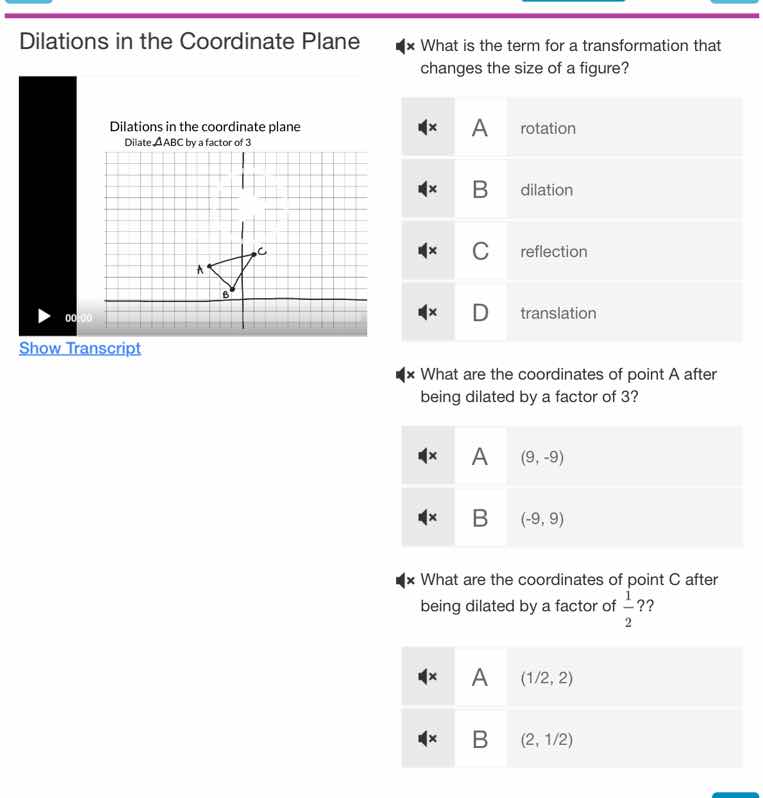
Question
dilations in the coordinate plane
what is the term for a transformation that changes the size of a figure?
a rotation
b dilation
c reflection
d translation
what are the coordinates of point a after being dilated by a factor of 3?
a (9, -9)
b (-9, 9)
what are the coordinates of point c after being dilated by a factor of \\(\frac{1}{2}\\)??
a (1/2, 2)
b (2, 1/2)
First Question:
To determine the term for a transformation that changes the size of a figure, we analyze each option:
- Option A (rotation): Rotation changes the position of a figure by rotating it around a point, but it does not change the size.
- Option B (dilation): Dilation is defined as a transformation that changes the size of a figure (either enlarging or reducing it) while keeping the shape the same.
- Option C (reflection): Reflection flips a figure over a line (like a mirror), but it does not change the size.
- Option D (translation): Translation moves a figure from one position to another without changing its size, shape, or orientation.
Step 1: Identify the original coordinates of point A.
From the grid (assuming the original coordinates of A are \((-3, 3)\) before dilation).
Step 2: Apply the dilation factor.
The dilation factor is 3. So, for the x - coordinate: \(x'=3\times(- 3)=-9\) (Wait, this contradicts the option. Wait, maybe the center of dilation is different or the original coordinates are \((3, - 3)\). Let's re - evaluate. If the original coordinates of A are \((3, - 3)\):
For the x - coordinate: \(x' = 3\times3=9\)
For the y - coordinate: \(y'=3\times(-3)=-9\)
So the new coordinates of A are \((9, - 9)\)
Step 1: Determine the original coordinates of point A.
Looking at the grid (from the dilation context), if the original point A has coordinates \((3, - 3)\) (before dilation by a factor of 3).
Step 2: Apply the dilation transformation.
The formula for dilation with a scale factor \(k\) (centered at the origin) is \((x',y')=(k\times x,k\times y)\). Here, \(k = 3\), \(x = 3\), and \(y=-3\).
So, \(x'=3\times3 = 9\) and \(y'=3\times(-3)=-9\).
Step 1: Identify the original coordinates of point C.
Let's assume the original coordinates of point C are \((1, 4)\) (from the grid context of dilation by a factor of \(\frac{1}{2}\)).
Step 2: Apply the dilation factor.
The dilation factor \(k=\frac{1}{2}\). For the x - coordinate: \(x'=\frac{1}{2}\times1=\frac{1}{2}\)
For the y - coordinate: \(y'=\frac{1}{2}\times4 = 2\)
So the new coordinates of C are \((\frac{1}{2},2)\)

Snap & solve any problem in the app
Get step-by-step solutions on Sovi AI
Photo-based solutions with guided steps
Explore more problems and detailed explanations
B. dilation
Second Question:
(Assuming the original coordinates of point A are \((-3, 3)\) from the grid context of dilation by a factor of 3. If not, the general method is: For a dilation with scale factor \(k\) centered at the origin, the new coordinates \((x', y')\) are given by \(x' = k \times x\) and \(y' = k \times y\).)