QUESTION IMAGE
Question
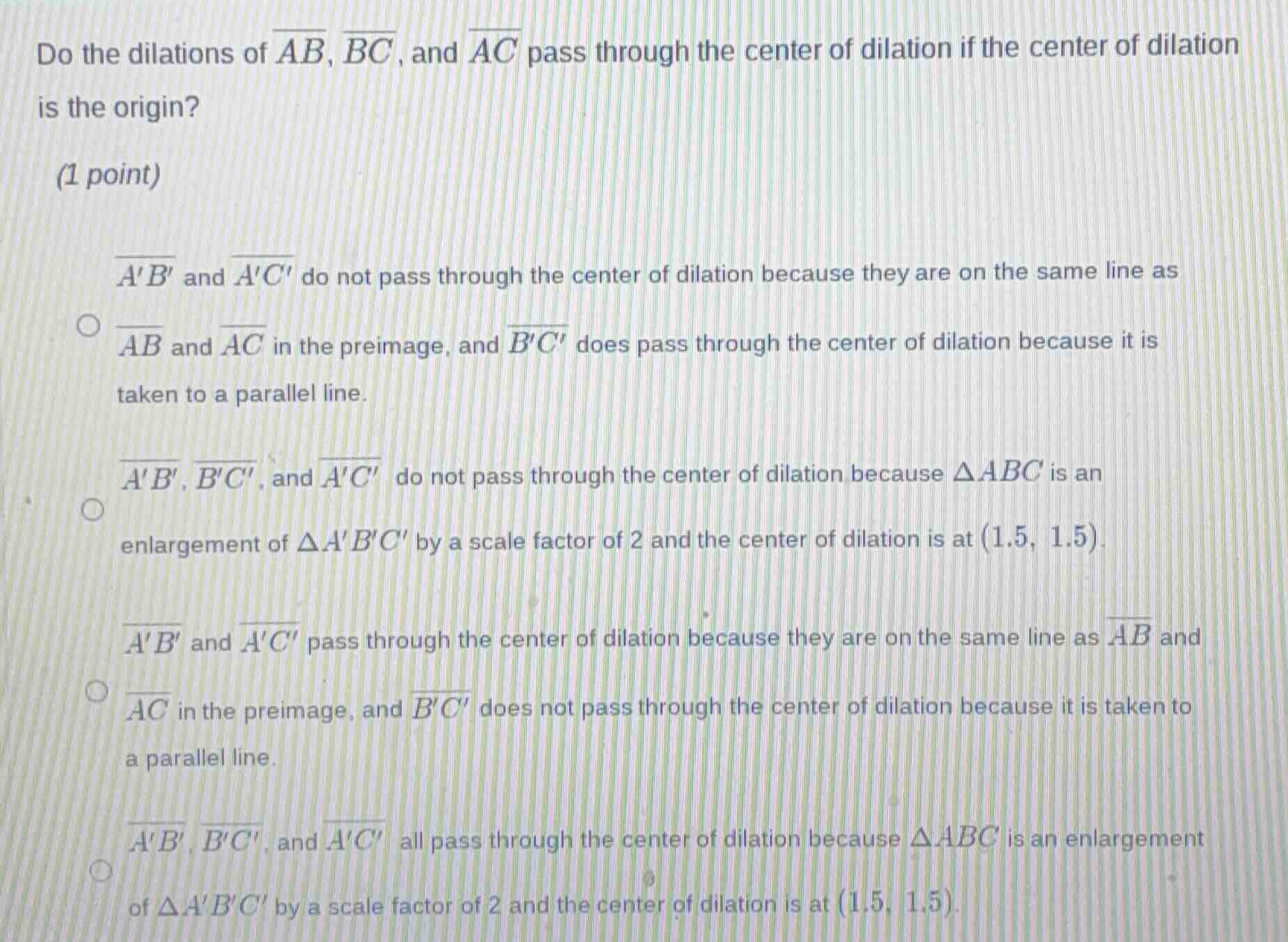
do the dilations of \\(\overline{ab}\\), \\(\overline{bc}\\), and \\(\overline{ac}\\) pass through the center of dilation if the center of dilation is the origin?
(1 point)
\\(\overline{ab}\\) and \\(\overline{ac}\\) do not pass through the center of dilation because they are on the same line as \\(\overline{ab}\\) and \\(\overline{ac}\\) in the preimage, and \\(\overline{bc}\\) does pass through the center of dilation because it is taken to a parallel line.
\\(\overline{ab}\\), \\(\overline{bc}\\), and \\(\overline{ac}\\) do not pass through the center of dilation because \\(\triangle abc\\) is an enlargement of \\(\triangle abc\\) by a scale factor of 2 and the center of dilation is at \\((1.5, 1.5)\\).
\\(\overline{ab}\\) and \\(\overline{ac}\\) pass through the center of dilation because they are on the same line as \\(\overline{ab}\\) and \\(\overline{ac}\\) in the preimage, and \\(\overline{bc}\\) does not pass through the center of dilation because it is taken to a parallel line.
\\(\overline{ab}\\), \\(\overline{bc}\\), and \\(\overline{ac}\\) all pass through the center of dilation because \\(\triangle abc\\) is an enlargement of \\(\triangle abc\\) by a scale factor of 2 and the center of dilation is at \\((1.5, 1.5)\\).
To determine the correct answer, we analyze the properties of dilation. When a figure is dilated with the center of dilation at the origin (or any point), the lines containing the pre - image segments and their image segments are collinear with the center of dilation if the pre - image segment passes through the center. For a segment like $\overline{AB}$ and its image $\overline{A'B'}$, if $\overline{AB}$ passes through the center of dilation, then $\overline{A'B'}$ also passes through the center. However, for a segment like $\overline{BC}$ and its image $\overline{B'C'}$, if $\overline{BC}$ is not passing through the center, then $\overline{B'C'}$ is parallel to $\overline{BC}$ and does not pass through the center.
Let's analyze each option:
- Option 1: Incorrect. If $\overline{AB}$ and $\overline{AC}$ pass through the center, their images $\overline{A'B'}$ and $\overline{A'C'}$ should pass through the center. Also, the reasoning about $\overline{B'C'}$ is wrong.
- Option 2: Incorrect. The center of dilation is given as the origin in the question, not (1.5, 1.5). Also, the statement about the segments not passing through the center is wrong based on dilation properties.
- Option 3: Correct. If $\overline{AB}$ and $\overline{AC}$ pass through the center of dilation (the origin), then their images $\overline{A'B'}$ and $\overline{A'C'}$ will also pass through the center (since dilation preserves collinearity with the center for segments passing through the center). And since $\overline{BC}$ does not pass through the center, its image $\overline{B'C'}$ is parallel to $\overline{BC}$ and does not pass through the center.
- Option 4: Incorrect. The center of dilation is the origin, not (1.5, 1.5) as stated in this option. Also, not all segments will pass through the center.

Snap & solve any problem in the app
Get step-by-step solutions on Sovi AI
Photo-based solutions with guided steps
Explore more problems and detailed explanations
The correct option is: $\boldsymbol{\overline{A'B'}}$ and $\overline{A'C'}$ pass through the center of dilation because they are on the same line as $\overline{AB}$ and $\overline{AC}$ in the preimage, and $\overline{B'C'}$ does not pass through the center of dilation because it is taken to a parallel line.