QUESTION IMAGE
Question
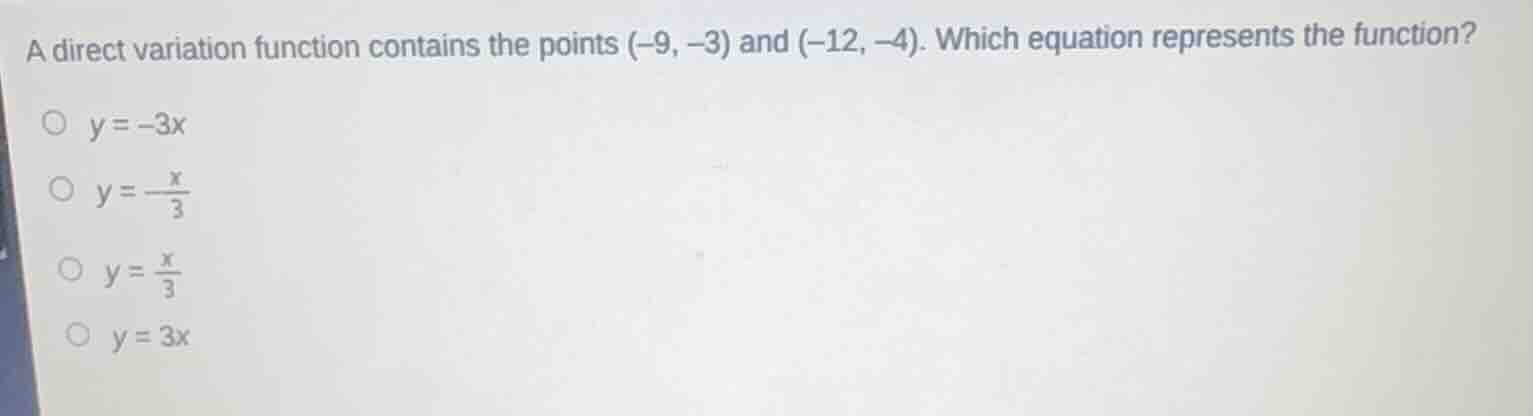
a direct variation function contains the points (-9, -3) and (-12, -4). which equation represents the function?
○ $y = -3x$
○ $y = \frac{x}{3}$
○ $y = \frac{x}{3}$
○ $y = 3x$
Step1: Recall direct variation formula
The formula for direct variation is \( y = kx \), where \( k \) is the constant of variation. We can find \( k \) by using the given points.
Step2: Calculate \( k \) using the first point \((-9, -3)\)
Substitute \( x = -9 \) and \( y = -3 \) into \( y = kx \):
\( -3 = k(-9) \)
Solve for \( k \):
\( k=\frac{-3}{-9}=\frac{1}{3} \)
Step3: Verify with the second point \((-12, -4)\)
Substitute \( x = -12 \) and \( k=\frac{1}{3} \) into \( y = kx \):
\( y=\frac{1}{3}(-12)= -4 \), which matches the \( y \)-value of the second point. So the equation is \( y=\frac{x}{3} \).

Snap & solve any problem in the app
Get step-by-step solutions on Sovi AI
Photo-based solutions with guided steps
Explore more problems and detailed explanations
\( y = \frac{x}{3} \) (corresponding to the option \( y=\frac{x}{3} \))