QUESTION IMAGE
Question
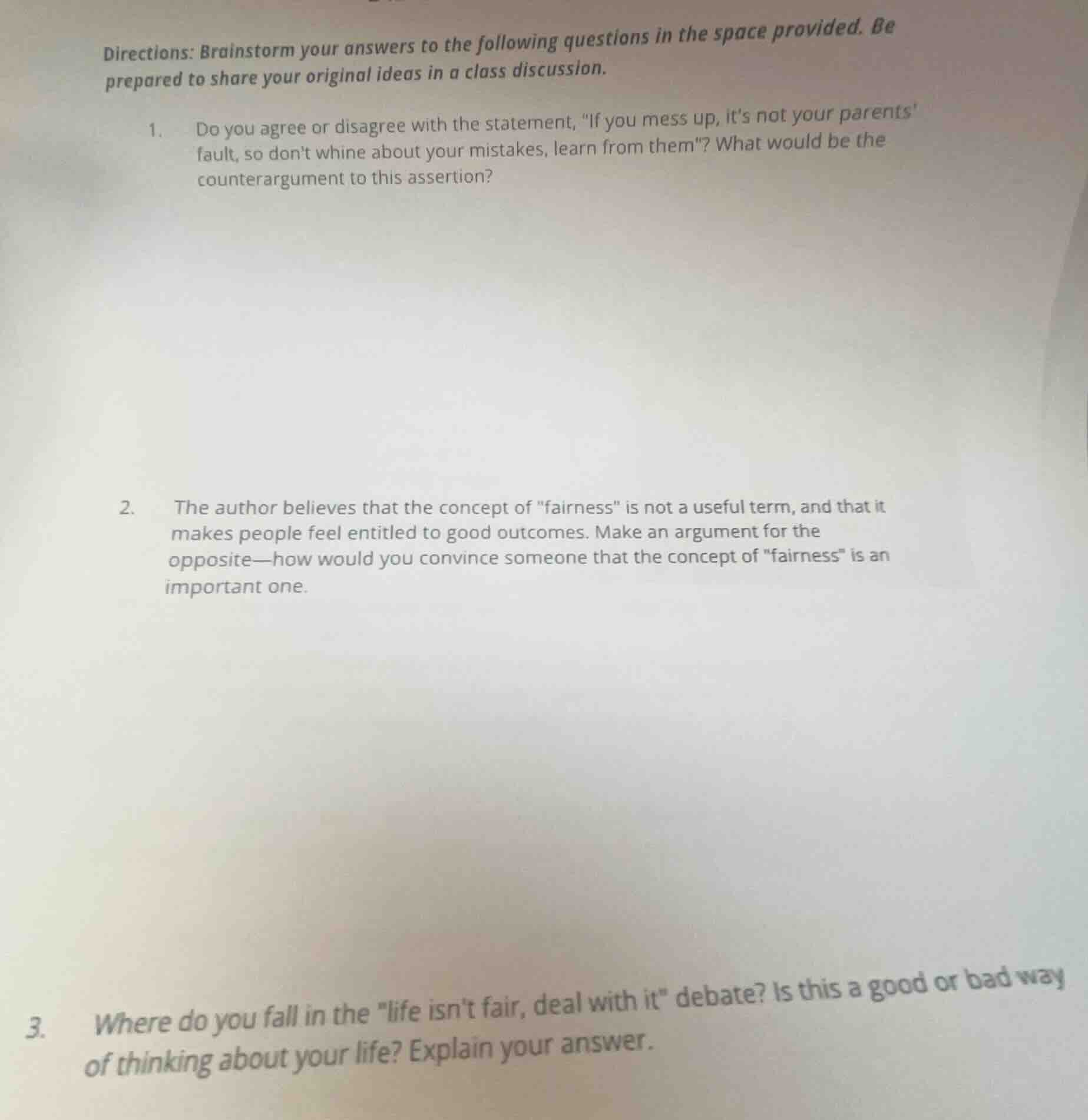
directions: brainstorm your answers to the following questions in the space provided. be prepared to share your original ideas in a class discussion.
- do you agree or disagree with the statement, \if you mess up, its not your parents fault, so dont whine about your mistakes, learn from them\? what would be the counterargument to this assertion?
- the author believes that the concept of \fairness\ is not a useful term, and that it makes people feel entitled to good outcomes. make an argument for the opposite—how would you convince someone that the concept of \fairness\ is an important one.
- where do you fall in the \life isnt fair, deal with it\ debate? is this a good or bad way of thinking about your life? explain your answer.
Brief Explanations
- For question 1: Partial agreement is reasonable. The core of taking responsibility for mistakes and learning from them is valuable, but the statement ignores contexts where parental influence contributes to missteps. A counterargument centers on how parental actions (like lack of guidance, unmet emotional needs, or modeling poor behavior) can shape a person's decision-making, making some mistakes indirectly tied to parental choices. It also notes that expressing frustration (not just "whining") can be a healthy step toward processing and learning, not just a refusal to take accountability.
- For question 2: Fairness is critical as it is the foundation of equitable systems and social cohesion. It ensures that people are not disadvantaged due to unchangeable traits (race, gender, disability) and sets clear, consistent standards for interactions, which reduces conflict. Fairness also motivates people to participate in communities and institutions, as they trust that their efforts will be evaluated justly; without it, resentment and disengagement grow, harming collective well-being.
- For question 3: This mindset is a harmful way of thinking. While it acknowledges that life has unavoidable hardships, it discourages empathy and collective action to address systemic unfairness. It can lead people to dismiss the struggles of marginalized groups who face structural barriers beyond their control, and it invalidates the need to advocate for better, more equitable conditions. A healthier approach is to acknowledge life's unfairness while working to mitigate harm and create more just outcomes for oneself and others.

Snap & solve any problem in the app
Get step-by-step solutions on Sovi AI
Photo-based solutions with guided steps
Explore more problems and detailed explanations
- Partial agreement. Counterargument: Parental influence (lack of guidance, modeled behavior) can contribute to mistakes; expressing frustration can be part of processing, not just whining, and some missteps are indirectly tied to parental choices.
- Fairness is important: it underpins equitable systems, reduces conflict by setting consistent standards, builds trust in institutions, and prevents resentment from unaccountable disadvantage, fostering social cohesion.
- This is a bad way of thinking. It dismisses systemic unfairness, invalidates marginalized people's struggles, and discourages collective action to create more equitable conditions, while a balanced approach acknowledges hardship and works toward justice.