QUESTION IMAGE
Question
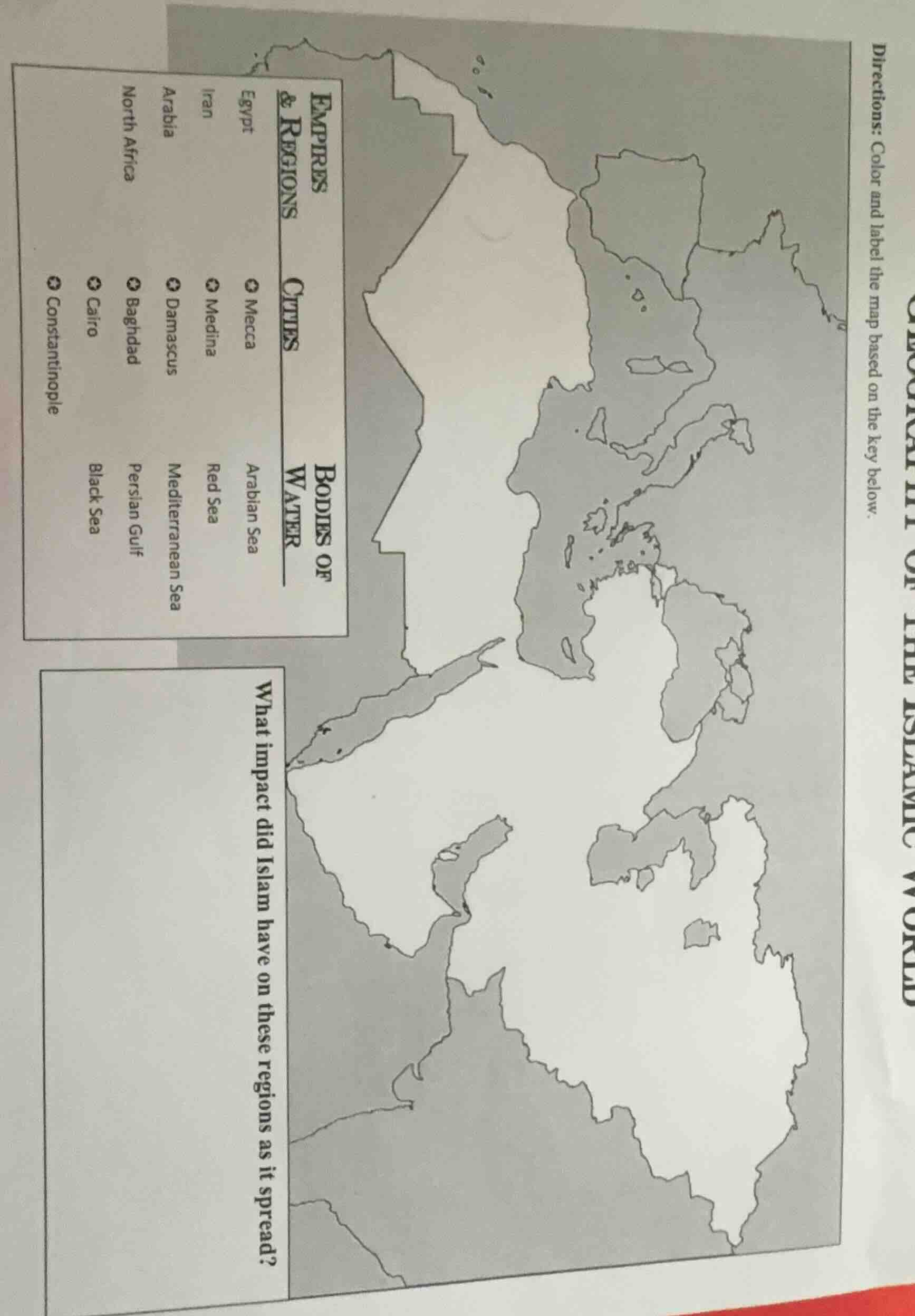
directions: color and label the map based on the key below.
what impact did islam have on these regions as it spread?
The question is about the impact of Islam on regions as it spread. This falls under the Social Science discipline, specifically the subfield of History (since it's about historical impact of a religion on regions) or Religion (since it's about the impact of Islam, a religion). But given the focus on regions and their historical development due to Islam's spread, History is a key subfield here. The impact includes cultural (spread of Islamic culture, languages like Arabic), social (changes in social structures, gender roles in some cases), economic (trade networks like Silk Road integration, development of cities like Mecca, Medina, Cairo as centers), and political (establishment of Islamic empires, caliphates, governance based on Islamic law). Also, architectural impacts (mosques, Islamic architecture), intellectual (preservation and advancement of knowledge in science, math, philosophy in Islamic golden age) in regions like Egypt, Arabia, Iran, North Africa.

Snap & solve any problem in the app
Get step-by-step solutions on Sovi AI
Photo-based solutions with guided steps
Explore more problems and detailed explanations
Islam's spread impacted these regions in multiple ways:
- Cultural: Spread Arabic language, Islamic art/architecture (e.g., mosques), and traditions (like Ramadan, pilgrimage to Mecca).
- Social: Influenced social hierarchies, family structures, and gender norms (e.g., women’s rights in Islamic law context).
- Economic: Boosted trade (via Islamic trade networks, cities like Cairo/Baghdad became commercial hubs) and agricultural innovation (irrigation techniques).
- Political: Established Islamic states/caliphates, implementing Sharia law and uniting regions under Islamic governance.
- Intellectual: Sparked a “Golden Age” of learning (science, math, philosophy) in cities like Baghdad, preserving classical knowledge.
Regions like Egypt, Arabia, and North Africa saw Islam shape their identity, governance, and cultural practices for centuries.