QUESTION IMAGE
Question
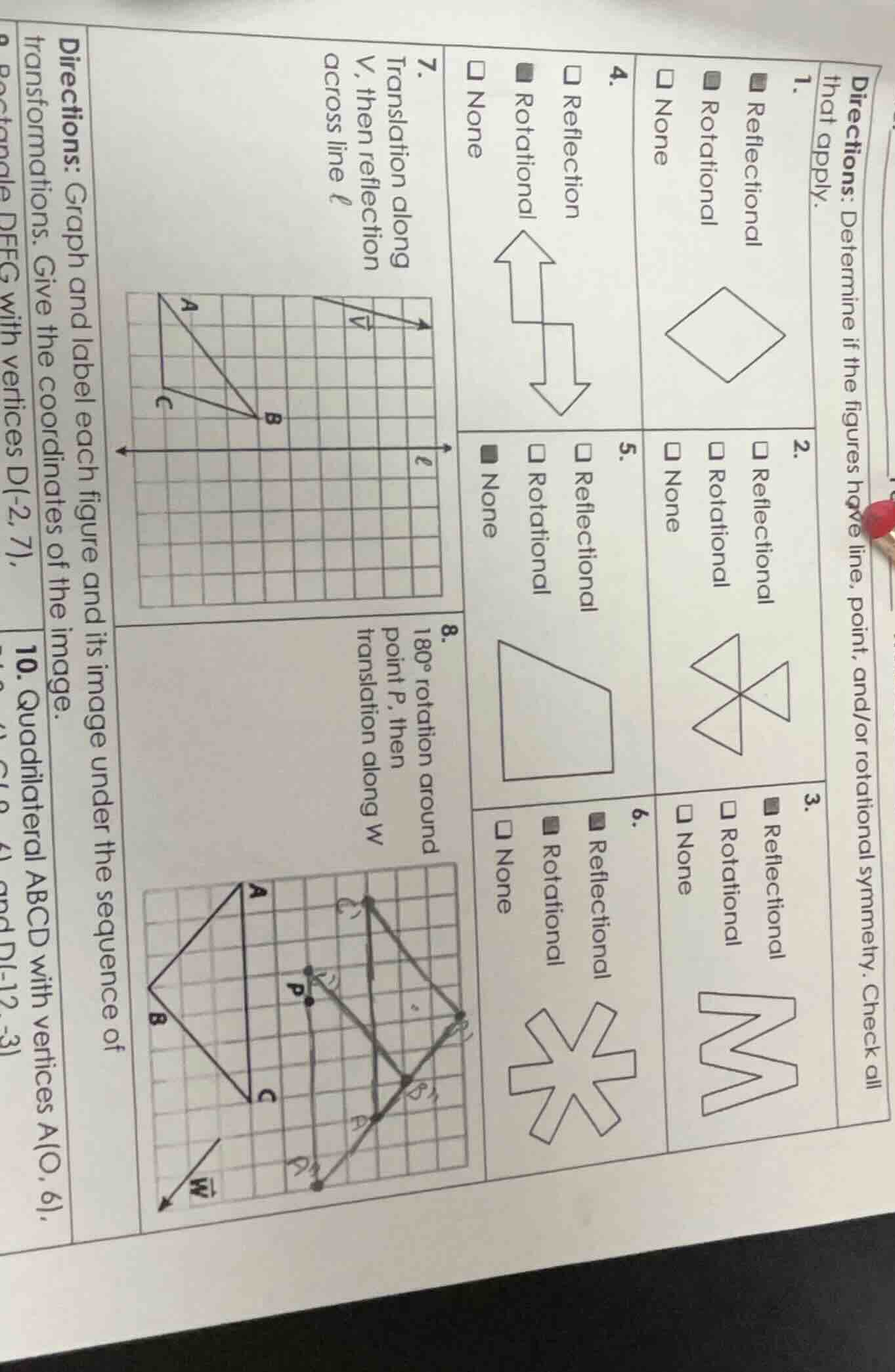
directions: determine if the figures have line, point, and/or rotational symmetry. check all that apply.
1.
□ reflectional ■ rotational □ none
2.
□ reflectional □ rotational □ none
3.
■ reflectional □ rotational □ none
4.
□ reflection ■ rotational □ none
5.
□ reflectional □ rotational ■ none
6.
■ reflectional ■ rotational □ none
- translation along \\( \vec{v} \\), then reflection across line \\( \ell \\)
graph of triangle abc and line \\( \ell \\) on a grid
- 180° rotation around point p, then translation along \\( \vec{w} \\)
graph of quadrilateral abc and another figure with point p and vector \\( \vec{w} \\) on a grid
directions: graph and label each figure and its image under the sequence of transformations. give the coordinates of the image.
... (partial text about rectangles and quadrilaterals with vertices)
To solve these symmetry - related problems, we analyze each figure based on the definitions of reflectional and rotational symmetry:
Problem 1:
- Reflectional Symmetry: A figure has reflectional symmetry if there is a line (axis of symmetry) such that when the figure is reflected over this line, it maps onto itself. The diamond - shaped figure (a rhombus) has multiple lines of reflection (e.g., the vertical and horizontal lines through its center and the two diagonal lines), so it has reflectional symmetry.
- Rotational Symmetry: A figure has rotational symmetry if there is a non - zero angle of rotation (less than \(360^{\circ}\)) about its center such that the figure maps onto itself. A rhombus has rotational symmetry of \(180^{\circ}\) about its center. So both reflectional and rotational symmetries apply.
So the answer is: Reflectional (checked), Rotational (checked), None (unchecked)
Problem 2:
- Reflectional Symmetry: The figure (two triangles forming a sort of bow - tie - like shape but not symmetric about a vertical or horizontal line or a diagonal in a way that reflection would map it to itself) does not have a line of reflection that maps it to itself.
- Rotational Symmetry: If we rotate the figure by \(180^{\circ}\) about the center point where the two triangles meet, the figure maps onto itself. So it has rotational symmetry.
So the answer is: Reflectional (unchecked), Rotational (checked), None (unchecked)
Problem 3:
- Reflectional Symmetry: The letter 'M' has a vertical line of symmetry. If we reflect it over the vertical line through its center, it maps onto itself.
- Rotational Symmetry: There is no non - zero angle of rotation (less than \(360^{\circ}\)) about its center that would map the 'M' onto itself.
So the answer is: Reflectional (checked), Rotational (unchecked), None (unchecked)
Problem 4:
- Reflectional Symmetry: The two - step - like figure (a non - symmetric shape in terms of reflection) does not have a line of reflection that maps it to itself.
- Rotational Symmetry: If we rotate the figure by \(180^{\circ}\) about its center, the figure maps onto itself (the upward - facing step and downward - facing step swap places). So it has rotational symmetry.
So the answer is: Reflectional (unchecked), Rotational (checked), None (unchecked)
Problem 5:
- Reflectional Symmetry: The trapezoid - like figure does not have a line of reflection that maps it to itself.
- Rotational Symmetry: There is no non - zero angle of rotation (less than \(360^{\circ}\)) about its center that would map the trapezoid - like figure onto itself. So the only applicable symmetry is None.
So the answer is: Reflectional (unchecked), Rotational (unchecked), None (checked)
Problem 6:
- Reflectional Symmetry: The star - like figure (a regular - looking star - polygon) has multiple lines of reflection (e.g., lines from the tip of each arm to the center of the opposite "valley").
- Rotational Symmetry: A regular star - polygon has rotational symmetry. For example, if the star has \(n\) arms, the angle of rotation for rotational symmetry is \(\frac{360^{\circ}}{n}\) (in this case, a non - zero angle less than \(360^{\circ}\) about its center will map it to itself). So both reflectional and rotational symmetries apply.
So the answer is: Reflectional (checked), Rotational (checked), None (unchecked)
Final Answers for each problem:
- Reflectional (✓), Rotational (✓), None (✗)
- Reflectional (✗), Rotational (✓), None (✗)
- Reflectional (✓), Rotational (✗), None (✗)…

Snap & solve any problem in the app
Get step-by-step solutions on Sovi AI
Photo-based solutions with guided steps
Explore more problems and detailed explanations
To solve these symmetry - related problems, we analyze each figure based on the definitions of reflectional and rotational symmetry:
Problem 1:
- Reflectional Symmetry: A figure has reflectional symmetry if there is a line (axis of symmetry) such that when the figure is reflected over this line, it maps onto itself. The diamond - shaped figure (a rhombus) has multiple lines of reflection (e.g., the vertical and horizontal lines through its center and the two diagonal lines), so it has reflectional symmetry.
- Rotational Symmetry: A figure has rotational symmetry if there is a non - zero angle of rotation (less than \(360^{\circ}\)) about its center such that the figure maps onto itself. A rhombus has rotational symmetry of \(180^{\circ}\) about its center. So both reflectional and rotational symmetries apply.
So the answer is: Reflectional (checked), Rotational (checked), None (unchecked)
Problem 2:
- Reflectional Symmetry: The figure (two triangles forming a sort of bow - tie - like shape but not symmetric about a vertical or horizontal line or a diagonal in a way that reflection would map it to itself) does not have a line of reflection that maps it to itself.
- Rotational Symmetry: If we rotate the figure by \(180^{\circ}\) about the center point where the two triangles meet, the figure maps onto itself. So it has rotational symmetry.
So the answer is: Reflectional (unchecked), Rotational (checked), None (unchecked)
Problem 3:
- Reflectional Symmetry: The letter 'M' has a vertical line of symmetry. If we reflect it over the vertical line through its center, it maps onto itself.
- Rotational Symmetry: There is no non - zero angle of rotation (less than \(360^{\circ}\)) about its center that would map the 'M' onto itself.
So the answer is: Reflectional (checked), Rotational (unchecked), None (unchecked)
Problem 4:
- Reflectional Symmetry: The two - step - like figure (a non - symmetric shape in terms of reflection) does not have a line of reflection that maps it to itself.
- Rotational Symmetry: If we rotate the figure by \(180^{\circ}\) about its center, the figure maps onto itself (the upward - facing step and downward - facing step swap places). So it has rotational symmetry.
So the answer is: Reflectional (unchecked), Rotational (checked), None (unchecked)
Problem 5:
- Reflectional Symmetry: The trapezoid - like figure does not have a line of reflection that maps it to itself.
- Rotational Symmetry: There is no non - zero angle of rotation (less than \(360^{\circ}\)) about its center that would map the trapezoid - like figure onto itself. So the only applicable symmetry is None.
So the answer is: Reflectional (unchecked), Rotational (unchecked), None (checked)
Problem 6:
- Reflectional Symmetry: The star - like figure (a regular - looking star - polygon) has multiple lines of reflection (e.g., lines from the tip of each arm to the center of the opposite "valley").
- Rotational Symmetry: A regular star - polygon has rotational symmetry. For example, if the star has \(n\) arms, the angle of rotation for rotational symmetry is \(\frac{360^{\circ}}{n}\) (in this case, a non - zero angle less than \(360^{\circ}\) about its center will map it to itself). So both reflectional and rotational symmetries apply.
So the answer is: Reflectional (checked), Rotational (checked), None (unchecked)
Final Answers for each problem:
- Reflectional (✓), Rotational (✓), None (✗)
- Reflectional (✗), Rotational (✓), None (✗)
- Reflectional (✓), Rotational (✗), None (✗)
- Reflectional (✗), Rotational (✓), None (✗)
- Reflectional (✗), Rotational (✗), None (✓)
- Reflectional (✓), Rotational (✓), None (✗)