QUESTION IMAGE
Question
directions: for each section, answer the questions in complete sentences.
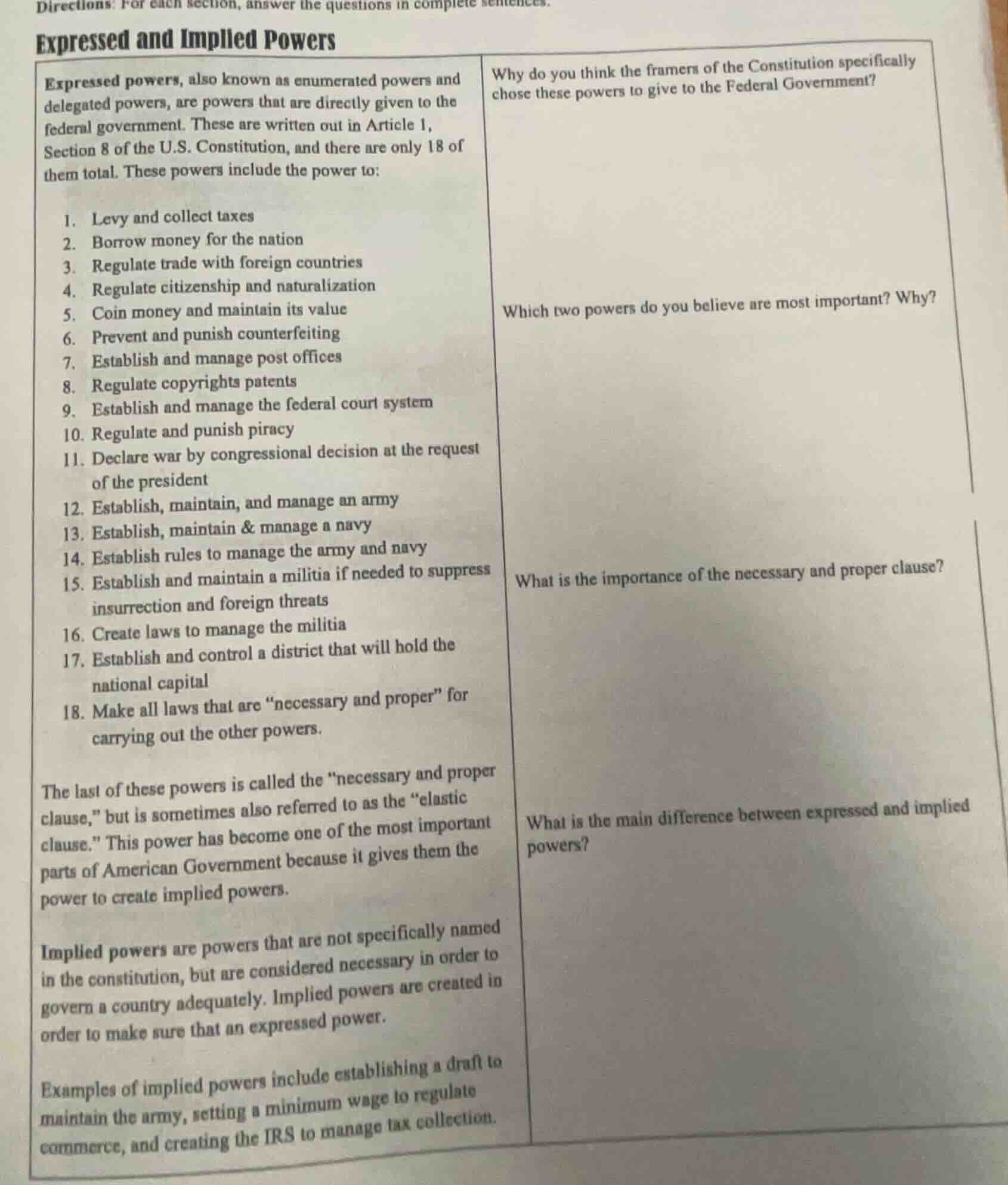
expressed and implied powers
expressed powers, also known as enumerated powers and delegated powers, are powers that are directly given to the federal government. these are written out in article 1, section 8 of the u.s. constitution, and there are only 18 of them total. these powers include the power to:
- levy and collect taxes
- borrow money for the nation
- regulate trade with foreign countries
- regulate citizenship and naturalization
- coin money and maintain its value
- prevent and punish counterfeiting
- establish and manage post offices
- regulate copyrights patents
- establish and manage the federal court system
- regulate and punish piracy
- declare war by congressional decision at the request of the president
- establish, maintain, and manage an army
- establish, maintain & manage a navy
- establish rules to manage the army and navy
- establish and maintain a militia if needed to suppress insurrection and foreign threats
- create laws to manage the militia
- establish and control a district that will hold the national capital
- make all laws that are
ecessary and proper\ for carrying out the other powers.
the last of these powers is called the
ecessary and proper clause,\ but is sometimes also referred to as the \elastic clause.\ this power has become one of the most important parts of american government because it gives them the power to create implied powers.
implied powers are powers that are not specifically named in the constitution, but are considered necessary in order to govern a country adequately. implied powers are created in order to make sure that an expressed power.
examples of implied powers include establishing a draft to maintain the army, setting a minimum wage to regulate commerce, and creating the irs to manage tax collection.
why do you think the framers of the constitution specifically chose these powers to give to the federal government?
which two powers do you believe are most important? why?
what is the importance of the necessary and proper clause?
what is the main difference between expressed and implied powers?
- For the first question: The framers chose these powers to create a functional, unified federal government that could address national-level needs the individual states could not handle alone, like national defense, cross-state/foreign trade, and a stable national currency, while balancing state authority.
- For the second question: The power to levy and collect taxes (1) and the power to declare war and manage the military (11,12,13) are most important. Taxation funds all federal government operations, from infrastructure to defense, while military and war powers ensure national security, a core responsibility of a federal government.
- For the third question: The necessary and proper clause (elastic clause) lets the federal government adapt to new, unforeseen needs by creating implied powers, ensuring the government can effectively carry out its enumerated powers as the country evolves over time.
- For the fourth question: Expressed powers are explicitly written and named in the U.S. Constitution (Article I, Section 8), while implied powers are not directly stated but are derived from expressed powers, deemed necessary to fulfill the government's constitutional duties.

Snap & solve any problem in the app
Get step-by-step solutions on Sovi AI
Photo-based solutions with guided steps
Explore more problems and detailed explanations
- The framers of the Constitution specifically chose these powers to build a cohesive national government capable of addressing collective national needs that individual states could not adequately manage, such as funding federal operations, ensuring national security, regulating cross-border and foreign trade, and establishing a stable national framework, while still preserving state-level governance for local matters.
- The two most important powers are the power to levy and collect taxes (1) and the power to declare war and manage the military (11, 12, 13). The power to tax is critical because it provides the financial foundation for all federal government functions, including funding defense, infrastructure, and public services. The military and war powers are essential because they enable the federal government to protect the nation's sovereignty, citizens, and interests from external threats, a core duty that individual states cannot fulfill on their own.
- The necessary and proper clause (elastic clause) is important because it grants the federal government the flexibility to create implied powers that are not explicitly listed in the Constitution but are needed to effectively carry out its enumerated expressed powers. This allows the government to adapt to new challenges and changing national needs over time, ensuring the Constitution remains a functional, relevant governing document.
- The main difference between expressed and implied powers is that expressed powers are explicitly written and named in the U.S. Constitution (specifically Article I, Section 8), while implied powers are not directly stated in the Constitution but are derived from expressed powers, as they are deemed necessary and proper to fulfill the federal government's constitutional responsibilities.