QUESTION IMAGE
Question
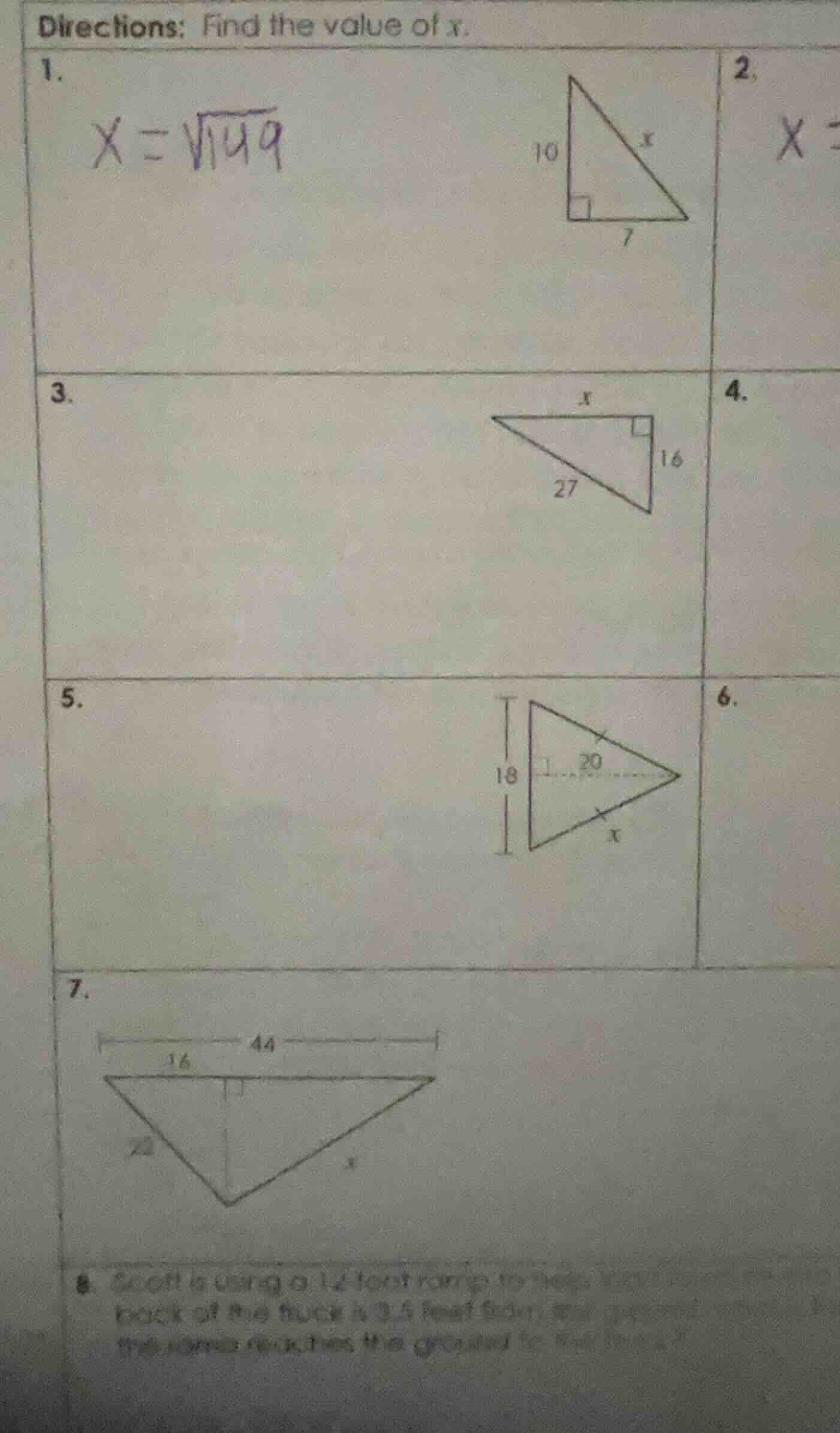
directions: find the value of x.
1.
2.
3.
4.
5.
6.
7.
- scott is using a 14 - foot ramp to help... back of the truck is 3.5 feet... the ground? how...
Problem 1
Step1: Identify the triangle type (right triangle)
We have a right triangle with legs 10 and 7, and hypotenuse \( x \). Use the Pythagorean theorem \( a^2 + b^2 = c^2 \), where \( a = 10 \), \( b = 7 \), and \( c = x \).
\( x^2 = 10^2 + 7^2 = 100 + 49 = 149 \)
Step2: Solve for \( x \)
Take the square root of both sides: \( x = \sqrt{149} \approx 12.21 \) (but the given expression is \( x = \sqrt{149} \), so we can present it as is or calculate the approximate value. However, if we follow the written expression \( x = \sqrt{149} \), that's the exact form. If we calculate the numerical value: \( \sqrt{149} \approx 12.21 \))
Step1: Identify the triangle type (right triangle)
We have a right triangle with hypotenuse 27 and one leg 16, and the other leg \( x \). Use the Pythagorean theorem: \( x^2 + 16^2 = 27^2 \)
Step2: Solve for \( x^2 \)
\( x^2 = 27^2 - 16^2 = 729 - 256 = 473 \)
Step3: Solve for \( x \)
Take the square root: \( x = \sqrt{473} \approx 21.75 \)
Step1: Identify the triangle type (isosceles triangle with height 20, base 18? Wait, no, the diagram shows a triangle with height 20, and the two equal sides are \( x \), and the base is 18? Wait, no, the height is 20, and the base is 18? Wait, no, the height is drawn to the base, so the base is 18, and the height is 20? Wait, no, the diagram has a right angle, so it's a right triangle? Wait, no, the triangle has a height of 20, and the two equal sides (marked with x) are the legs? Wait, no, the diagram shows a triangle with a height of 20, and the base is 18, and the two equal sides (x) are the hypotenuses? Wait, no, let's re-examine. The triangle has a height of 20, and the base is 18, so the height splits the base into two equal parts? Wait, no, the base is 18, so half of the base is \( \frac{18}{2} = 9 \). Then we have a right triangle with legs 9 and 20, and hypotenuse \( x \).
Step2: Use the Pythagorean theorem
\( x^2 = 9^2 + 20^2 = 81 + 400 = 481 \)
Step3: Solve for \( x \)
\( x = \sqrt{481} \approx 21.93 \)

Snap & solve any problem in the app
Get step-by-step solutions on Sovi AI
Photo-based solutions with guided steps
Explore more problems and detailed explanations
\( x = \sqrt{149} \) (or approximately \( 12.21 \))