QUESTION IMAGE
Question
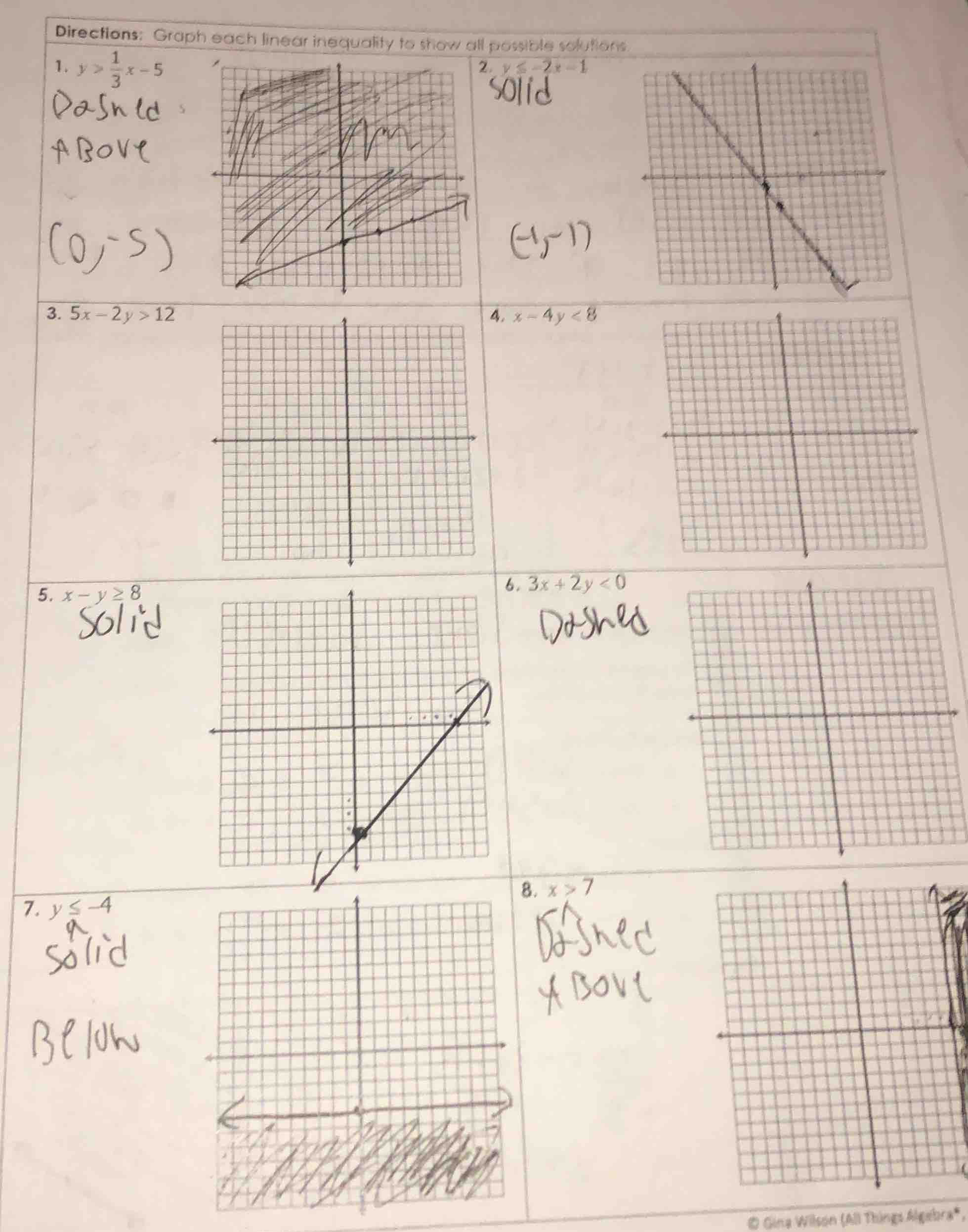
directions: graph each linear inequality to show all possible solutions.
- $y > \frac{1}{3}x - 5$
- $y \leq -2x - 1$
- $5x - 2y > 12$
- $x - 4y < 8$
- $x - y \geq 8$
- $3x + 2y < 0$
- $y \leq -4$
- $x > 7$
Let's solve one of the linear inequality graphing problems, say problem 3: \( 5x - 2y > 12 \).
Step 1: Rewrite in slope - intercept form
We want to get the inequality in the form \( y=mx + b\) (or an inequality with \(y\) alone) to identify the slope and y - intercept.
Starting with \(5x - 2y>12\), we subtract \(5x\) from both sides: \(-2y>- 5x + 12\).
Then we divide every term by \(-2\). Remember that when we divide or multiply an inequality by a negative number, the direction of the inequality sign changes. So we have \(y<\frac{5}{2}x-6\).
Step 2: Graph the boundary line
The boundary line is \(y = \frac{5}{2}x-6\). Since the inequality is \(y<\frac{5}{2}x - 6\) (not \(y\leq\frac{5}{2}x-6\)), the boundary line is dashed (because the points on the line are not included in the solution set).
To graph the line, we can find the y - intercept and the slope. The y - intercept \(b=-6\), so the line crosses the y - axis at \((0, - 6)\). The slope \(m = \frac{5}{2}\), which means from the y - intercept, we can go up 5 units and to the right 2 units to find another point on the line (e.g., from \((0,-6)\), moving up 5 and right 2 gives us \((2, - 1)\)).
Step 3: Shade the solution region
We test a point that is not on the line to see which side of the line to shade. A common test point is the origin \((0,0)\).
Substitute \(x = 0\) and \(y = 0\) into the original inequality \(5x-2y>12\): \(5(0)-2(0)=0\), and \(0>12\) is false. So we shade the side of the line that does not include the origin.
If we were to solve problem 4: \(x - 4y<8\)
Step 1: Rewrite in slope - intercept form
Subtract \(x\) from both sides: \(-4y<-x + 8\).
Divide every term by \(-4\) (and reverse the inequality sign): \(y>\frac{1}{4}x - 2\).
Step 2: Graph the boundary line
The boundary line is \(y=\frac{1}{4}x - 2\). Since the inequality is \(y>\frac{1}{4}x-2\) (not \(y\geq\frac{1}{4}x - 2\)), the boundary line is dashed.
The y - intercept is \((0,-2)\) and the slope is \(\frac{1}{4}\). So from \((0, - 2)\), we can go up 1 unit and to the right 4 units to find another point (e.g., \((4,-1)\)).
Step 3: Shade the solution region
Test the origin \((0,0)\) in the original inequality \(x - 4y<8\): \(0-4(0)=0<8\), which is true. So we shade the side of the line that includes the origin.
For problem 1: \(y>\frac{1}{3}x-5\)
Step 1: Identify the boundary line and inequality type
The boundary line is \(y=\frac{1}{3}x - 5\). Since the inequality is \(y>\frac{1}{3}x-5\) (not \(y\geq\frac{1}{3}x - 5\)), the boundary line is dashed. The y - intercept is \((0,-5)\) and the slope is \(\frac{1}{3}\).
Step 2: Shade the solution region
Test the origin \((0,0)\): \(0>\frac{1}{3}(0)-5\) i.e., \(0>-5\), which is true. So we shade the region above the dashed line (since \(y\) values are greater than the line's \(y\) values).
For problem 2: \(y\leq - 2x-1\)
Step 1: Identify the boundary line and inequality type
The boundary line is \(y=-2x - 1\). Since the inequality is \(y\leq - 2x-1\), the boundary line is solid (because the points on the line are included in the solution set). The y - intercept is \((0,-1)\) and the slope is \(-2\).
Step 2: Shade the solution region
Test the origin \((0,0)\): \(0\leq-2(0)-1\) i.e., \(0\leq - 1\), which is false. So we shade the region below the solid line (since \(y\) values are less than or equal to the line's \(y\) values).
For problem 5: \(x - y\geq8\)
Step 1: Rewrite in slope - intercept form
Subtract \(x\) from both sides: \(-y\geq - x + 8\).
Divide by \(-1\) (and reverse the inequality sign): \(y\leq x - 8\).
Step 2: Graph the boundary line
The boundary line is \(y=x - 8\). Since the inequality is \(y…

Snap & solve any problem in the app
Get step-by-step solutions on Sovi AI
Photo-based solutions with guided steps
Explore more problems and detailed explanations
Step 1: Rewrite in slope - intercept form
We want to get the inequality in the form \( y=mx + b\) (or an inequality with \(y\) alone) to identify the slope and y - intercept.
Starting with \(5x - 2y>12\), we subtract \(5x\) from both sides: \(-2y>- 5x + 12\).
Then we divide every term by \(-2\). Remember that when we divide or multiply an inequality by a negative number, the direction of the inequality sign changes. So we have \(y<\frac{5}{2}x-6\).
Step 2: Graph the boundary line
The boundary line is \(y = \frac{5}{2}x-6\). Since the inequality is \(y<\frac{5}{2}x - 6\) (not \(y\leq\frac{5}{2}x-6\)), the boundary line is dashed (because the points on the line are not included in the solution set).
To graph the line, we can find the y - intercept and the slope. The y - intercept \(b=-6\), so the line crosses the y - axis at \((0, - 6)\). The slope \(m = \frac{5}{2}\), which means from the y - intercept, we can go up 5 units and to the right 2 units to find another point on the line (e.g., from \((0,-6)\), moving up 5 and right 2 gives us \((2, - 1)\)).
Step 3: Shade the solution region
We test a point that is not on the line to see which side of the line to shade. A common test point is the origin \((0,0)\).
Substitute \(x = 0\) and \(y = 0\) into the original inequality \(5x-2y>12\): \(5(0)-2(0)=0\), and \(0>12\) is false. So we shade the side of the line that does not include the origin.
If we were to solve problem 4: \(x - 4y<8\)
Step 1: Rewrite in slope - intercept form
Subtract \(x\) from both sides: \(-4y<-x + 8\).
Divide every term by \(-4\) (and reverse the inequality sign): \(y>\frac{1}{4}x - 2\).
Step 2: Graph the boundary line
The boundary line is \(y=\frac{1}{4}x - 2\). Since the inequality is \(y>\frac{1}{4}x-2\) (not \(y\geq\frac{1}{4}x - 2\)), the boundary line is dashed.
The y - intercept is \((0,-2)\) and the slope is \(\frac{1}{4}\). So from \((0, - 2)\), we can go up 1 unit and to the right 4 units to find another point (e.g., \((4,-1)\)).
Step 3: Shade the solution region
Test the origin \((0,0)\) in the original inequality \(x - 4y<8\): \(0-4(0)=0<8\), which is true. So we shade the side of the line that includes the origin.
For problem 1: \(y>\frac{1}{3}x-5\)
Step 1: Identify the boundary line and inequality type
The boundary line is \(y=\frac{1}{3}x - 5\). Since the inequality is \(y>\frac{1}{3}x-5\) (not \(y\geq\frac{1}{3}x - 5\)), the boundary line is dashed. The y - intercept is \((0,-5)\) and the slope is \(\frac{1}{3}\).
Step 2: Shade the solution region
Test the origin \((0,0)\): \(0>\frac{1}{3}(0)-5\) i.e., \(0>-5\), which is true. So we shade the region above the dashed line (since \(y\) values are greater than the line's \(y\) values).
For problem 2: \(y\leq - 2x-1\)
Step 1: Identify the boundary line and inequality type
The boundary line is \(y=-2x - 1\). Since the inequality is \(y\leq - 2x-1\), the boundary line is solid (because the points on the line are included in the solution set). The y - intercept is \((0,-1)\) and the slope is \(-2\).
Step 2: Shade the solution region
Test the origin \((0,0)\): \(0\leq-2(0)-1\) i.e., \(0\leq - 1\), which is false. So we shade the region below the solid line (since \(y\) values are less than or equal to the line's \(y\) values).
For problem 5: \(x - y\geq8\)
Step 1: Rewrite in slope - intercept form
Subtract \(x\) from both sides: \(-y\geq - x + 8\).
Divide by \(-1\) (and reverse the inequality sign): \(y\leq x - 8\).
Step 2: Graph the boundary line
The boundary line is \(y=x - 8\). Since the inequality is \(y\leq x - 8\), the boundary line is solid. The y - intercept is \((0,-8)\) and the slope is \(1\).
Step 3: Shade the solution region
Test the origin \((0,0)\): \(0\leq0 - 8\) i.e., \(0\leq - 8\), which is false. So we shade the region below the solid line.
For problem 6: \(3x + 2y<0\)
Step 1: Rewrite in slope - intercept form
Subtract \(3x\) from both sides: \(2y<-3x\).
Divide by 2: \(y<-\frac{3}{2}x\).
Step 2: Graph the boundary line
The boundary line is \(y = -\frac{3}{2}x\). Since the inequality is \(y<-\frac{3}{2}x\), the boundary line is dashed. The line passes through the origin \((0,0)\) (since \(b = 0\)) and has a slope of \(-\frac{3}{2}\) (from the origin, we can go down 3 units and to the right 2 units to find another point, e.g., \((2,-3)\)).
Step 2: Shade the solution region
Test a point not on the line, say \((0,1)\): \(1<-\frac{3}{2}(0)\) i.e., \(1 < 0\), which is false. So we shade the region below the dashed line.
For problem 7: \(y\leq - 4\)
Step 1: Identify the boundary line and inequality type
The boundary line is \(y=-4\), which is a horizontal line. Since the inequality is \(y\leq - 4\), the boundary line is solid (because the points on the line are included in the solution set).
Step 2: Shade the solution region
We shade the region below the solid horizontal line \(y = - 4\) (since \(y\) values are less than or equal to \(-4\)).
For problem 8: \(x>7\)
Step 1: Identify the boundary line and inequality type
The boundary line is \(x = 7\), which is a vertical line. Since the inequality is \(x>7\) (not \(x\geq7\)), the boundary line is dashed.
Step 2: Shade the solution region
We shade the region to the right of the dashed vertical line \(x = 7\) (since \(x\) values are greater than 7).
If you want the answer for a specific problem, for example, for problem 3, the graph has a dashed line \(y=\frac{5}{2}x - 6\) and the region below the line (but wait, no, from step 1 we had \(y<\frac{5}{2}x-6\), so we shade below? Wait no, when we have \(y Original inequality \(5x-2y>12\), at \((0,0)\): \(0 - 0>12\) is false. The line \(y=\frac{5}{2}x-6\), when \(x = 0\), \(y=-6\). So the region where \(y<\frac{5}{2}x-6\) and does not include the origin (which is above \(y=-6\) when \(x = 0\))? Wait, maybe a better way: When \(x = 2\), the line \(y=\frac{5}{2}(2)-6=5 - 6=-1\). So for \(x = 2\), \(y\) values less than \(-1\) satisfy \(y<\frac{5}{2}x-6\). So the solution region is below the line \(y=\frac{5}{2}x-6\) (since \(y\) is less than the line's \(y\) value at each \(x\)). The final answer for the graphing of each inequality would be the correctly graphed region (dashed or solid line with appropriate shading). For example, for \(y>\frac{1}{3}x - 5\), the graph has a dashed line with slope \(\frac{1}{3}\), y - intercept \((0,-5)\) and shading above the line. If we are to summarize the key steps for graphing linear inequalities: