QUESTION IMAGE
Question
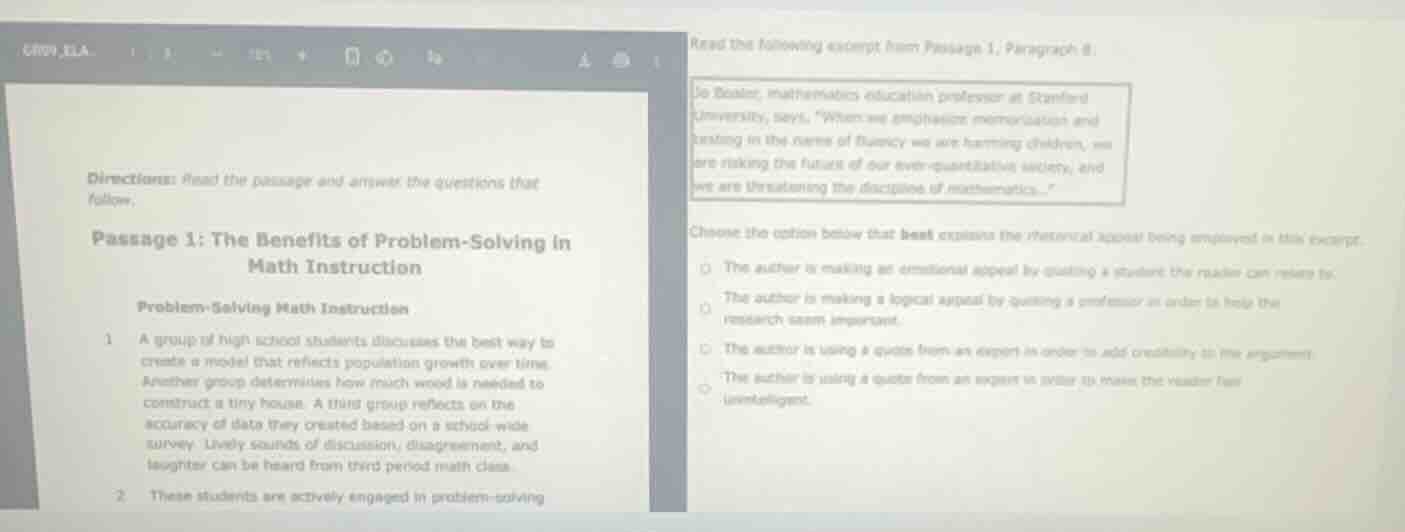
directions: read the passage and answer the questions that follow.
passage 1: the benefits of problem-solving in math instruction
problem-solving math instruction
1 a group of high school students discusses the best way to create a model that reflects population growth over time. another group determines how much wood is needed to construct a tiny house. a third group reflects on the accuracy of data they created based on a school-wide survey. lively sounds of discussion, disagreement, and laughter can be heard from third period math class.
2 these students are actively engaged in problem-solving
read the following excerpt from passage 1, paragraph 8:
jo boaler, mathematics education professor at stanford university, says, \when we emphasize memorization and testing in the name of fluency we are harming children, we are risking the future of our ever-quantitative society, and we are threatening the discipline of mathematics.\
choose the option below that best explains the rhetorical appeal being employed in this excerpt:
○ the author is making an emotional appeal by quoting a student the reader can relate to.
○ the author is making a logical appeal by quoting a professor in order to help the research seem important.
○ the author is using a quote from an expert in order to add credibility to the argument.
○ the author is using a quote from an expert in order to make the reader feel unintelligent.
The excerpt quotes Jo Boaler, a Stanford mathematics education professor, an expert in the field. This type of appeal uses authority/expertise to strengthen an argument, which adds credibility. The other options are incorrect: the source is a professor, not a student; it is an appeal to authority, not pure logic; and the quote does not aim to make readers feel unintelligent.

Snap & solve any problem in the app
Get step-by-step solutions on Sovi AI
Photo-based solutions with guided steps
Explore more problems and detailed explanations
The author is using a quote from an expert in order to add credibility to the argument