QUESTION IMAGE
Question
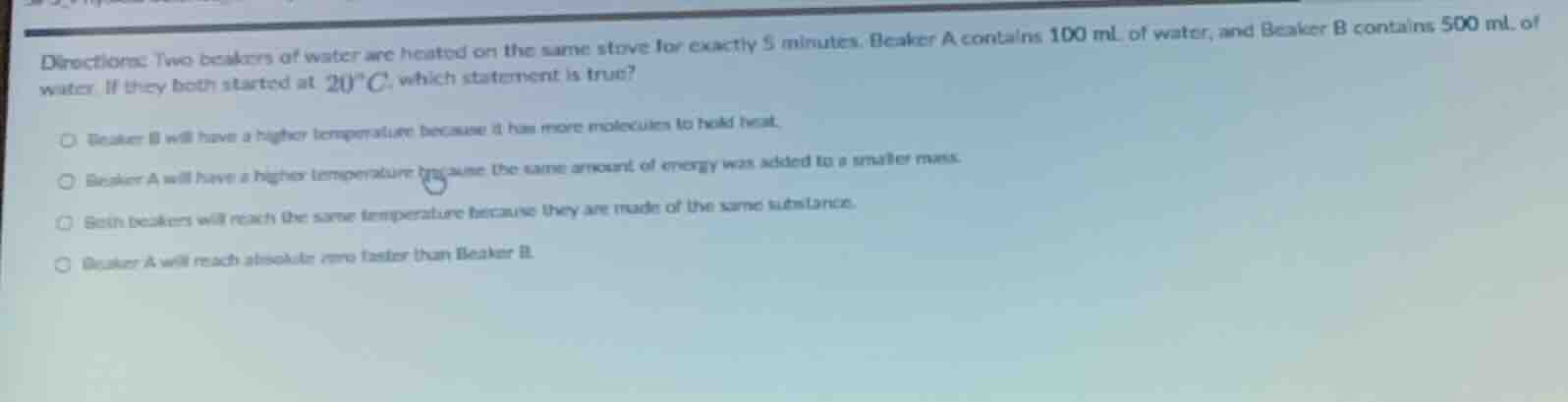
directions: two beakers of water are heated on the same stove for exactly 5 minutes. beaker a contains 100 ml of water, and beaker b contains 500 ml of water. if they both started at $20^{circ}c$, which statement is true?
- beaker b will have a higher temperature because it has more molecules to hold heat.
- beaker a will have a higher temperature because the same amount of energy was added to a smaller mass.
- both beakers will reach the same temperature because they are made of the same substance.
- beaker a will reach absolute zero faster than beaker b.
Step1: Relate heat to temperature change
The heat-energy-temperature relationship is given by the formula:
$$Q = mc\Delta T$$
where $Q$ = heat energy, $m$ = mass, $c$ = specific heat capacity, $\Delta T = T_{final}-T_{initial}$
Step2: Rearrange for temperature change
Isolate $\Delta T$ to compare temperature changes:
$$\Delta T = \frac{Q}{mc}$$
Step3: Analyze constant variables
Both beakers use water, so $c$ is identical. They are heated on the same stove for the same time, so $Q$ is equal. Beaker A has smaller $m$ (100 mL water has less mass than 500 mL water).
Step4: Compare temperature changes
Since $\Delta T$ is inversely proportional to $m$, smaller $m$ leads to larger $\Delta T$. Starting from the same $20^\circ C$, Beaker A will have a higher final temperature.

Snap & solve any problem in the app
Get step-by-step solutions on Sovi AI
Photo-based solutions with guided steps
Explore more problems and detailed explanations
Beaker A will have a higher temperature because the same amount of energy was added to a smaller mass.