QUESTION IMAGE
Question
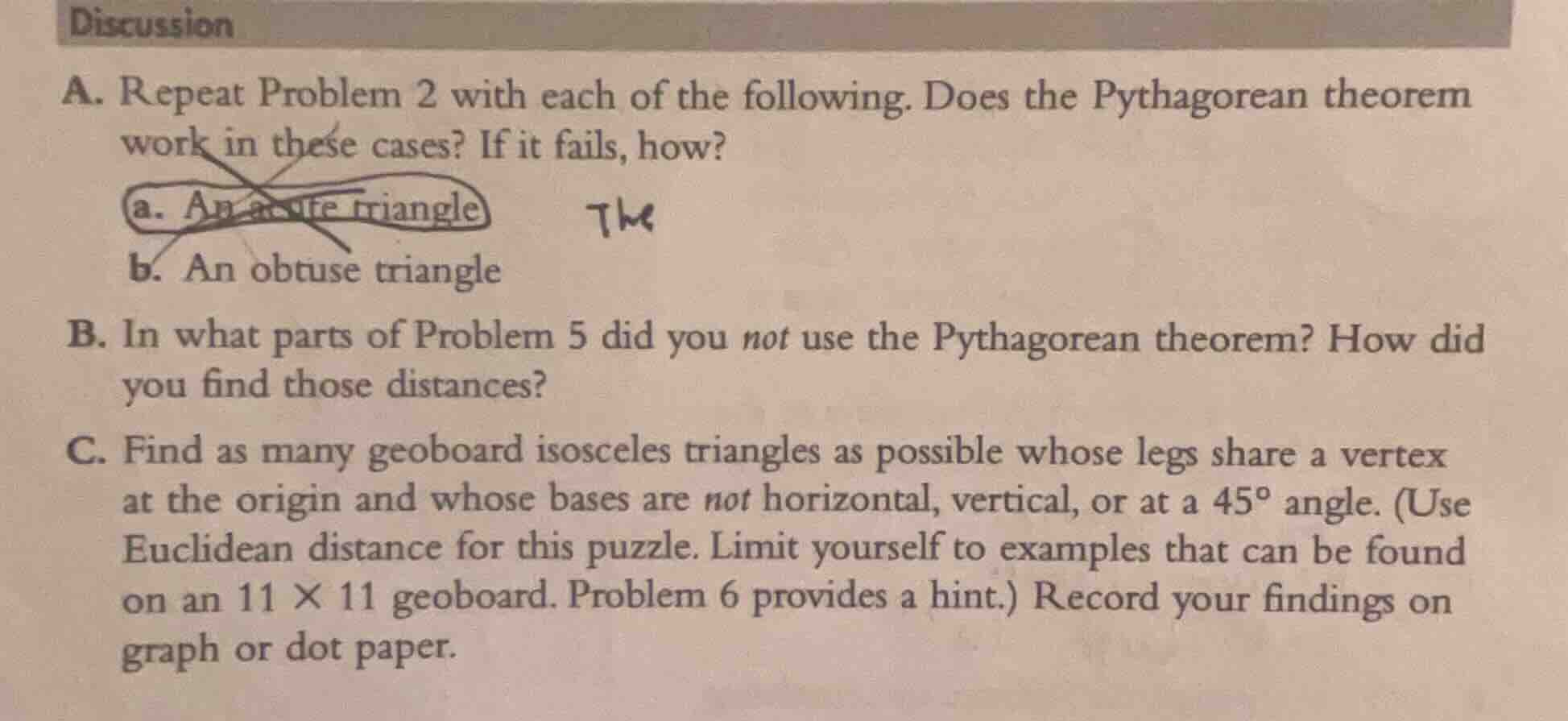
discussion
a. repeat problem 2 with each of the following. does the pythagorean theorem work in these cases? if it fails, how?
a. an acute triangle (crossed out) the
b. an obtuse triangle
b. in what parts of problem 5 did you not use the pythagorean theorem? how did you find those distances?
c. find as many geoboard isosceles triangles as possible whose legs share a vertex at the origin and whose bases are not horizontal, vertical, or at a 45° angle. (use euclidean distance for this puzzle. limit yourself to examples that can be found on an 11 × 11 geoboard. problem 6 provides a hint.) record your findings on graph or dot paper.
Part A
a. Acute Triangle
Step1: Recall Pythagorean Theorem
The Pythagorean theorem states that for a right - triangle with legs of length \(a\) and \(b\) and hypotenuse of length \(c\), \(a^{2}+b^{2}=c^{2}\). For an acute triangle with side lengths \(a\), \(b\), and \(c\) (where \(c\) is the longest side), we have the inequality \(a^{2}+b^{2}>c^{2}\). So the Pythagorean theorem (the equation \(a^{2}+b^{2}=c^{2}\)) does not hold in the same way as in a right - triangle. The Pythagorean theorem is specific to right - triangles. In an acute triangle, the sum of the squares of the two shorter sides is greater than the square of the longest side.
Step2: Conclusion for Acute Triangle
The Pythagorean theorem (the equality \(a^{2}+b^{2}=c^{2}\)) does not work for an acute triangle. Instead, the relationship is \(a^{2}+b^{2}>c^{2}\) (where \(c\) is the longest side of the acute triangle).
b. Obtuse Triangle
Step1: Recall the inequality for Obtuse Triangle
For an obtuse triangle with side lengths \(a\), \(b\), and \(c\) (where \(c\) is the longest side, opposite the obtuse angle), the relationship between the sides is given by the inequality \(a^{2}+b^{2} The Pythagorean theorem does not work for an obtuse triangle. The correct relationship between the sides of an obtuse triangle (with \(c\) as the longest side) is \(a^{2}+b^{2} Since we don't have the details of Problem 5, we can provide a general approach. If Problem 5 involved non - right - triangle figures (like acute or obtuse triangles, or other geometric shapes like quadrilaterals that are not right - angled), we would not use the Pythagorean theorem. For example, if we were finding the distance between two points in a non - right - angled context, we might use the distance formula (which is derived from the Pythagorean theorem, but if the figure is not a right - triangle, we can't directly apply \(a^{2}+b^{2}=c^{2}\) in the same way). Or if we were dealing with shapes like circles, we would use properties of circles (radius, diameter, circumference formulas) instead of the Pythagorean theorem. If we were finding distances in a one - dimensional context (like along a straight line on a number line), we would use the absolute difference of the coordinates (\(d=\vert x_2 - x_1\vert\)) instead of the Pythagorean theorem. To find geoboard isosceles triangles with legs sharing a vertex at the origin and bases not horizontal, vertical, or at \(45^{\circ}\): Another example: We can continue to find more such triangles by choosing pairs of points \((x,y)\) and \((y,x)\) (where \(xStep2: Conclusion for Obtuse Triangle
Part B
Part C
eq…

Snap & solve any problem in the app
Get step-by-step solutions on Sovi AI
Photo-based solutions with guided steps
Explore more problems and detailed explanations
Step1: Recall the inequality for Obtuse Triangle
For an obtuse triangle with side lengths \(a\), \(b\), and \(c\) (where \(c\) is the longest side, opposite the obtuse angle), the relationship between the sides is given by the inequality \(a^{2}+b^{2} The Pythagorean theorem does not work for an obtuse triangle. The correct relationship between the sides of an obtuse triangle (with \(c\) as the longest side) is \(a^{2}+b^{2} Since we don't have the details of Problem 5, we can provide a general approach. If Problem 5 involved non - right - triangle figures (like acute or obtuse triangles, or other geometric shapes like quadrilaterals that are not right - angled), we would not use the Pythagorean theorem. For example, if we were finding the distance between two points in a non - right - angled context, we might use the distance formula (which is derived from the Pythagorean theorem, but if the figure is not a right - triangle, we can't directly apply \(a^{2}+b^{2}=c^{2}\) in the same way). Or if we were dealing with shapes like circles, we would use properties of circles (radius, diameter, circumference formulas) instead of the Pythagorean theorem. If we were finding distances in a one - dimensional context (like along a straight line on a number line), we would use the absolute difference of the coordinates (\(d=\vert x_2 - x_1\vert\)) instead of the Pythagorean theorem. To find geoboard isosceles triangles with legs sharing a vertex at the origin and bases not horizontal, vertical, or at \(45^{\circ}\): Another example: We can continue to find more such triangles by choosing pairs of points \((x,y)\) and \((y,x)\) (where \(x a. The Pythagorean theorem (equality \(a^{2}+b^{2}=c^{2}\)) does not work. For an acute triangle with longest side \(c\), \(a^{2}+b^{2}>c^{2}\). (Depends on Problem 5 details, general: non - right - triangle related parts, e.g., 1D distances, non - right - angled shapes; distances found via absolute difference (1D) or other geometric properties). Examples include triangles with vertices \((0,0)\), \((2,3)\), \((3,2)\) and \((0,0)\), \((1,4)\), \((4,1)\) (and more by choosing \((x,y)\) and \((y,x)\) with \(xStep2: Conclusion for Obtuse Triangle
Part B
Part C
eq y\) and \(x,y\in\{1,2,\cdots,10\}\) since the geoboard is \(11\times11\) with coordinates from \((0,0)\) to \((10,10)\)) to ensure that the legs from the origin are equal in length, and then checking that the base is not horizontal, vertical, or at \(45^{\circ}\).Final Answers (Summarized)
Part A
b. The Pythagorean theorem (equality \(a^{2}+b^{2}=c^{2}\)) does not work. For an obtuse triangle with longest side \(c\), \(a^{2}+b^{2}Part B
Part C
eq y\) on the \(11\times11\) geoboard).