QUESTION IMAGE
Question
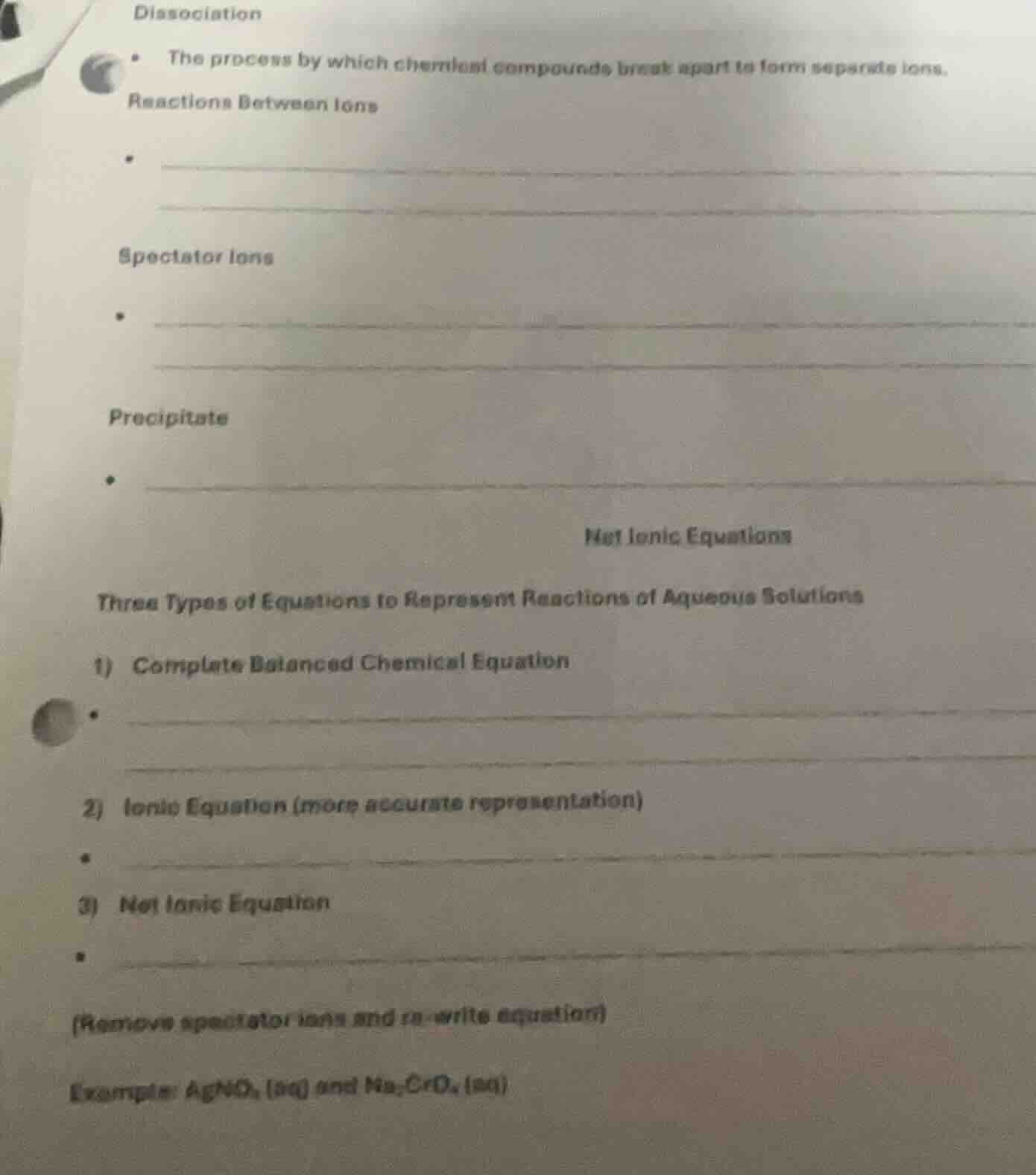
dissociation
- the process by which chemical compounds break apart to form separate ions.
reactions between ions
-
spectator ions
-
precipitate
-
net ionic equations
three types of equations to represent reactions of aqueous solutions
- complete balanced chemical equation
-
- ionic equation (more accurate representation)
-
- net ionic equation
-
(remove spectator ions and re - write equation)
example: agno₃(aq) and na₂cro₄(aq)
Brief Explanations
- Reactions Between Ions: Reactions where dissolved ionic compounds in aqueous solution react via their free ions, often forming a precipitate, gas, or weak electrolyte.
- Spectator Ions: Ions present in solution that do not participate in the chemical reaction; they remain unchanged before and after the reaction.
- Precipitate: A solid insoluble product formed from the reaction of dissolved ions in an aqueous solution.
- Complete Balanced Chemical Equation: A chemical equation that shows all reactants and products in their neutral, undissociated molecular forms, with equal numbers of each atom on both sides.
- Ionic Equation (more accurate representation): A chemical equation that shows all strong electrolytes as dissociated free ions in aqueous solution, while keeping weak electrolytes, solids, and gases in their molecular/undissolved forms.
- Net Ionic Equation: A simplified ionic equation that excludes spectator ions, only showing the species that directly participate in forming the product (precipitate, gas, weak electrolyte).
Example (AgNO₃(aq) and Na₂CrO₄(aq)):
- Complete Balanced Chemical Equation:
$$2\text{AgNO}_3(aq) + \text{Na}_2\text{CrO}_4(aq)
ightarrow \text{Ag}_2\text{CrO}_4(s) + 2\text{NaNO}_3(aq)$$
- Ionic Equation:
$$2\text{Ag}^+(aq) + 2\text{NO}_3^-(aq) + 2\text{Na}^+(aq) + \text{CrO}_4^{2-}(aq)
ightarrow \text{Ag}_2\text{CrO}_4(s) + 2\text{Na}^+(aq) + 2\text{NO}_3^-(aq)$$
- Net Ionic Equation:
$$2\text{Ag}^+(aq) + \text{CrO}_4^{2-}(aq)
ightarrow \text{Ag}_2\text{CrO}_4(s)$$

Snap & solve any problem in the app
Get step-by-step solutions on Sovi AI
Photo-based solutions with guided steps
Explore more problems and detailed explanations
- Reactions Between Ions: Reactions of dissolved ionic species in solution
- Spectator Ions: Unchanged, non-participating ions in a reaction
- Precipitate: Insoluble solid product of an ionic reaction
- Complete Balanced Chemical Equation: Balanced equation with neutral molecular formulas
- Ionic Equation (more accurate representation): Equation showing dissociated strong electrolytes as ions
- Net Ionic Equation: Equation excluding spectator ions, showing only reacting species
- Example (AgNO₃(aq) and Na₂CrO₄(aq)):
- Complete Balanced: $2\text{AgNO}_3(aq) + \text{Na}_2\text{CrO}_4(aq)
ightarrow \text{Ag}_2\text{CrO}_4(s) + 2\text{NaNO}_3(aq)$
- Ionic: $2\text{Ag}^+(aq) + 2\text{NO}_3^-(aq) + 2\text{Na}^+(aq) + \text{CrO}_4^{2-}(aq)
ightarrow \text{Ag}_2\text{CrO}_4(s) + 2\text{Na}^+(aq) + 2\text{NO}_3^-(aq)$
- Net Ionic: $2\text{Ag}^+(aq) + \text{CrO}_4^{2-}(aq)
ightarrow \text{Ag}_2\text{CrO}_4(s)$