QUESTION IMAGE
Question
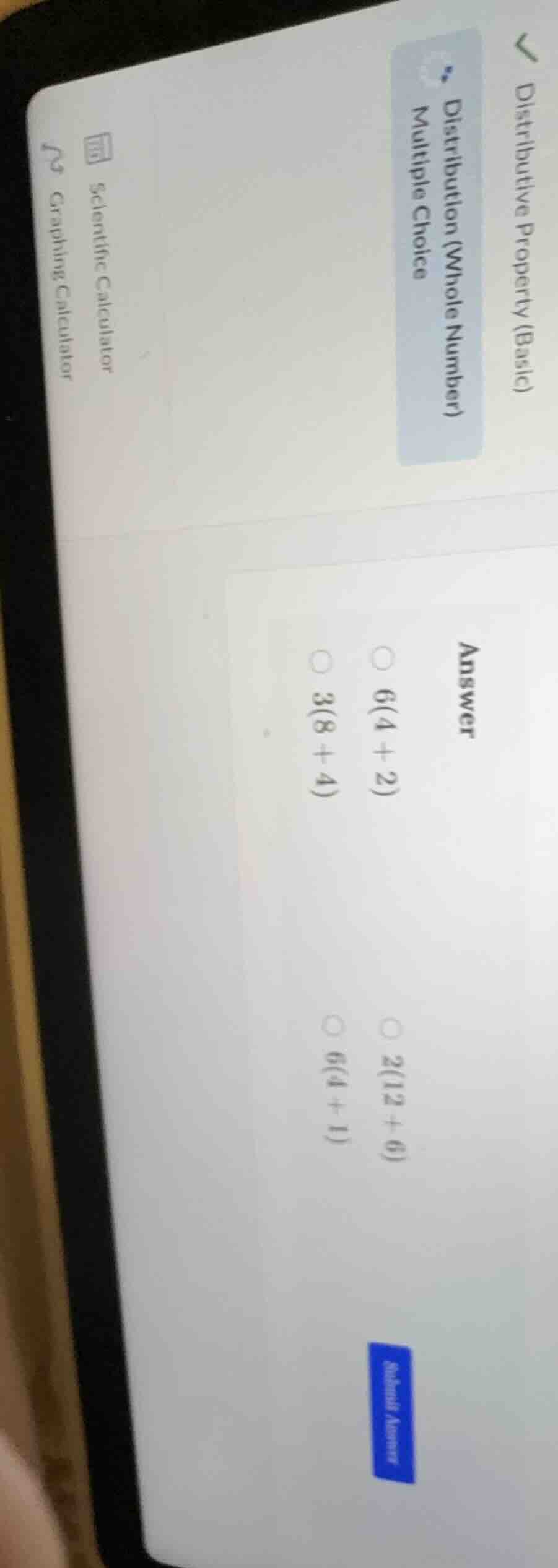
distribution (whole number) multiple choice answer \\(6(4 + 2)\\) \\(2(12 + 6)\\) \\(3(8 + 4)\\) \\(6(4 + 1)\\) submit answer
To solve this, we need to analyze each option using the distributive property \(a(b + c)=ab+ac\) and check if they represent a valid distribution of whole numbers. But since the original problem (what we are distributing, like a specific expression) is not fully clear from the image, we assume we need to check which option is a correct application of distribution. Wait, maybe the original problem was something like factoring or distributing a number. Let's check each option:
- Analyze \(6(4 + 2)\): Using distributive property, \(6\times4+6\times2 = 24 + 12=36\). If we calculate the inside first: \(4 + 2 = 6\), then \(6\times6 = 36\). So this is a valid distribution.
- Analyze \(2(12 + 6)\): \(2\times12+2\times6=24 + 12 = 36\), and \(12 + 6=18\), \(2\times18 = 36\). Also valid, but maybe the original problem had a specific number. Wait, maybe the question was to find which expression is equivalent to a certain value (like 36). Let's check \(3(8 + 4)\): \(3\times8+3\times4 = 24+12 = 36\), and \(8 + 4 = 12\), \(3\times12 = 36\). And \(6(4 + 1)=6\times4+6\times1=24 + 6 = 30\), which is different.
But since the problem is about "Distribution (Whole Number)" and multiple choice, maybe the correct answer is one of them. Wait, perhaps the original problem was to factor 36, and we need to see which expression is a correct factorization. Let's see:
- \(6(4 + 2)\): \(4 + 2 = 6\), \(6\times6 = 36\)
- \(2(12 + 6)\): \(12 + 6 = 18\), \(2\times18 = 36\)
- \(3(8 + 4)\): \(8 + 4 = 12\), \(3\times12 = 36\)
- \(6(4 + 1)\): \(4 + 1 = 5\), \(6\times5 = 30\) (not 36)
Assuming the original problem was to find the expression that distributes to a certain value (maybe 36), and if we consider the most straightforward, \(6(4 + 2)\) is a simple distribution. But without the original problem's context (like what number we are distributing from), it's a bit unclear. However, if we assume the question is to identify a correct distribution, and if we take a common example, \(6(4 + 2)\) is a valid distribution of 6 over 4 and 2.
But maybe the original problem was, for example, to rewrite 36 as a product of a number and a sum. Let's check:
- \(6(4 + 2)=6\times6 = 36\)
- \(2(12 + 6)=2\times18 = 36\)
- \(3(8 + 4)=3\times12 = 36\)
All three (except the last) give 36. But maybe the question was to find which expression is a correct application of the distributive property for a specific case. Since the image shows "Distributive Property (Basic)" and "Distribution (Whole Number)", the most probable correct answer among the options (if we assume the original problem was to factor 36 into a number times a sum of two whole numbers) could be \(6(4 + 2)\) as 4 and 2 are smaller numbers, or \(3(8 + 4)\), or \(2(12 + 6)\). But perhaps the intended answer is \(6(4 + 2)\).
We analyze each option using the distributive property \(a(b + c)=ab + ac\) and check for whole - number distribution. For \(6(4 + 2)\), applying the distributive property gives \(6\times4+6\times2=24 + 12 = 36\), and calculating the sum inside the parentheses first (\(4 + 2 = 6\)) and then multiplying by 6 also gives \(6\times6 = 36\), showing a valid whole - number distribution.

Snap & solve any problem in the app
Get step-by-step solutions on Sovi AI
Photo-based solutions with guided steps
Explore more problems and detailed explanations
A. \(6(4 + 2)\) (assuming this is the correct option based on the analysis of whole - number distribution and the distributive property)