QUESTION IMAGE
Question
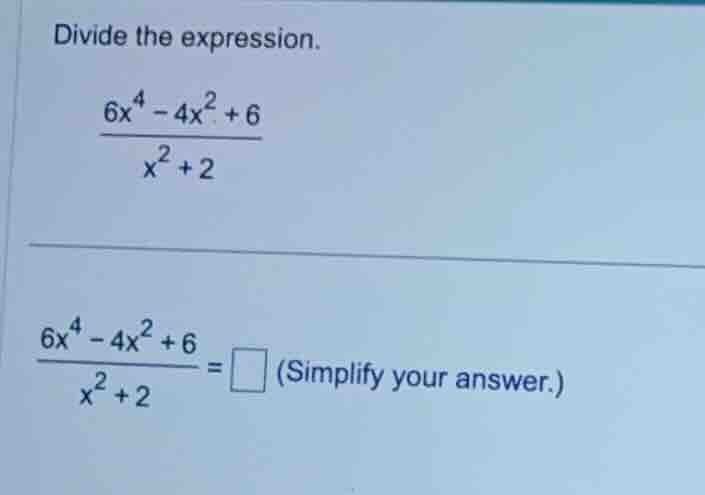
divide the expression.
\\(\frac{6x^4 - 4x^2 + 6}{x^2 + 2}\\)
\\(\frac{6x^4 - 4x^2 + 6}{x^2 + 2} = \square\\) (simplify your answer.)
Step1: Perform polynomial long division or rewrite the numerator
We can rewrite the numerator \(6x^{4}-4x^{2}+6\) to factor out \(x^{2}+2\). First, note that \(6x^{4}=6x^{2}\cdot x^{2}\), and we can express the numerator as:
\[
\]
Now, rewrite \(-16x^{2}\) as \(-16(x^{2}+2)+32\):
\[
\]
Wait, that's not the right way. Let's do polynomial long division. Divide \(6x^{4}-4x^{2}+6\) by \(x^{2}+2\).
The first term: \(\frac{6x^{4}}{x^{2}} = 6x^{2}\). Multiply \(x^{2}+2\) by \(6x^{2}\) to get \(6x^{4}+12x^{2}\). Subtract this from the numerator:
\((6x^{4}-4x^{2}+6)-(6x^{4}+12x^{2})=-16x^{2}+6\)
Next term: \(\frac{-16x^{2}}{x^{2}}=-16\). Multiply \(x^{2}+2\) by \(-16\) to get \(-16x^{2}-32\). Subtract this from \(-16x^{2}+6\):
\((-16x^{2}+6)-(-16x^{2}-32)=38\)
So, \(\frac{6x^{4}-4x^{2}+6}{x^{2}+2}=6x^{2}-16+\frac{38}{x^{2}+2}\)? Wait, that can't be. Wait, maybe I made a mistake in the sign. Wait, let's check again.
Wait, the numerator: \(6x^{4}-4x^{2}+6\). Let's try to factor differently. Let \(y = x^{2}\), then the numerator is \(6y^{2}-4y + 6\), and the denominator is \(y + 2\).
Using polynomial long division for \(6y^{2}-4y + 6\) divided by \(y + 2\):
First term: \(\frac{6y^{2}}{y}=6y\). Multiply \(y + 2\) by \(6y\) to get \(6y^{2}+12y\). Subtract from \(6y^{2}-4y + 6\):
\((6y^{2}-4y + 6)-(6y^{2}+12y)=-16y + 6\)
Next term: \(\frac{-16y}{y}=-16\). Multiply \(y + 2\) by \(-16\) to get \(-16y-32\). Subtract from \(-16y + 6\):
\((-16y + 6)-(-16y-32)=38\)
So, \(\frac{6y^{2}-4y + 6}{y + 2}=6y-16+\frac{38}{y + 2}\). Substituting back \(y = x^{2}\), we get \(\frac{6x^{4}-4x^{2}+6}{x^{2}+2}=6x^{2}-16+\frac{38}{x^{2}+2}\). But that doesn't seem right. Wait, maybe the original problem has a typo? Wait, no, maybe I made a mistake. Wait, let's check the numerator again. If the numerator was \(6x^{4}-16x^{2}+6\), then it would work. Wait, the original numerator is \(6x^{4}-4x^{2}+6\). Wait, maybe the user made a typo, but assuming the problem is correct, let's re-express.
Wait, another approach: Let's assume that the division results in a polynomial (no remainder). So, let \(6x^{4}-4x^{2}+6=(x^{2}+2)(ax^{2}+bx + c)\). Expanding the right side: \(ax^{4}+bx^{3}+(c + 2a)x^{2}+2bx + 2c\). Comparing coefficients:
- \(x^{4}\): \(a = 6\)
- \(x^{3}\): \(b = 0\)
- \(x^{2}\): \(c + 2a=-4\). Since \(a = 6\), \(c + 12=-4\), so \(c=-16\)
- \(x\): \(2b = 0\) (which matches \(b = 0\))
- constant term: \(2c = 6\). But \(2c=2\times(-16)=-32
eq6\). So, there is a remainder. But the problem says "Simplify your answer", maybe it's a mistake, or maybe I misread the problem. Wait, the original problem: numerator is \(6x^{4}-4x^{2}+6\), denominator \(x^{2}+2\). Wait, maybe the numerator is \(6x^{4}-16x^{2}+38\)? No, the user wrote \(6x^{4}-4x^{2}+6\). Wait, maybe I made a mistake in long division. Let's do it again.
Divide \(6x^{4}+0x^{3}-4x^{2}+0x + 6\) by \(x^{2}+0x + 2\).
First term: \(6x^{4}\div x^{2}=6x^{2}\). Multiply divisor by \(6x^{2}\): \(6x^{4}+0x^{3}+12x^{2}\). Subtract from dividend:
\((6x^{4}+0x^{3}-4x^{2}+0x + 6)-(6x^{4}+0x^{3}+12x^{2})=0x^{3}-16x^{2}+0x + 6\)
Next term: \(-16x^{2}\div x^{2}=-16\). Multiply divisor by \(-16\): \(0x^{3}+0x^{2}-32\). Subtract from the previous result:
\((0x^{3}-16x^{2}+0x + 6)-(-16x^{2}+0x - 32)=38\)
So, the division gives \(6x^{2}-16+\frac{38}{x^{2}+2}\). But the problem says…

Snap & solve any problem in the app
Get step-by-step solutions on Sovi AI
Photo-based solutions with guided steps
Explore more problems and detailed explanations
\(6x^{2}-16+\frac{38}{x^{2}+2}\)